



AT A GLANCE
- Although appropriate treatment can reduce the risk of vision loss by up to 90%, more than half of individuals with diabetic retinopathy (DR) remain undiagnosed, emphasizing the urgent need for improved screening, surveillance, and care delivery models.
- AI-powered technologies such as convolutional neural networks have led to major breakthroughs in image recognition with powerful applications in detecting DR.
- To address critical gaps in DR screening, we must shift toward a proactive strategy and create a dedicated task force composed of key stakeholders, including clinicians, policymakers, algorithm developers, payers, and patient advocates.
Diabetes is a growing global health problem that affects nearly one in 10 adults worldwide. Projections suggest that, by 2045, the number of individuals living with diabetes will approach one billion globally.1 In a 2021 report, the disease showed a higher prevalence in urban settings compared with rural areas (12.1% vs 8.3%, respectively) and in high-income compared with low-income countries (11.1% vs 5.5%, respectively).1 However, future trends indicate a significant shift, with middle income countries expected to experience the most significant increase in diabetes prevalence.1 The widespread and ever-evolving nature of diabetes, which exceeds geographic and socioeconomic expectations, underscores its complexity and global impact.
GLOBAL TRENDS IN DR
Diabetic retinopathy (DR) remains a significant global public health challenge and a leading cause of vision loss among working-age adults.2 DR is a progressive microvascular disease of the retina caused by long-standing, poorly controlled diabetes. Its clinical spectrum ranges from nonproliferative DR (NPDR) to proliferative (PDR), which is associated with complications such as vitreous hemorrhage and tractional retinal detachment. Diabetic macular edema can further compromise central vision in this patient population.
More than 75% of individuals living with diabetes for more than 2 decades will experience some form of DR.3 The condition accounts for 4.8% of cases of blindness worldwide.4
Roughly one in four patients with any stage of DR will require intervention at some point. Although appropriate treatment can reduce the risk of vision loss by up to 90%, more than half of individuals with DR remain undiagnosed, emphasizing the urgent need for improved screening, surveillance, and care delivery models.5-7 Despite this knowledge, screening rates are trending downward; in 2020, only 58.3% of adults diagnosed with diabetes had an eye examination within the last year, which is significantly lower than the year before (64.8%). Furthermore, only about 40% of patients at high risk of vision loss from DR receive timely and appropriate treatment; however, with proper disease management and timely intervention, DR can often be effectively controlled, significantly preserving vision.8
SCREENING INITIATIVES
Faced with multiple comorbidities, individuals with diabetes are often forced to prioritize medical appointments, understandably placing general medicine and chronic disease management ahead of ophthalmic care. Additionally, limited access to specialized services in underserved regions and an insufficient ophthalmic workforce (a gap expected to widen in the coming years9) further restrict recommended DR surveillance. While numerous screening programs for DR have been proposed and piloted to emphasize early detection and prevention, only a few have demonstrated long-term sustainability.10
Barriers to Adoption
Several barriers impede the widespread adoption of DR screening. These include the infrastructure challenges previously mentioned, particularly in rural and resource-limited settings, as well as difficulties in integrating DR screening programs into existing clinical workflows. Inconsistent reimbursement models and regulatory policies further complicate implementation. Moreover, reliance on asynchronous, “human-in-the-loop” interpretation (ie, the need for human interaction or intervention11) can introduce delays in communication and disrupt continuity of care.
A broader obstacle remains the lack of a unified community consensus on critical components, including optimal imaging modalities, the extent of retinal visualization (eg, widefield vs standard views), standardized grading rubrics, financial models, reimbursement structures, liability considerations, and data ownership. These challenges underscore the pressing need for a dedicated task force responsible for aligning stakeholders, defining best practices, and driving the strategic advancement of this long-overdue effort.
AI-Powered DR Screening
Advances in machine learning have significantly affected the field of medicine, particularly ophthalmology. Machine learning has advanced even further with deep learning, which uses multi-layered neural networks with convoluted deductions similar to how the human brain works. AI technologies such as convolutional neural networks have led to major breakthroughs in image recognition with powerful applications in detecting DR.
Training an AI screening algorithm for DR involves three key phases: learning, validating, and testing. In the initial learning phase, the algorithm is trained on carefully labeled retinal images, allowing it to self-adjust and recognize disease features. During validation, the algorithm is tested on a separate labeled dataset to fine-tune performance and ensure it generalizes the knowledge, rather than simply memorizing patterns. Finally, in the testing phase, the model is applied to large diverse populations (ideally using independent datasets) to confirm its accuracy and robustness across real-world clinical settings.8,12
Multiple well-established and emerging companies are competing to provide accurate, efficient, and accessible point-of-care screening solutions. In these settings, retinal images (typically color fundus photographs) are captured by nonexpert personnel and uploaded to the cloud, where proprietary AI algorithms perform automated interpretation. These sophisticated systems can generate diagnostic reports in less than 30 seconds, seamlessly integrating the results into electronic health records.
Moreover, the reports generated by AI-powered systems can go beyond simple binary identification (ie, DR presence or absence) and offer basic disease classification, distinguishing between early and more advanced changes and allowing for triage to the appropriate subspecialty eye care (Figure). Timely feedback of results directly to the ordering provider can enable immediate communication with patients, facilitate prompt referrals, reinforce the importance of follow-up care, and significantly improve patient adherence and engagement in disease management. This model stands in contrast to traditional physician-guided screening, where asynchronous image grading can result in substantial delays, thus disturbing continuity of care.7
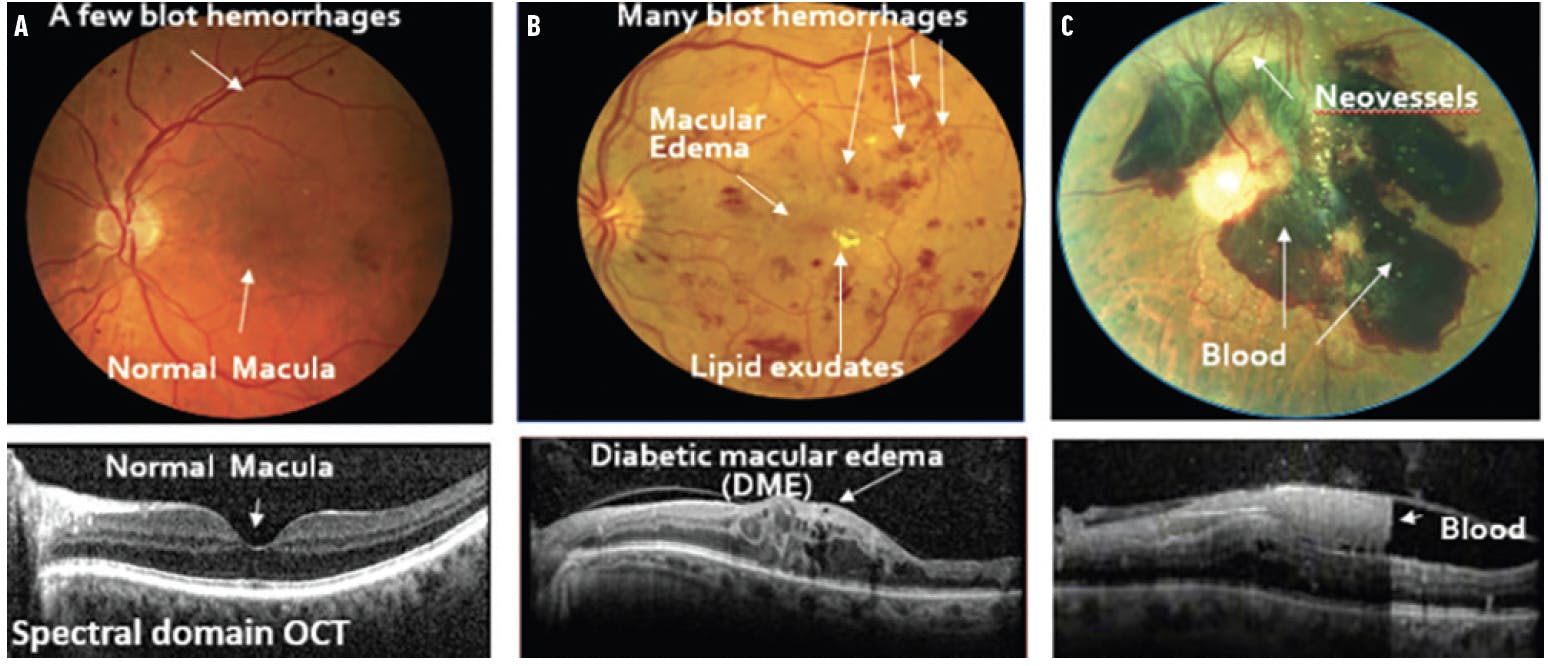
Figure. Many AI-powered screening tools can detect various stages of DR, including mild NPDR (A), moderate-to-severe NPDR (B), and PDR (C).
Commercially Available AI-Powered DR Screening Systems
In 2018, LumineticsCore (formerly IDx-DR; Digital Diagnostics) became the first fully autonomous AI system in any field of medicine to receive FDA clearance through a de novo approval process. There are now three additional systems cleared by the FDA: EyeArt (Eyenuk), Aeye Diagnostic Screening (Aeye Health), and Retina-AI Galaxy (Retina-AI Health). Importantly, the 2021 introduction of CPT code 92229 made AI-supported DR screening reimbursement possible, promoting broader acceptance in the United States.
DIABETIC EYE DISEASE SCREENING IN BRAZIL
With strong support from our industry partners, we are launching a new initiative to screen for diabetic retinopathy in Brazil, the first of its kind to achieve large-scale patient capture while generating detailed insights across the entire implementation process. This effort will not only address the practical logistics of setting up and executing a nationwide screening program, but will also create one of the largest and most comprehensive diabetic retinopathy datasets in the region. We are hopeful that the framework established through this initiative will empower the broader ophthalmic and public health communities to advance this critically important mission to improve access, early detection, and outcomes for patients at risk of vision loss.
CALL TO ACTION
Despite decades of research and established guidelines, DR screening continues to be underused, resulting in delayed diagnoses, preventable vision loss, and billions of dollars in health care costs for late-stage interventions that often yield suboptimal clinical outcomes. To address critical gaps, we must shift toward a proactive strategy and create a dedicated task force composed of key stakeholders, including clinicians, policymakers, developers, payers, and patient advocates. This broad collaboration is essential to define safe deployment, ensure thorough validation, and, ultimately, develop a unified, evidence-based screening protocol.
1. Sun H, Saeedi P, Karuranga S, et al. IDF Diabetes Atlas: Global, regional and country-level diabetes prevalence estimates for 2021 and projections for 2045. Diabetes Res Clin Pract. 2022;183:109119. Erratum in: Diabetes Res Clin Pract. 2023;204:110945.
2. Bourne RRA, Jonas JB, Bron AM, et al. Prevalence and causes of vision loss in high-income countries and in Eastern and Central Europe in 2015: magnitude, temporal trends and projections. Br J Ophthalmol. 2018;102(5):575-585.
3. Upadhayay P, Singh N, Pandey M, et al. Unveiling the link between lifestyle risk factors and diabetic retinopathy. Int J Diabetes Dev Ctries. 2025;45:63-68.
4. World Health Organization. Prevention of blindness from diabetes mellitus: report of a WHO consultation in Geneva, Switzerland. World Health Organization. 2005. Accessed June 30, 2025. apps.who.int/iris/bitstream/handle/10665/43576/924154712X_eng.pdf
5. Lee PP, Feldman ZW, Ostermann J, Brown DS, Sloan FA. Longitudinal rates of annual eye examinations of persons with diabetes and chronic eye diseases. Ophthalmology. 2003;110(10):1952-1959.
6. Paz SH, Varma R, Klein R, Wu J, Azen SP. Los Angeles Latino eye study group: noncompliance with vision care guidelines in Latinos with type 2 diabetes mellitus: the Los Angeles Latino Eye Study. Ophthalmology. 2006;113(8):1372-1377.
7. Prevention and Health Promotion. Increase the proportion of adults with diabetes who have a yearly eye exam. US Department of Health and Human Services. Accessed June 20, 2025. health.gov/healthypeople/objectives-and-data/browse-objectives/diabetes/increase-proportion-adults-diabetes-who-have-yearly-eye-exam-d-04
8. Office of Disease Prevention and Health Promotion. Increase the proportion of adults with diabetes who have a yearly eye exam. US Department of Health and Human Services. Accessed June 30, 2025. health.gov/healthypeople/objectives-and-data/browse-objectives/diabetes/increase-proportion-adults-diabetes-who-have-yearly-eye-exam-d-04
9. Berkowitz ST, Finn AP, Parikh R, Kuriyan AE, Patel S. Ophthalmology workforce projections in the United States, 2020 to 2035. Ophthalmology. 2024;131(2):133-139.
10. Abou Taha A, Dinesen S, Vergmann AS, Grauslund J. Present and future screening programs for diabetic retinopathy: a narrative review. Int J Retina Vitreous. 2024;10(1):14.
11. Meng X-L. Data science and engineering with human in the loop, behind the loop, and above the loop. Harvard Data Sci Rev. 2023;5(2).
12. Dow ER, Chen KM, Zhao CS, et al. Artificial intelligence improves patient follow-up in diabetic retinopathy screening program. Clinical Ophthalmol. 2023;17:3323-3330.


