





Pathologic myopia (PM) is a leading cause of irreversible blindness in East Asia and a growing global public health concern.1-6 According to the International Myopia Institute, PM is characterized by excessive axial elongation associated with myopia, resulting in structural changes in the posterior segment of the eye, such as posterior staphyloma, myopic maculopathy (MM), and high myopia-associated optic neuropathy.7
To standardize the diagnosis of MM, a classification system known as the META-analysis for pathologic myopia (META-PM) was introduced in 2015 based on fundus photographs.8 This system categorizes MM into five grades (0 to 4) according to the severity of atrophic changes, with three additional “plus” features: lacquer cracks, myopic macular neovascularization (MNV), and Fuchs spot. Based on this classification, PM is defined as myopic eyes with MM equal to or more severe than diffuse atrophy and/or eyes with posterior staphyloma.9
Deep learning (DL) architectures—particularly convolutional neural networks (CNNs)—have demonstrated remarkable efficiency in detecting ocular diseases from fundus photographs, including the diagnosis and classification of PM.10,11 AI-powered DL systems not only offer automated classification, but also have the potential to enhance diagnostic efficiency, making them valuable tools for large-scale screening and clinical decision making (Figure).12
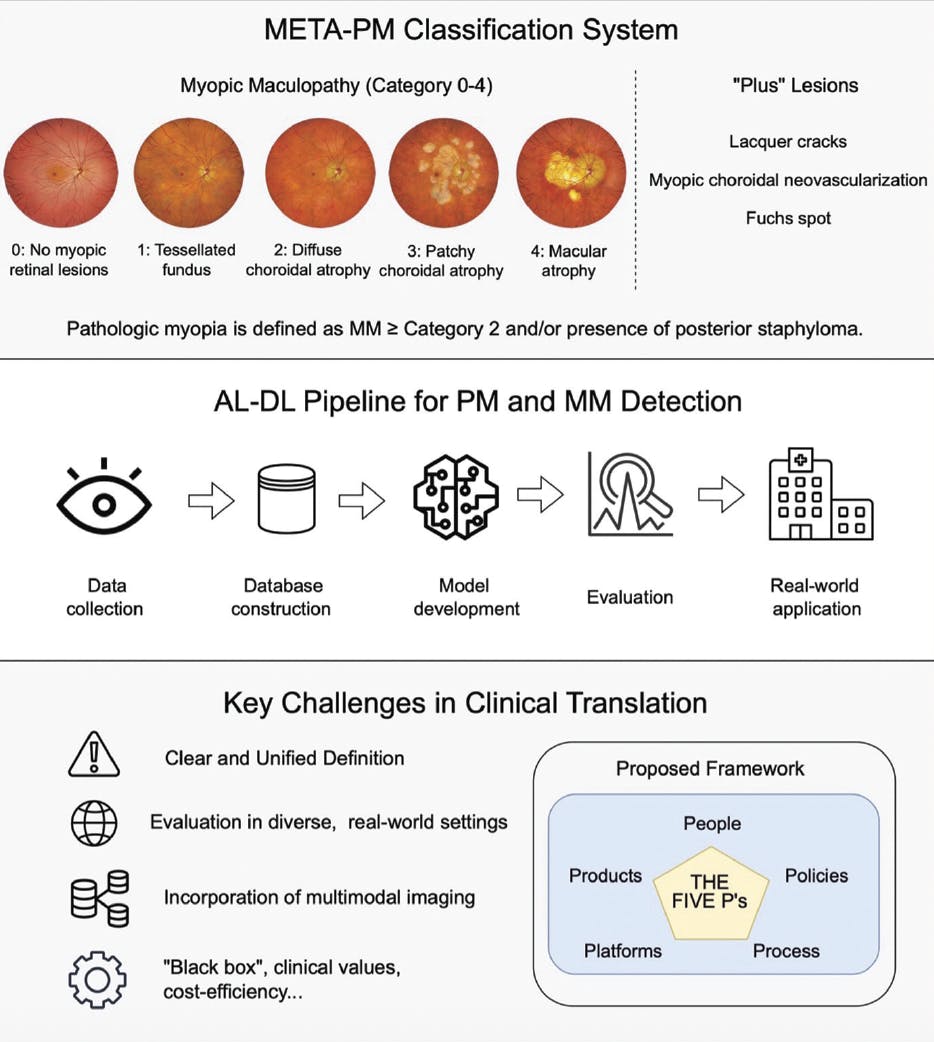
Figure. This schematic illustrates the META-PM classification system used for MM and PM diagnosis, the development pipeline of AI-DL algorithms, and the key challenges to clinical translation, including the need for standardized definitions, diverse and real-world datasets, integration of multimodal imaging, and effective clinical implementation strategies.
FUNDUS-BASED PM DETECTION USING AI
As a cost-effective and noninvasive imaging modality widely used in routine eye care, fundus photography remains the primary choice for AI-driven PM detection. Its accessibility has facilitated the construction of large-scale datasets, enabling the development of robust CNN architectures. Additionally, the META-PM classification based on fundus imaging aligns well with AI model labeling requirements, further supporting automated PM detection.
A recent meta-analysis of 11 studies involving 165,787 eyes reported high diagnostic performance of AI-based tools in detecting MM and PM from fundus images, with an area under the summary receiver operator curve of 0.9905 and a pooled sensitivity of 0.959.13 Several representative studies illustrate the evolution of this field—from simple binary classification (ie, MM vs non-MM) to more detailed grading across all five META-PM categories. In 2021, a retrospective multicohort study using 226,686 fundus images from nine multiethnic cohorts across six regions developed DL algorithms for classifying high myopia and MM.12 In the same year, two studies demonstrated the ability of DL models to classify MM across categories 0 to 4 and detect “plus” lesions.14,15
The application of advanced computer vision techniques has enhanced the performance and efficiency of AI-based MM and PM detection. These innovations aim to reduce reliance on extensive manual annotations and explore the potential for fully automated diagnosis.
For example, Sun et al introduced a module that used the information of tessellated fundus and brightest image regions to assist in lesion localization using coarse-labeled images.16 Yao et al developed DeepGraFT, a classification-and-segmentation co-decision model that first applies image masking to isolate the region of interest.17 This was followed by a binary classification for each MM category by Zhang et al that uses a technique known as self-supervised learning,18 which refers to the development of generalist models capable of adapting to various downstream tasks with significantly less annotated data, demonstrating promising performance in automated MM diagnosis and grading.
CHALLENGES TO AI IN PM SCREENING
Establishing Clear, Unified Definitions of PM and MM in AI-Based Studies
One of the major challenges with AI-driven detection of PM and MM is inconsistency in their definitions. In the previously mentioned systematic review and meta-analysis, 17 studies were included in the systematic review, and only eight explicitly stated the use of the META-PM classification for MM identification, while the remaining studies did not clarify which classification system was applied.13 This inconsistency complicates direct comparisons between models, as variations in diagnostic criteria can lead to significant differences in reported performance. Additionally, the lack of standardized definitions limits model generalization across diverse datasets and clinical settings. Future research should focus on establishing unified diagnostic criteria and standardized image labeling frameworks to enhance the reliability and applicability of AI models.
Evaluating DL Algorithms in Diverse, Real-World Settings
Despite the increasing availability of publicly annotated datasets for PM (eg, the Pathologic Myopia Challenge dataset and the Singapore Epidemiology of Eye Diseases study dataset),19-21 developing robust DL models for PM and MM diagnosis remains challenging. Variations in medical systems across different regions result in differences in the prevalence of PM and MM subtypes within study cohorts, affecting model performance and generalizability.
Recently, Qian et al introduced a publicly available dataset for MM diagnosis as part of the Myopic Maculopathy Analysis Challenge.22 This dataset comprised 2,306 fundus images for MM classification, with seven teams participating in the competition. However, all fundus images were exclusively sourced from Chinese patients, which may limit the model’s generalizability to other populations. Future research should expand datasets to include multiethnic populations and evaluate model performance in diverse clinical environments to ensure real-world applicability.
Incorporating Multimodal Imaging
While the META-PM classification provides a standardized framework for identifying various stages of MM, it is solely based on fundus photographs, which presents potential diagnostic limitations. Fundus pigmentation variations among racial and ethnic groups can affect image interpretation, and other critical myopic macular pathologies, such as myopic traction maculopathy and dome-shaped macula, are not included. To address these gaps, an OCT-based classification has been proposed.23
Recent studies have demonstrated that DL models based on OCT images can reliably detect PM and its complications, including MNV, dome-shaped macula, and tractional changes such as retinoschisis, macular hole, and retinal detachment.24-27 However, compared with fundus photography-based models, OCT-based AI research remains relatively limited. One major challenge is the lack of uniform diagnostic criteria and large annotated datasets, likely due to the complexity of PM and its diverse manifestations. Moreover, variations in OCT imaging systems used in real-world clinical practice pose additional barriers to the widespread implementation of these AI algorithms.
Despite the success of multimodal DL approaches in conditions such as glaucoma and AMD,28-33 their application in PM remains underexplored. Future research should focus on integrating fundus photography, OCT, and other imaging modalities to enhance diagnostic accuracy and provide a more comprehensive assessment of PM-related complications.
CLINICAL TRANSLATION
In addition to challenges related to AI model development and evaluation, systemic barriers remain in the clinical translation of AI-based DL algorithms for PM and MM detection. First, the “black box” nature of many AI algorithms continues to hinder trust and acceptance among clinicians. This challenge has given rise to the field of explainable AI, which focuses on developing models that not only achieve high accuracy, but also provide transparent, interpretable reasoning behind their outputs, thereby enhancing clinical trust and usability.34
The lack of rigorous clinical trials also limits our understanding of the true clinical value of these models—are they safe, effective, affordable, and relevant in the dynamic health care environment?35 While many algorithms demonstrate high diagnostic performance in research settings, few have demonstrated meaningful clinical effect in real-world practice.36 Furthermore, the seamless integration of AI tools into existing clinical workflows remains an obstacle. For example, it is unclear whether current PM and MM detection models are better suited for use in primary eye care settings or specialized settings, such as retinal clinics or high myopia centers. Determining the most appropriate clinical environment is essential for maximizing their utility and minimizing workflow disruption.
ADDRESSING THESE CHALLENGES
Gunasekeran et al proposed a comprehensive framework known as the “5Ps: People, Policies, Processes, Platforms, and Products.”37 This framework outlines essential elements for the successful, large-scale deployment of medical AI solutions, such as those implemented in national diabetic retinopathy screening programs. Applying a similar framework to AI-based MM and PM detection systems may facilitate more effective, scalable, and sustainable integration into health care systems. n
Disclosure: The authors used ChatGPT in the original drafting of this article solely for language editing and grammar improvement. No content generation, data analysis, or interpretation was performed by AI.
1. Iwase A, Araie M, Tomidokoro A, et al. Prevalence and causes of low vision and blindness in a Japanese adult population: the Tajimi Study. Ophthalmology. 2006;113(8):1354-1362.
2. Hsu WM, Cheng CY, Liu JH, Tsai SY, Chou P. Prevalence and causes of visual impairment in an elderly Chinese population in Taiwan: the Shihpai Eye Study. Ophthalmology. 2004;111(1):62-99.
3. Xu L, Wang Y, Li Y, et al. Causes of blindness and visual impairment in urban and rural areas in Beijing: the Beijing Eye Study. Ophthalmology. 2006;113(7):1134e1-1134e11.
4. Holden BA, Fricke TR, Wilson DA, et al. Global prevalence of myopia and high myopia and temporal trends from 2000 through 2050. Ophthalmology. 2016;123(5):1036-1342.
5. Sankaridurg P, Tahhan N, Kandel H, et al. IMI impact of myopia. Invest Ophthalmol Vis Sci. 2021;62(5):2.
6. Wong TY, Ferreira A, Hughes R, Carter G, Mitchell P. Epidemiology and disease burden of pathologic myopia and myopic choroidal neovascularization: an evidence-based systematic review. Am J Ophthalmol. 2014;157(1):9-25e12.
7. Flitcroft DI, He M, Jonas JB, et al. IMI - defining and classifying myopia: a proposed set of standards for clinical and epidemiologic studies. Invest Ophthalmol Vis Sci. 2019;60(3):M20-M30.
8. Ohno-Matsui K, Kawasaki R, Jonas JB, et al. International photographic classification and grading system for myopic maculopathy. Am J Ophthalmol. 2015;159(5):877-883e7.
9. Ohno-Matsui K, Lai TY, Lai CC, Cheung CM. Updates of pathologic myopia. Prog Retin Eye Res. 2016;52:156-187.
10. Li Z, Wang L, Wu X, et al. Artificial intelligence in ophthalmology: the path to the real-world clinic. Cell Rep Med. 18 2023;4(7):101095.
11. Du R, Ohno-Matsui K. Novel uses and challenges of artificial intelligence in diagnosing and managing eyes with high myopia and pathologic myopia. Diagnostics (Basel). 2022;12(5):1210.
12. Tan TE, Anees A, Chen C, et al. Retinal photograph-based deep learning algorithms for myopia and a blockchain platform to facilitate artificial intelligence medical research: a retrospective multicohort study. Lancet Digit Health. 2021;3(5):e317-e329.
13. Prashar J, Tay N. Performance of artificial intelligence for the detection of pathological myopia from colour fundus images: a systematic review and meta-analysis. Eye (Lond). 2024;38(2):303-314.
14. Du R, Xie S, Fang Y, et al. Deep learning approach for automated detection of myopic maculopathy and pathologic myopia in fundus images. Ophthalmol Retina. 2021;5(12):1235-1244.
15. Lu L, Ren P, Tang X, et al. AI-model for identifying pathologic myopia based on deep learning algorithms of myopic maculopathy classification and “plus” lesion detection in fundus images. Front Cell Dev Biol. 2021;9:719262.
16. Sun Y, Li Y, Zhang F, et al. A deep network using coarse clinical prior for myopic maculopathy grading. Comput Biol Med. 2023;154:106556.
17. Yao Y, Yang J, Sun H, et al. DeepGraFT: A novel semantic segmentation auxiliary ROI-based deep learning framework for effective fundus tessellation classification. Comput Biol Med. 2024;169:107881.
18. Zhang J, Xiao F, Zou H, Feng R, He J. Self-supervised learning-enhanced deep learning method for identifying myopic maculopathy in high myopia patients. iScience. 2024;27(8):110566.
19. Huazhu Fu, Fei Li, José Ignacio Orlando, et al. PALM: PAthoLogic Myopia Challenge. IEEE Dataport. July 8, 2019. Accessed July 16, 2025. ieee-dataport.org/documents/palm-pathologic-myopia-challenge
20. Fang H, Li F, Wu J, et al. Open fundus photograph dataset with pathologic myopia recognition and anatomical structure annotation. Sci Data. 2024;11(1):99.
21. Majithia S, Tham YC, Chee ML, et al. Cohort Profile: The Singapore epidemiology of eye diseases study (SEED). Int J Epidemiol. 2021;50(1):41-52.
22. Qian B, Sheng B, Chen H, et al. A competition for the diagnosis of myopic maculopathy by artificial intelligence algorithms. JAMA Ophthalmol. 2024;142(11):1006-1015.
23. Fang Y, Du R, Nagaoka N, et al. OCT-based diagnostic criteria for different Stages of myopic ,aculopathy. Ophthalmology. 2019;126(7):1018-1032.
24. Ye X, Wang J, Chen Y, et al. Automatic screening and identifying myopic maculopathy on optical coherence tomography images using deep learning. Transl Vis Sci Technol. 2021;10(13):10.
25. Li Y, Feng W, Zhao X, et al. Development and validation of a deep learning system to screen vision-threatening conditions in high myopia using optical coherence tomography images. Br J Ophthalmol. 2022;106(5):633-639.
26. Du R, Xie S, Fang Y, et al. Validation of soft lebels in developing deep learning algorithms for detecting lesions of myopic maculopathy from optical coherence tomographic images. Asia Pac J Ophthalmol (Phila). 2022;11(3):227-236.
27. He X, Ren P, Lu L, et al. Development of a deep learning algorithm for myopic maculopathy classification based on OCT images using transfer learning. Front Public Health. 2022;10:1005700.
28. Kihara Y, Montesano G, Chen A, et al. Policy-driven, multimodal deep learning for predicting visual fields from the optic disc and OCT imaging. Ophthalmology. 2022;129(7):781-791.
29. Xiong J, Li F, Song D, et al. Multimodal machine learning using visual fields and peripapillary circular OCT scans in detection of glaucomatous optic neuropathy. Ophthalmology. 2022;129(2):171-180.
30. Bowd C, Belghith A, Rezapour J, et al. Multimodal deep learning classifier for primary open angle glaucoma diagnosis using wide-field optic nerve head cube scans in eyes with and without high myopia. J Glaucoma. 2023;32(10):841-847.
31. Anegondi N, Gao SS, Steffen V, et al. Deep learning to predict geographic atrophy area and growth rate from multimodal imaging. Ophthalmol Retina. 2023;7(3):243-252.
32. Spaide T, Jiang J, Patil J, et al. Geographic atrophy segmentation using multimodal deep learning. Transl Vis Sci Technol. 2023;12(7):10.
33. Yoo TK, Choi JY, Seo JG, Ramasubramanian B, Selvaperumal S, Kim DW. The possibility of the combination of OCT and fundus images for improving the diagnostic accuracy of deep learning for age-related macular degeneration: a preliminary experiment. Med Biol Eng Comput. 2019;57(3):677-687.
34. Hassija V, Chamola V, Mahapatra A, et al. Interpreting black-box models: a review on explainable artificial intelligence. Cognitive Computation. 2024;16(1):45-74.
35. Longhurst CA, Singh K, Chopra A, Atreja A, Brownstein JS. A call for artificial intelligence implementation science centers to evaluate clinical effectiveness. NEJM AI. 2024;1(8):AIp2400223.
36. Wolf RM, Channa R, Liu TYA, et al. Autonomous artificial intelligence increases screening and follow-up for diabetic retinopathy in youth: the ACCESS randomized control trial. Nat Commun. 2024;15(1):421.
37. Gunasekeran DV, Miller S, Hsu W, et al. National use of artificial intelligence for Eee screening in Singapore. NEJM AI. 2024;1(12):AIcs2400404.


