


AT A GLANCE
- Although fluorescein angiography (FA) is now used less frequently, it remains a valuable imaging modality for patients with diabetic macular edema.
- Quantitative leakage on ultra-widefield FA is strongly correlated with diabetic retinopathy severity score as well as risk of disease progression.
- OCT and the increasing use of OCT angiography will further augment the role of FA in retinal vascular diseases such as diabetic retinopathy.
Diabetic retinopathy (DR) remains a major burden on the health care system and continues to be the leading cause of legal blindness in working-age adults.1 This will continue to be an immense challenge for the field, given the prediction that 191 million people will have DR and 56 million people will have vision-threatening disease by 2030.2 Vision loss in DR can be secondary to multiple processes, including vitreous hemorrhage, tractional retinal detachment, macular ischemia, disorganization of the inner retinal layers, and diabetic macular edema (DME). Because DME remains the most prevalent mechanism of decreased visual acuity in patients with diabetes,3 effective diagnostics and treatment of DME is critical.
IMAGING IN DME
DME is evaluated on clinical examination as well as multimodal imaging, such as OCT, OCT angiography (OCTA), fundus photography, and fluorescein angiography (FA). FA is now used less frequently due to the invasive nature of the test, increased time of acquisition, and potential dye reactions, alongside the proliferation and increasing sophistication of alternative imaging modalities such as OCTA, which can provide high-resolution vascular imaging to illuminate posterior pole vascular pathology. However, FA remains valuable as the only way to directly assess vessel leakage as well as to image retinal perfusion in the periphery. Thus, fluorescein images provide a functional correlate to the anatomic microstructural changes visualized on OCT and OCTA.
Ultra-widefield (UWF) imaging in conjunction with FA has demonstrated that peripheral retinal findings may aid in the identification of patients who will progress to more severe disease (Figure 1). Quantitative leakage on UWF FA is strongly correlated with DR severity score as well as risk of DR progression, including the transition from nonproliferative to proliferative disease.4-7 Peripheral retinal findings also correlate with the presence of DME,8-11 including quantitative areas of peripheral retinal nonperfusion, retinal vascular bed area, and the ischemic index. These measurements, all derived from FA images, could be potentially useful biomarkers to predict which patients may develop clinically significant DME. Notably, these studies have only used peripheral retinal data in their analysis, which suggests effects on the blood-retinal barrier in the posterior pole are either correlated with global VEGF levels or that peripheral retinal findings can be used as a proxy for pathologic transformation and breakdown of the blood-retinal barrier in the macula.
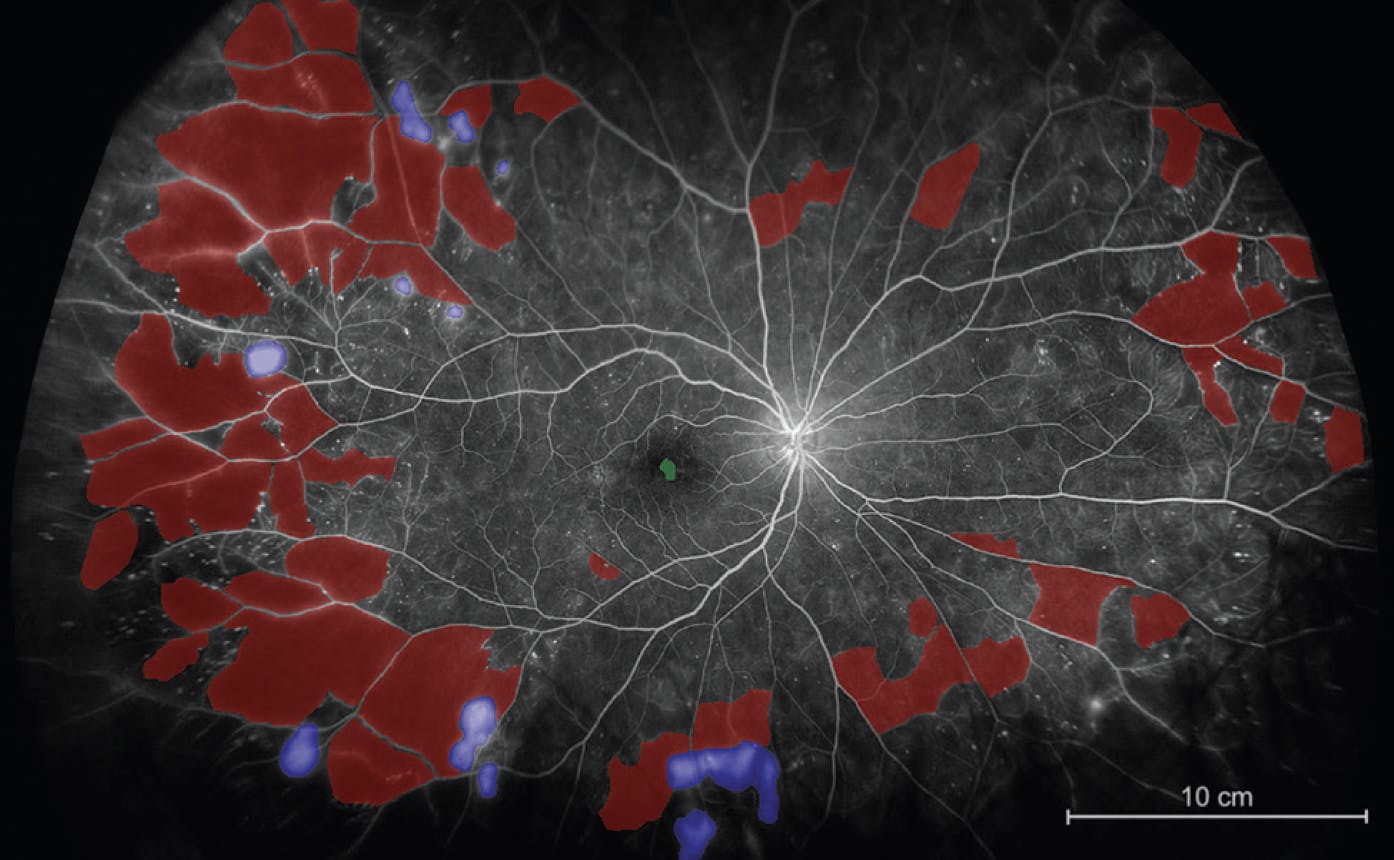
Figure 1. UWF FA of proliferative DR demonstrates areas of nonperfusion (red) and neovascularization (purple) and the foveal avascular zone (green). Following segmentation, biomarker areas can be calculated. Reproduced with permission from Fleifil S et al.6
THE MECHANICS OF FA
FA functions by imaging the location of the intravenous injected tracer molecule. The intravascular space is imaged, but perhaps more importantly, the efflux of this tracer out of the retinal intravascular space provides a direct measurement of blood-retinal barrier breakdown and leakage from microaneurysms or pathologic neovascular vessels. Direct visualization of leaking vessels that are driving the accumulation of cystic fluid also enables the possibility of precise targeting of focal laser to directly treat pathologic vessels.12
With appropriate protocols, FA can be treated in a quantitative fashion to define areas of nonperfusion, neovascular vessels, and total retinal blood vessels. Furthermore, the efflux of fluorescein dye from the intravascular space into the retina can be measured to quantify leakage. These are time-intensive processes for a clinician to perform, although future measurements are likely to be less dependent on human effort and oversight. Computational advances have recently led to the development of advanced image analysis software and AI algorithms that may lead to automated image interpretation and analysis.13 This will be an important tool to increase throughput with retina specialist oversight or to potentially automate decision making.
TREATMENT CONSIDERATIONS
Anti-VEGF therapy is often quite successful in resolving cystoid fluid with resultant improvement in visual acuity. However, anti-VEGF therapy is not a panacea for all patients with edema, as some demonstrate persistent disease activity despite therapy. In addition, treatment with an anti-VEGF agent is typically avoided in certain patients, such as those who are pregnant or who have certain medical conditions.
Some patients are resistant to multiple injections and multiple different anti-VEGF agents.14 In cases where specific areas of leakage are suspected, focal laser remains a viable option for DME monotherapy or as an adjuvant therapy with anti-VEGF injections. Adjuvant focal laser therapy can decrease the number of required injections by 49% and increase the time between injections, effectively decreasing injection burden and endophthalmitis risk (Figure 2).15 Laser is also an attractive option in situations where intravitreal steroids or anti-VEGF therapy are contraindicated or unavailable. Development of novel laser therapies—such as selective retinal therapy, subthreshold diode micropulse laser, and endpoint management technology—continues to improve the safety of focal laser in ways that are less destructive than traditional photocoagulation (Figure 3).16-19
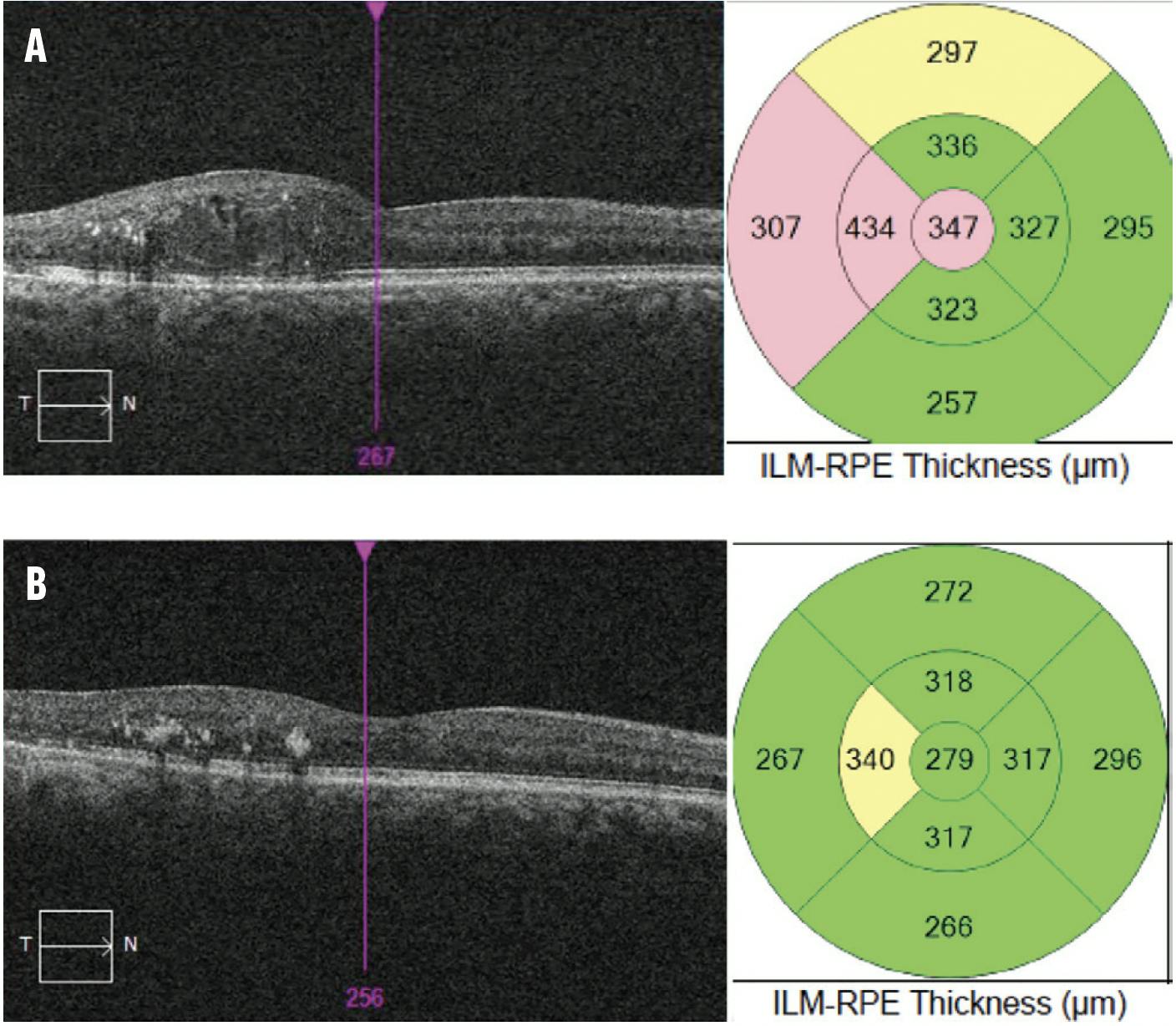
Figure 2. OCT of the macula and thickness measurement mapping before (A) and after (B) endpoint management laser therapy demonstrating a reduction in DME with fewer anti-VEGF injections. Reproduced with permission from Azzouz L et al.15
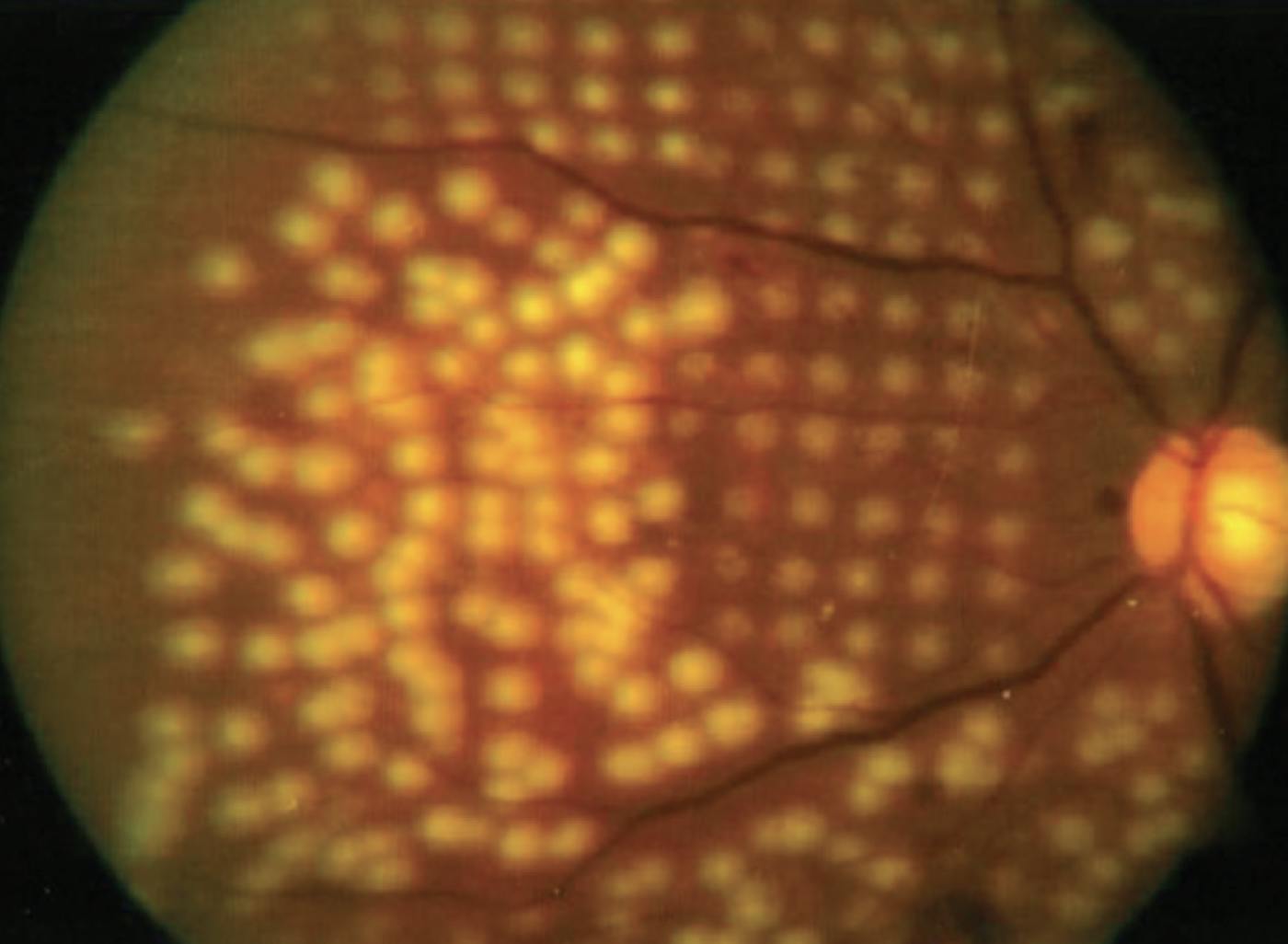
Figure 3. When comparing conventional laser (lower left) with patterned scanning laser (upper right), note the more uniformly spaced, less intense small spots provided by pattern scanning laser therapy. Reproduced with permission from Paulus YM et al.19
FUTURE UTILITY
OCT and the increasing use of OCTA will further augment the role of FA in retinal vascular diseases and DR specifically. High-resolution vessel imaging can be obtained with OCTA,20 with the potential to identify microaneurysms that anatomically occur in close proximity to areas of cystoid macular edema. While this is suggestive of pathologic blood-retinal barrier dysfunction, only FA can demonstrate leakage via extravascular extravasation of contrast.
These imaging modalities continue to complement each other, and we continue to value FA as an important imaging modality to help us treat patients with DR and DME.
1. Bourne RRA, Jonas JB, Bron AM, et al. Prevalence and causes of vision loss in high-income countries and in Eastern and Central Europe in 2015: magnitude, temporal trends and projections. Br J Ophthalmol. 2018;102(5):575-585.
2. Ting DS, Cheung GC, Wong TY. Diabetic retinopathy: global prevalence, major risk factors, screening practices and public health challenges: a review. Clin Exp Ophthalmol. 2016;44(4):260-277.
3. Lee R, Wong TY, Sabanayagam C. Epidemiology of diabetic retinopathy, diabetic macular edema and related vision loss. Eye Vis (Lond). 2015;2:17.
4. Ehlers JP, Josic K, Yordi S, et al. Assessment of baseline ultrawidefield fluorescein angiographic quantitative leakage parameters with ultrawidefield fundus features and clinical parameters in diabetic retinopathy in protocol AA. Ophthalmol Retina. 2025;9(3):243-252.
5. Iyengar RS, Fleifil S, Aaberg MT, et al. Quantitative ultra-widefield fluorescein angiography biomarkers in diabetic
retinopathy and association with treatment and progression. Clin Ophthalmol. 2024;18:4019-4028.
6. Fleifil S, Azzouz L, Yu G, Powell C, Bommakanti N, Paulus YM. Quantitative biomarkers of diabetic retinopathy using ultra-widefield fluorescein angiography. Clin Ophthalmol. 2024;18:1961-1970.
7. Silva PS, Marcus DM, Liu D, et al. Association of ultra-widefield fluorescein angiography-identified retinal nonperfusion and the risk of diabetic retinopathy worsening over time. JAMA Ophthalmol. 2022;140(10):936-945.
8. Huang RS, Mihalache A, Popovic MM, et al. Quantitative fluorescein angiography biomarkers in diabetic macular edema. Retina. 2025;45(6):1125-1133.
9. Fan W, Wang K, Ghasemi Falavarjani K, et al. Distribution of nonperfusion area on ultra-widefield fluorescein angiography in eyes with diabetic macular edema: DAVE Study. Am J Ophthalmol. 2017;180:110-116.
10. Fan W, Uji A, Wang K, et al. Severity of diabetic macular edema correlates with retinal vascular bed area on ultra-wide field fluorescein angiography: DAVE Study. Retina. 2020;40(6):1029-1037.
11. Wessel MM, Nair N, Aaker GD, Ehrlich JR, D’Amico DJ, Kiss S. Peripheral retinal ischaemia, as evaluated by ultra-widefield fluorescein angiography, is associated with diabetic macular oedema. Br J Ophthalmol. 2012;96(5):694-698.
12. Maltsev DS, Kulikov AN, Burnasheva MA, Kazak AA, Chhablani J. Efficacy of navigated focal laser photocoagulation in diabetic macular edema planned with en face optical coherence tomography versus fluorescein angiography. Int Ophthalmol. 2020;40(8):1913-1921.
13. Zhao PY, Bommakanti N, Yu G, Aaberg MT, Patel TP, Paulus YM. Deep learning for automated detection of neovascular leakage on ultra-widefield fluorescein angiography in diabetic retinopathy. Sci Rep. 2023;13(1):9165.
14. Bressler NM, Beaulieu WT, Glassman AR, et al. persistent macular thickening following intravitreous aflibercept, bevacizumab, or ranibizumab for central-involved diabetic macular edema with vision impairment: a secondary analysis of a randomized clinical trial. JAMA Ophthalmol. 2018;136(3):257-269.
15. Azzouz L, Durrani A, Zhou Y, Paulus YM. Adjunct nondamaging focal laser reduces intravitreal injection burden in diabetic macular edema. Photonics. 2023;10(10):1165.
16. Everett LA, Paulus YM. Laser therapy in the treatment of diabetic retinopathy and diabetic macular edema. Curr Diab Rep. 2021;21(9):35.
17. Lois N, Campbell C, Waugh N, et al. Diabetic macular edema and diode subthreshold micropulse laser: a randomized double-masked noninferiority clinical trial. Ophthalmology. 2023;130(1):14-27.
18. Tai F, Nanji K, Garg A, et al. Subthreshold compared with threshold macular photocoagulation for diabetic macular edema: a systematic review and meta-analysis. Ophthalmol Retina. 2024;8(3):223-233.
19. Paulus YM, Palanker D, Blumenkranz MS. Short-pulse laser treatment: redefining retinal therapy. Retinal Physician. 2010;7(1):54-56.
20. Peres MB, Kato RT, Kniggendorf VF, et al. Comparison of optical coherence tomography angiography and fluorescein angiography for the identification of retinal vascular changes in eyes with diabetic macular edema. Ophthalmic Surg Lasers Imaging Retina. 2016;47(11):1013-1019.


