


KEY TAKEAWAYS
- Retinopathy associated with incontinentia pigmenti (IP), a rare X-linked genetic condition, carries a high risk for permanent morbidity.
- The course of IP-associated retinopathy varies widely: Some infants demonstrate peripheral avascular findings that remains stable for years, while others develop rapid neovascularization and tractional retinal detachment within months.
- Widefield fluorescein angiography is central to identifying high risk patients, particularly those with vascular activity, who require closer surveillance and often earlier intervention.
Incontinentia pigmenti (IP), or Bloch-Sulzberger syndrome, is a rare X-linked dominant neuroectodermal dysplasia that presents a unique clinical challenge for vitreoretinal surgeons.1,2 Caused primarily by mutations in the IKBKG (formerly NEMO) gene, IP is typically lethal in males, leading to a more than 96% female cohort.1 While a cutaneous “marble cake” hyperpigmentation is the clinical hallmark, ocular manifestations—specifically, IP-related retinopathy—carry the highest risk for permanent morbidity.
As our understanding of the vascular pathogenesis of IP evolves, management is shifting from reactive observation toward a more proactive, risk-adapted strategy. Using insights from a recent multicenter study involving more than 400 eyes, together with emerging literature, we describe how to identify high-risk patients and determine when intervention is most critical.
REMARKABLE HETEROGENEITY
IP-related retinal disease is marked by striking heterogeneity in both presentation and disease course. Some infants demonstrate peripheral avascular retinal findings that remains stable for years, while others develop rapid neovascularization and tractional retinal detachment (TRD) within months (Figure).3-5 At the extreme end of the spectrum, neonates may present with advanced fibrovascular proliferation or total TRD at birth, suggesting aggressive disease can begin in utero.3,4 The biological basis for this variability remains unclear; although all patients share disruption of the NF-κB signaling pathway, genotype-phenotype correlations have not yet been established. It is possible that additional modifying genetic factors contribute to disease severity, but this hypothesis remains speculative and, as yet, lacks definitive evidence.
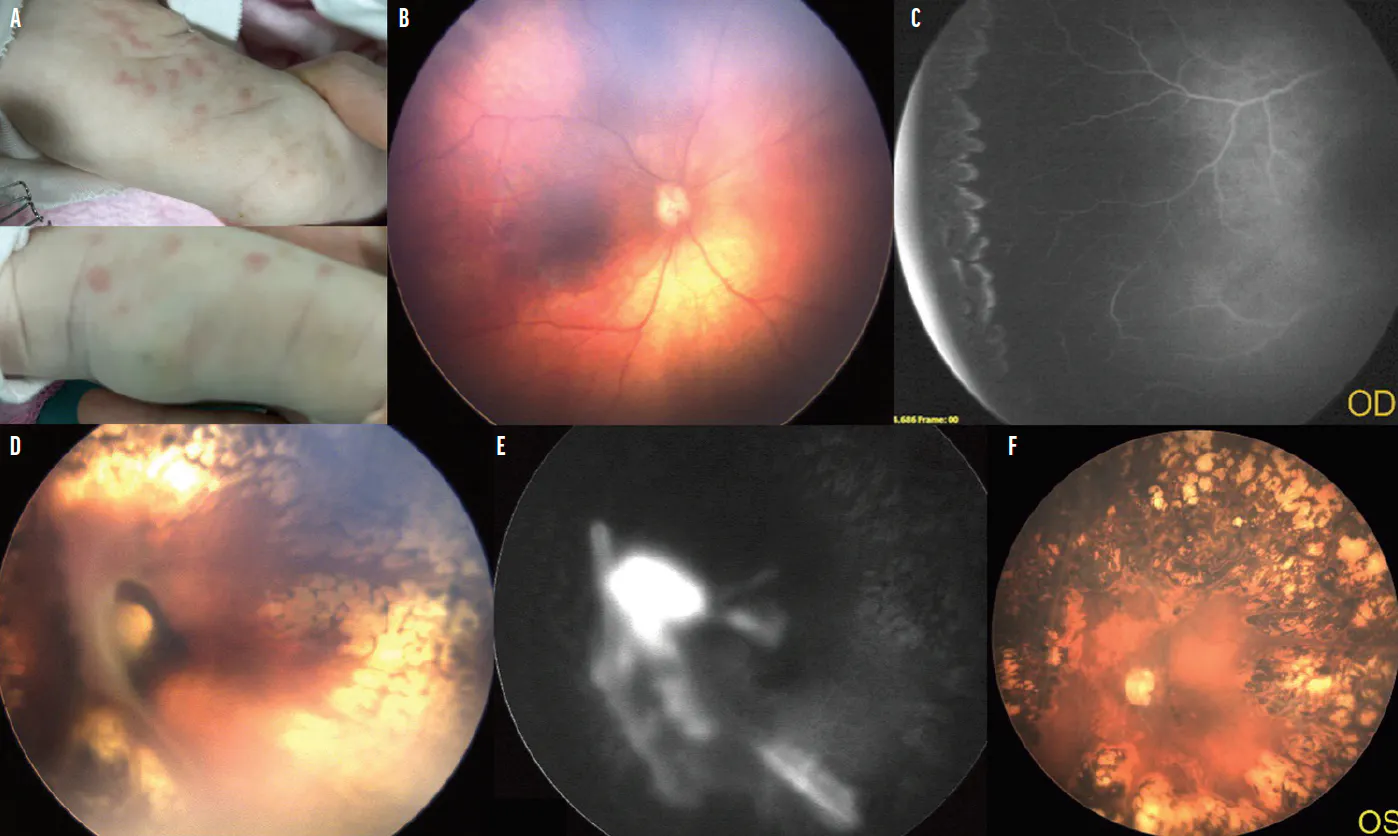
Figure. A full-term infant with IP was referred for progressive RD in her left eye 6 weeks after bilateral laser photocoagulation performed at 3 weeks of age. Cutaneous lesions typical of IP were present (A). Her right eye showed an attached and stable retina with 360° peripheral laser scars (B) and no new vascular activity on FA (C). Her left eye showed partial TRD involving the nasal and peripapillary retina with 360° laser scars extending toward the macula (D). FA demonstrated severe leakage from neovascular tissue associated with TRD (E), and fundus photography obtained 9 months postoperatively showed resolution of the TRD (F).
What is clear, however, is that IP-associated retinopathy does not behave like retinopathy of prematurity (ROP), despite their similarities as ischemic pediatric retinopathies.6 While vascular development follows a relatively predictable timeline in RP, IP may demonstrate prolonged, quiescent avascular retina with late-onset neovascularization, sometimes emerging years after initial stability. Moreover, IP can exhibit a dynamic vaso-occlusive course: New areas of peripheral—or even posterior—nonperfusion may arise in previously vascularized areas, a phenomenon not characteristic of ROP.6 In addition, some infants with IP display an aggressive phenotype, progressing rapidly to vitreous hemorrhage or TRD within the first months of life, sometimes despite timely laser intervention.5
DIAGNOSTIC INSIGHTS
Assessing Risk
Recent literature suggests as many as 70% of infants with IP exhibit angiographic signs of retinal disease.7 Similarly, in our recent multicenter cohort of 434 eyes, fluorescein angiography (FA) identified retinal pathology in 65% of eyes at a median of 3 months of age.8 Notably, we also found that 25% of eyes that appeared normal on indirect ophthalmoscopy demonstrated angiographic abnormalities. This mismatch is clinically significant, as subtle peripheral nonperfusion or late-phase leakage may be invisible on routine examination yet carry prognostic implications. For this reason, baseline widefield FA early in life is central to stratifying risk.
Prior reports have emphasized that IP-associated retinopathy is dynamic, with both progression and, less commonly, possible spontaneous involution.3-5 Nevertheless, our multicenter data suggest baseline clinical features, particularly angiographic phenotype, provide meaningful risk stratification. In our cohort, FA findings were able to independently predict disease course: Compared with eyes with a normal FA, eyes with isolated nonperfusion carried a five-fold increased risk of progression, while the presence of angiographic leakage or neovascularization increased risk 10- to 15-fold. In practical terms, the presence of vascular activity signals biologically active disease and a substantially higher likelihood of continued progression, warranting closer monitoring and earlier intervention.
Predicting RD
For clinicians and families, the greatest concern with IP-associated retinopathy tends to be the development of an RD. Encouragingly, only 2.6% of eyes in our cohort developed RD over a median follow-up of 4 years. When RD occurred, it tended to be within the first years of life. This early vulnerability mirrored a report by Chen et al,5 who observed RD in 22% of eyes over extended follow-up and described a bimodal distribution: TRD occurred predominantly in infancy and early childhood, while rhegmatogenous RD (RRD) developed later in adolescence and adulthood.
In our study, no eyes with a normal baseline FA developed an RD; risk increased stepwise with angiographic severity and was highest in eyes with leakage or neovascularization. Similarly, Chen et al identified retinal neovascularization as a strong risk factor for RD, whereas peripheral nonperfusion alone was less clearly predictive.5 Taken together, these findings support an aggressive surveillance strategy in infancy and early childhood, particularly for eyes with vascular activity. In later childhood and adolescence, follow-up intervals may be individualized, but patients and families should be educated about symptoms of RRD and encouraged to monitor vision in each eye separately.
MANAGEMENT STRATEGIES
Laser Photocoagulation
Peripheral laser photocoagulation remains a mainstay of treatment in IP-related retinopathy in which the primary goal is to reduce angiogenic drive by ablating ischemic retina and decreasing the risk of neovascular complications and RD.
That said, laser treatment does not guarantee protection from RD. Chen et al reported that three of four infants treated prophylactically still developed TRD,5 and in our cohort, most eyes that progressed to RD had received early laser. These observations underscore that early ablation may not reliably prevent RD in biologically aggressive disease. On the other hand, another series demonstrated favorable outcomes when treatment was initiated very early, suggesting both timing and disease phenotype are relevant.9
In our multicenter study, a subgroup analysis of infants showed that retreatment rates peaked within the first 3 to 6 months after presentation and declined substantially thereafter. After 3 years, additional treatment was relatively uncommon. Accordingly, follow-up intervals can often be gradually extended after early childhood in stable eyes, while maintaining lifelong awareness.
Anti-VEGF Therapy
Intravitreal anti-VEGF therapy has been reported in select cases of IP-related retinopathy, typically in eyes with severe neovascularization or vitreous hemorrhage.10 In our cohort, anti-VEGF injections were rare and limited to adjunctive treatment, preventing reliable assessment of efficacy.
There are also theoretical safety concerns, as IP is a multisystem vascular disorder involving the central nervous system, and the systemic effects of VEGF suppression in infants are not fully understood.11 For now, anti-VEGF therapy is best considered a selective adjunct in cases of severe posterior neovascularization or media opacity limiting laser, rather than as a primary treatment strategy.
Surgical Management
Data on surgical outcomes in IP are limited, and previously reported results have been guarded.3,5 In our multicenter study, eyes with TRD undergoing primary vitreoretinal surgery demonstrated greater anatomic stability compared with those managed conservatively or with laser alone. Although visual outcomes remained guarded, surgical intervention appeared to reduce the likelihood of further structural deterioration in some cases.
Importantly, a subset of eyes with peripheral or fovea-sparing TRD remained stable over prolonged follow-up without surgical intervention. This suggests careful observation with or without laser treatment may be reasonable in nonprogressive, non–macula-threatening RD cases, particularly when traction is extrafoveal, localized, and stable, and the fellow eye has better visual potential.
In contrast, outcomes were poor in eyes presenting with advanced TRD. Many of these infants presented within weeks of birth, suggesting an aggressive in-utero phenotype, rather than delayed recognition. Even with surgical intervention, progression to phthisis was common; in such cases, realistic counseling regarding prognosis is essential.
REMAIN VIGILANT
IP-related retinopathy is a dynamic, biologically heterogeneous disease that demands early, risk-adapted management. Widefield FA has become central to identifying high-risk eyes, particularly those with vascular activity, who require closer surveillance and often earlier intervention. The period of greatest vulnerability is early infancy, when disease activity and retreatment burden peak; after this window, many eyes stabilize, although long-term vigilance remains essential.
1. Berlin AL, Paller AS, Chan LS. Incontinentia pigmenti: A review and update on the molecular basis of pathophysiology. J Am Acad Dermatol. 2002;47(2):169-190.
2. Kohler J, Mundae R, Naravane A, Montezuma SR. Incontinentia Pigmenti. In: Özdek Ş, Berrocal A, Spandau U, eds. Pediatric Vitreoretinal Surgery. Springer International Publishing; 2023:385-398.
3. Holmström G, Thorén K. Ocular manifestations of incontinentia pigmenti. Acta Ophthalmol Scand. 2000;78(3):348-353.
4. Hull S, Arno G, Thomson P, et al. Somatic mosaicism of a novel IKBKG mutation in a male patient with incontinentia pigmenti. Am J Med Genet A. 2015;167(7):1601-1604.
5. Chen CJ, Han IC, Tian J, Muñoz B, Goldberg MF. Extended follow-up of treated and untreated retinopathy in incontinentia pigmenti: analysis of peripheral vascular changes and incidence of retinal detachment. JAMA Ophthalmol. 2015;133(5):542.
6. Özdek Ş, Özdemir Zeydanlı E, Baumal C, et al. Avascular peripheral retina in infants. Turk J Ophthalmol. 2023;53(1):44-57.
7. Danford ID, Scruggs BA, Capone A, et al. The prevalence of retinal disease and associated CNS disease in young patients with incontinentia pigmenti. Ophthalmol Retina. 2022;6(12):1113-1121.
8. Özdek Ş. Incontinentia pigmenti related retinopathies: treatment and prognosis. Presented at: Advances in Pediatric Retina; September 18-20, 2025; Durham, NC.
9. Michel S, Reynaud C, Daruich A, et al. Early management of sight threatening retinopathy in incontinentia pigmenti. Orphanet J Rare Dis. 2020;15:223.
10. Ho M, Yip WWK, Chan VCK, Young AL. Successful treatment of refractory proliferative retinopathy of incontinentia pigmenti by intravitreal ranibizumab as adjunct therapy in a 4-year-old child. Retin Cases Brief Rep. 2017;11(4):352.
11. Avery RL. What is the evidence for systemic effects of intravitreal anti-VEGF agents, and should we be concerned? Br J Ophthalmol. 2014;98(Suppl 1):i7-i10.


