


The concept of prior authorizations (PAs) originated in the 1960s, when insurers began requiring physicians to pre-certify medical necessity for hospitalizations.1 In the 1980s, PAs became a management tool to limit the costs of advanced imaging and newer therapies.1 The use of PAs has grown substantially since their inception, with almost 50 million PA requests submitted for Medicare Advantage insurers in 2023.2
PAs incur approximately $35 billion annually in administrative costs.3 In a recent study comparing five Medicare Advantage plans with 30.5 million beneficiaries, 93% of Medicare Part B medication spending would have required PAs from at least one insurer; for ophthalmology, an estimated 26% of spending would have been for PAs.4 The current PA process for anti-VEGF therapies places unnecessary burdens on both patients and providers; while PAs increased by 30% in 2023, their use outpaced the potential 8% cost-saving opportunity.5
QUANTIFYING THE PRIOR AUTHORIZATION BURDEN ACROSS MEDICAL SPECIALTIES
Traditional Medicare (Parts A and B) plans do not require PAs for most procedures, including anti-VEGF injections. Medicare Advantage (Medicare Part C) and commercial insurance plans, however, frequently require prior authorizations.2 (Medicare Advantage plans are subsidized by the government but are often managed by private insurers.)
In a 2024 survey of the American Medical Association, 93% of physicians reported that PAs delayed necessary care, 94% reported that PAs negatively affected patient outcomes, 82% reported that PAs could lead to abandonment of treatments, and 29% reported that PAs led to a serious adverse event.6 Approximately 88% reported that PAs resulted in higher overall use of health care resources, with 77% using ineffective initial treatments due to step therapy requirements, and 73% reporting that PAs increased office visits. About 80% of physicians were concerned that PAs may lead to higher patient out-of-pocket costs, and 58% thought they may adversely affect the workforce. Physicians and their staff spent approximately 13 hours per week processing an average of 39 PAs weekly.6 The majority of PA requests were performed manually, with 59% via phone calls and 45% via fax7; only 23% of physicians reported they were able to submit their PAs electronically.6
Even after the claims are submitted, some PAs may be denied. The Office of the Inspector General previously found that Medicare Advantage insurers had inappropriately denied 13% of PAs for medical services that should have been covered.4 There is also a rising concern that the use of AI may lead to increased denials.5
PRIOR AUTHORIZATIONS FOR ANTI-VEGF AGENTS
A PA request for an anti-VEGF injection takes approximately 100 minutes to process.8 Medical staff must identify which insurers require PAs, what prerequisites are required for each specific insurer, and which clinical notes and documentation are necessary to receive approval.6 In studies of two different large electronic medical databases, approximately 96% to 98% of PA requests for anti-VEGF agents were ultimately approved,8,9 indicating that the majority of physicians were using the therapies for approved conditions. However, only 2% of PA requests were approved on the same day.9 There was a mean delay of 1.5 days for Medicare Advantage plans, 5 days for commercial carriers, and 4 days for Medicaid,9 which means that patients often must return on a different day for treatment. Of the few PAs that were denied, the reasons were unknown, but they may have included PA requests for off-label but clinically effective and evidence-based indications.
Costs to Society
While the physician’s office and insurers are the most actively involved in the PA process compared with patients,3 each group, and society as a whole, can be adversely affected by the PA process due to delays and denial of care. In a theoretical model based on the average demographics of a patient receiving anti-VEGF therapy and using average employment rates and salaries, average number of patients with a caretaker/driver, and average life expectancy, each PA request increased the total societal costs by approximately $640 (range: $25 to $4,100), amounting to an increased cost of approximately $11,000 over a patient’s lifetime (range: $230 to $90,000).9 These estimates included direct and indirect health care and non–health care sector costs, including patient and caretaker lost wages, patient out-of-pocket costs, transportation costs, staffing, the weighted proportion of additional imaging and clinical examinations for delayed return visits beyond 30 days, material costs associated with submitting and processing the PA requests, lost patient and caretaker productivity due to missing work, and lost patient productivity at work due to an undertreated visual impairment. A variety of clinical scenarios were evaluated, with variables ranging from least to most expensive in the probability sensitivity analyses.
It should be noted that these calculations of increased societal costs included only the submitted PA costs and not the PAs that were never submitted because the physician was deterred by the lengthy and costly PA process. They also did not include the baseline patient insurance premiums and deductibles. The direct savings from denying one PA for an anti-VEGF agent was only about $27 per injection (range: $3 to $50).9 Because PAs do not confer any direct clinical benefit to patients, the cost-utility of PAs for anti-VEGF injections could not be calculated.
The workplace was found to experience the greatest economic burden, followed by the patient and family, and the medical practice (Figure).9 If a solo or small practice physician does not have sufficient staff to help process a PA request or has to undergo a time-consuming peer-to-peer review to appeal a denial, the time and opportunity costs for the physician may exceed the reimbursements for the injection.
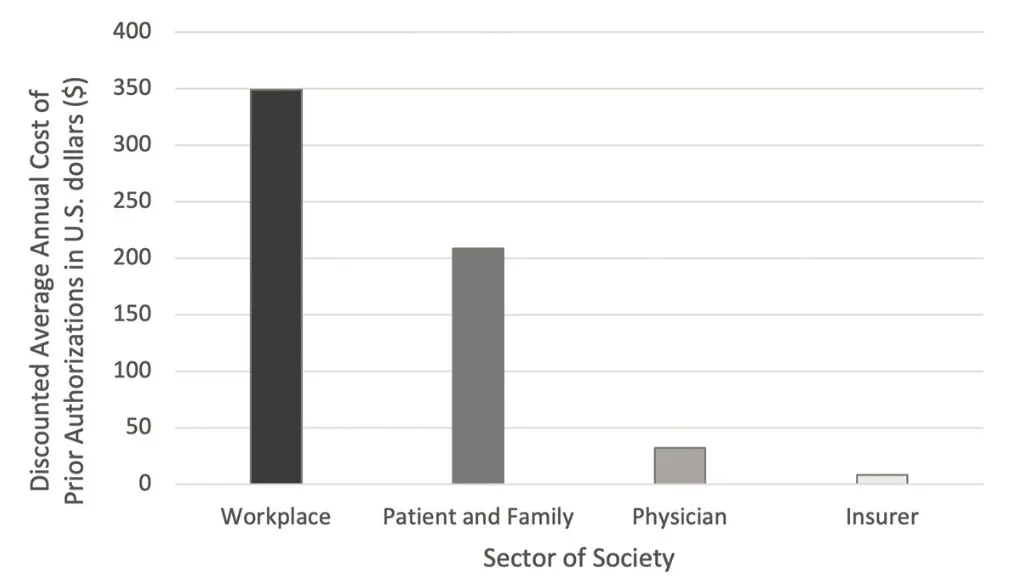
Figure. In the average case, PAs increased costs for the workplace, patients and their family, physicians, and insurers, with the workplace and the patients and family the most affected. The costs were discounted 3% annually to account for future costs being valued less than current costs.
Effects on Insurers
Even the insurers had increased costs from PAs. Insurers had to pay an extra $5 per year in the average case to process anti-VEGF PA claims,9 similar to the estimated $2 to $4 costs per PA in other medical specialties.10 However, insurers were the only sector of society that could potentially save money from anti-VEGF PA requests in the least expensive clinical scenarios, where the PA denial rates were high, the delays for approval were the longest, and the physician had manufacturer-supplied drug samples available to use. Medicare Advantage and commercial carriers can gain interest from undistributed funds from delayed and denied care.11
Potential Solutions
While eliminating PAs would remove a barrier to patient care, some ways to help mitigate the PA burden in the future may include transitioning to electronic PAs, using AI programs, and training staff on the latest rules and regulations for each insurer. Starting January 1, 2026, CMS required that insurers implement electronic PA requests, and Medicare Advantage and Medicaid plans must respond to urgent requests for care within 3 days and routine requests within 7 days, but those requests excluded medications such as anti-VEGFs agents.12
Approximately 65% of insurers are considering the use of AI programs to expedite the PA process. While there is physician concern about increased denials, AI may also help combat the administrative work of PAs.1,10
ADVOCACY EFFORTS
Although most PAs for anti-VEGF therapies were ultimately approved by insurance companies, the majority were approved only after delays, increasing the costs for patients and society. It can take a total of 4 to 6 weeks from the initiation of the PA request until the physician receives reimbursement from the insurers.10 The current PA process increased the total costs of anti-VEGF therapies for patients, the workplace, the physician, and society without conferring a clinical benefit. PAs were not cost saving in the average case; the potential savings to the insurance companies did not offset the increased costs to the rest of society.
A proposed bipartisan bill, titled Improving Seniors Timely Access to Care Act (H.R. 3514), would not eliminate PAs, but it would expand beneficiary protections, implement a standardized electronic PA process, increase transparency, and require plans to report on their use of PAs. Insurers, lawmakers, and physicians should continue to work together to try to minimize the current burden of PA requirements and remove barriers to patient care.
1. Mazzolini C. Prior authorization: How it evolved, why it burdens physicians and patients, and the promise of AI. Medical Economics. January 25, 2026. Accessed April 10, 2026. www.medicaleconomics.com/view/prior-authorization-history-burden-ai-future
2. Fuglesten Biniek J, Sroczynski N, Freed M, Neuman T. Medicare Advantage insurers made nearly 50 million prior authorization determinations in 2023. KFF. January 28, 2025. Accessed April 10, 2026. www.kff.org/medicare/nearly-50-million-prior-authorization-requests-were-sent-to-medicare-advantage-insurers-in-2023/
3. Sahni NR, Istvan B, Stafford C, Cutler D. Perceptions of prior authorization burden and solutions. Health Aff Sch. 2024;2(9):qxae096.
4. Gupta R, Fein J, Newhouse JP, Schwartz AL. Comparison of prior authorization across insurers: cross sectional evidence from Medicare Advantage. BMJ. 2024;384:e077797.
5. CAQH Insights. 2023 CAQH Index Report. Published online 2023. www.caqh.org/hubfs/43908627/drupal/2024-01/2023_CAQH_Index_Report.pdf
6. AMA prior authorization (PA) physician survey. AMA. Accessed April 10, 2026. www.ama-assn.org/system/files/prior-authorization-survey.pdf
7. Robeznieks A. Why the end could be near for prior-authorization faxes. American Medical Association. October 20, 2022. Accessed April 10, 2026. www.ama-assn.org/practice-management/prior-authorization/why-end-could-be-near-prior-authorization-faxes
8. Dang S, Parke DW, Sodhi GS, et al. Anti-VEGF pharmaceutical prior authorization in retina practices. JAMA Ophthalmol. 2024;142(8):716-721.
9. Leung EH, Khanna S, Lai MM, et al. Economic impact of anti-vascular endothelial growth factor prior authorization process from a large electronic database. [published online ahead of print November 12, 2025]. J Vitreoretin Dis.
10. Sahni NR, Gupta P, Peterson M, Cutler DM. Active steps to reduce administrative spending associated with financial transactions in US health care. Health Aff Sch. 2023;1(5):qxad053.
11. US Health Insurance Industry Analysis Report. National Association of Insurance Commissioners. Published 2021. Accessed April 10, 2026. content.naic.org/sites/default/files/inline-files/2020-Annual-Health-Insurance-Industry-Analysis-Report.pdf
12. CMS Interoperability and Prior Authorization Final Rule CMS-0057-F. CMS. January 17, 2024. Accessed April 10, 2026. www.cms.gov/newsroom/fact-sheets/cms-interoperability-and-prior-authorization-final-rule-cms-0057-f


