


KEY TAKEAWAYS
- By appropriately selecting between evaluation and management (E/M; 992XX) and eye visit codes (920XX), practices can help offset declines in surgical revenue.
- For established patients, 99214 reimburses $135.61 compared with $127.26 for 92014; while the difference per visit may seem modest, it compounds quickly in a high-volume, injection-based retina practice.
- When an E/M and an eye visit code are both supported, selection should be based on documentation, payer rules, and allowable—not habit.
At the start of 2026, CMS made policy changes on facility-based surgical reimbursement. Several months into the year, the effects of these changes have already become evident, as retina practices have observed declining surgical reimbursement.1 Whether from relative value unit (RVU) adjustments, policy changes, or ongoing valuation pressure, revenue generated from retina surgeries is tighter than it was last year.
While surgical cases remain essential to patient care, their reimbursement is subject to payment constraints that are outside of a practice’s control. Examination code selection, however, is not. Under the 2026 Medicare Physician Fee Schedule (MPFS), and a combined increase of the conversion factor and RVUs, office visit reimbursement has increased from 2025. This shift presents an opportunity: By appropriately selecting between evaluation and management (E/M; 992XX) and eye visit (920XX) codes based on documentation and payer policies, retina practices can compliantly and strategically help offset declines in surgical revenue.
2026 NATIONAL AVERAGE MPFS FOR OFFICE SETTING
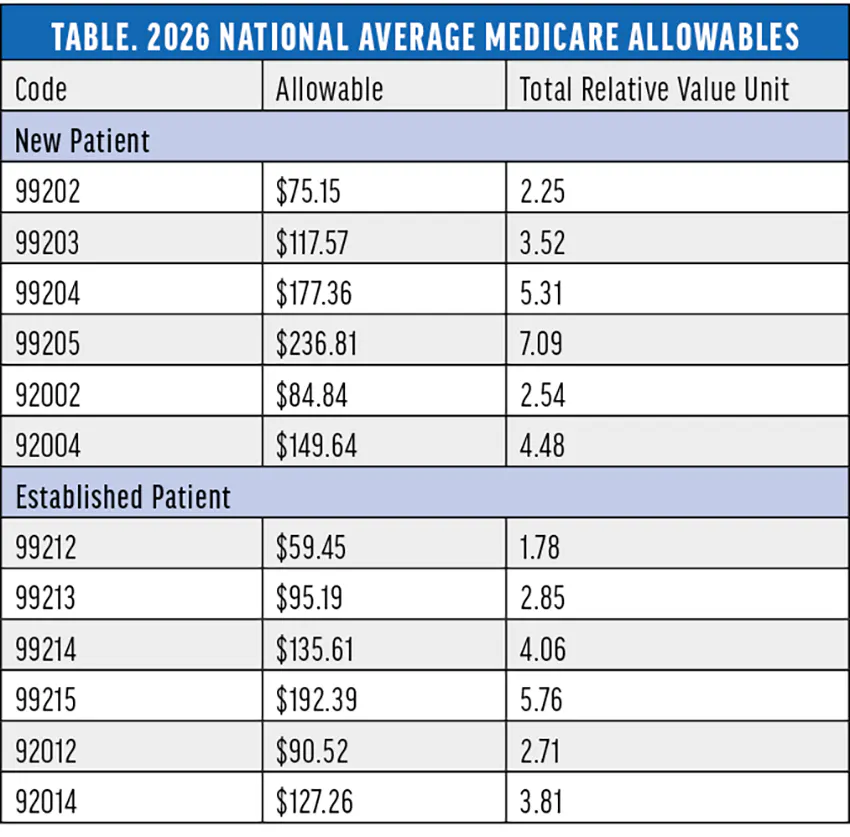
The 2026 national average Medicare allowables (Table) show meaningful differences between E/M and eye visit codes that directly affect retina practices.2 For example, for established patients, 99214 reimburses $135.61 compared with $127.26 for 92014. While an $8 difference per visit may seem modest, it can compound quickly in a high-volume, injection-based practice. The difference is even more significant for new patients: 99204 reimburses $177.36, while 92004 reimburses only $149.64—a nearly $28 Medicare differential per encounter.
It’s important to note that these figures reflect national average MPFS rates; actual reimbursement will vary by region. Medicare Advantage, commercial, and Medicaid payer fee schedules vary, and some plans may have frequency limitation for eye visit codes. However, by selecting the appropriate E/M or eye visit codes, retina practices can appropriately maximize reimbursement. Multiplied across thousands of encounters, appropriate examination code selection becomes a critical strategy for stabilizing revenue, especially in a year when surgical reimbursement has already declined.
Key Takeaways
- By appropriately selecting between evaluation and management (E/M; 992XX) and eye visit (920XX) codes, practices can help offset declines in surgical revenue.
- For established patients, 99214 reimburses $135.61 compared with $127.26 for 92014; while the difference per visit may seem modest, it compounds quickly in a high-volume, injection-based retina practice.
- When an E/M and an eye visit code are both supported, selection should be based on documentation, payer rules, and allowable—not habit.
E/M VERSUS EYE VISIT CODES: UNDERSTANDING THE DIFFERENCE
E/M Codes (99202–99215)
E/M codes require a medically relevant history and examination as determined by the physician. Since 2021, E/M codes are selected based on either medical decision making (MDM) or total physician/qualified professional time. MDM is based on the following:3
- Number/complexity of problems addressed
- Data reviewed/analyzed
- Risk of complications/morbidity
Eye Visit Codes (92002–92014)
Eye visit codes require:
- History
- General medical observation
- Chief complaint
- Examination elements (ie, intermediate vs comprehensive)
- Initiation or continuation of diagnostic/treatment
program
Eye visit codes are not leveled by complexity; rather, they are determined by examination requirements. Comprehensive eye visit codes (92004 for new patients, 92002 for established patients) require all 12 examination elements (ie, visual acuity, visual fields, motility, conjunctiva, adnexa, pupil/iris, cornea, anterior chamber, lens, IOP, optic nerve, and retina/vessels), while intermediate eye visit codes (92014 for a new patient, 92012 for established patients) require three or more examination elements.
RETINA-SPECIFIC CASE EXAMPLES FOR 2026
Case No. 1: Stable Dry AMD
An established patient with intermediate dry AMD in each eye presents for routine 5-month follow-up. Their OCT is stable, and they’re compliant with AREDS2 vitamins and home Amsler monitoring. No changes are made to the treatment plan, and the patient will return in 6 months. The documentation for this case shows:
- One stable chronic illness
- Minimal data
- No prescription drug management
This documentation supports a low MDM, consistent with 99213. However, the physician performed and documented a problem-focused examination (less than 12 examination elements), which also supports the intermediate eye visit code 92012.
Under 2026 Medicare averages, 99213 reimburses $95.19 and 92012 reimburses $90.52. Either code may be appropriate depending on documentation and payer policy. When both are supported, selection should be based on documentation, payer rules, and allowable—not habit.
Case No. 2: Stable Dry AMD With Coexisting Glaucoma
A commercially insured patient with bilateral dry AMD presents for a 6-month follow-up. A comprehensive examination (ie, all 12 examination elements, including dilation) is performed and documented. The assessment reveals intermediate dry AMD in the right eye and dry AMD with geographic atrophy in the left eye, both stable. The patient is scheduled to return in 2 months for monitoring. The patient also has glaucoma and continues using drops prescribed by their referring physician.
The electronic health record (EHR) suggests 99214 based on “two stable chronic illnesses” and prescription drug management. However, two ICD-10 codes for AMD in the right and left eye do not necessarily represent two separate chronic illnesses—rather, it is one disease process affecting both eyes. Additionally, prescription drug management only counts if the retina specialist is managing the medication; in this case, the patient’s glaucoma drops are prescribed elsewhere.
Because two of the three MDM elements do not meet moderate complexity, 99214 is not supported, so the appropriate E/M level is 99213. The documented comprehensive examination also supports 92014.
Under 2026 Medicare averages, 99213 reimburses $95.19 and 92014 reimburses $127.26. The physician—not the EHR—is responsible for ensuring the documentation supports the selected code.
FURTHER READING
Certain scenarios favor or require evaluation and management coding. These include systemic disease management (eg, diabetes with ocular manifestations), payers that restrict eye visit codes to routine examination, frequency edits by commercial carriers, and when prolonged services are appropriate, which can only be used for time-based selection. Understanding payer restrictions is essential to prevent denials and protect revenue. For more information, check out this article: When to Use an Evaluation and Management or Eye Visit Code.
Case No. 3: Diabetes Follow-Up With Chemotherapy-Related Dry Eye
An established patient with diabetic retinopathy presents for follow-up and reports worsening dry eye symptoms while undergoing chemotherapy. A comprehensive examination is performed, revealing stable mild nonproliferative diabetic retinopathy without diabetic macular edema. Severe dry eye is diagnosed, and cyclosporine ophthalmic emulsion 0.05% (Restasis, Abbvie) is prescribed. The visit was initially coded as 99215, citing severe exacerbation and high-risk drug therapy. The claim is denied. Why?
The reason is that although the patient is receiving chemotherapy, the ophthalmologist is not prescribing or monitoring that therapy, so it cannot be used to elevate risk. Prescribing drops for dry eye qualifies as prescription drug management—moderate risk, not high. To support 99215, two of the three MDM elements must meet high complexity, typically involving threat to life or bodily function requiring emergency surgery or hospitalization.
In this case, 99214 is appropriate. (The comprehensive examination would also support 92014, but E/M level 4 generally reimburses higher under Medicare.)
Common pitfalls include labeling disease as “severe” without meeting high-risk criteria, using future risk of blindness to justify high MDM, and overreliance on software rather than thorough documentation with oversight.
CODE CAREFULLY TO MAINTAIN STABLE REVENUE
Every encounter should prompt three questions:
- What E/M level of MDM is supported?
- Does the documentation meet eye visit code requirements?
- What are the payer’s reimbursement rates and policy restrictions?
Decreased surgical reimbursement is real in 2026; however, office-based examination reimbursement—when coded accurately and compliantly—offers retina practices a meaningful opportunity to stabilize revenue despite these changes.
1. Calendar year (CY) 2026 Medicare physician fee schedule final rule (CMS-1832-F). CMS. October 31, 2025. Accessed April 20, 2026. www.cms.gov/newsroom/fact-sheets/calendar-year-cy-2026-medicare-physician-fee-schedule-final-rule-cms-1832-f
2. Search the physician fee schedule. CMS. Updated October 17, 2024. Accessed April 20, 2026. www.cms.gov/medicare/physician-fee-schedule/search
3. Final determination table for medical decision-making. American Academy of Ophthalmology. Accessed April 15, 2026. www.aao.org/Assets/2787dc15-6b49-4f39-b768-b39fe2c174d1/637466823268730000/4859-medical-decision-making-coding-chart-pdf


