


Beginning in kindergarten, Gia Pergolini of Roswell, Georgia, had trouble seeing. But it wasn’t an issue easily corrected with eyeglasses. “There was something wrong with her eyes and no one could tell us what it was,” said Alice Pergolini, Gia’s mother. Gia and her family spent the next 4 years bouncing from specialist to specialist in their search for answers. The theories of why Gia was having trouble seeing through her central vision were just that, theories. “They couldn’t diagnose her, and they thought she fell on her head as a child. They were suggesting she had some sort of brain damage,” Alice told Retina Today.
Finally, when Gia was in the fourth grade, Alice took her to a neurosurgeon at Emory University who got to the heart of the problem: Stargardt disease. This autosomal recessive dystrophy is the most common form of inherited macular degeneration, affecting an estimated 1 in 8,000 to 10,000 people in the United States.1
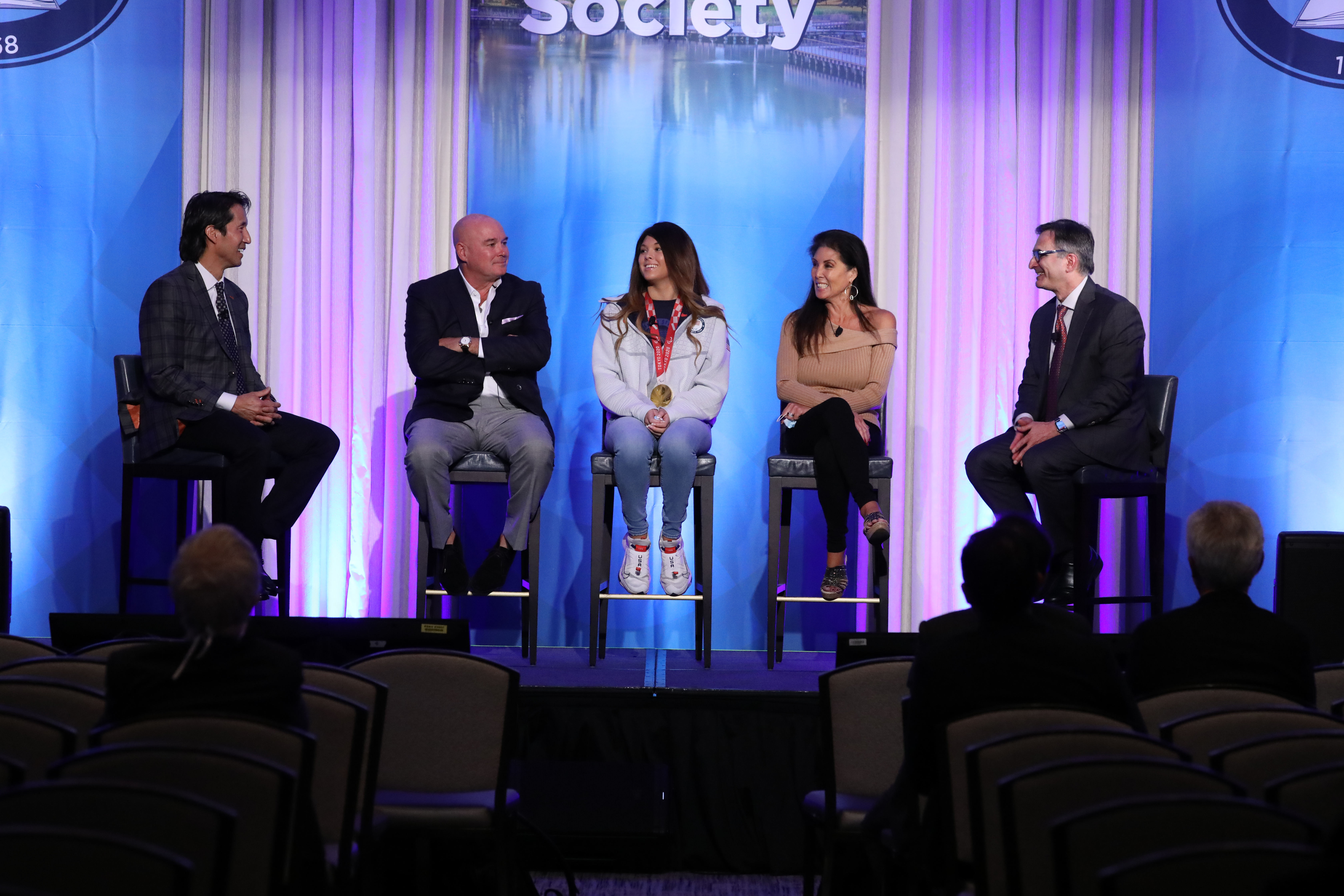
Figure 1. Gia showed off her gold at the Annual Retina Society Meeting in Chicago on September 30th. She was joined on stage by (left to right): Retina Society President Allen C. Ho, MD, her parents Bill and Alice Pergolini, and Retina Society Vice President Jeffrey S. Heier, MD.
EARLY STRUGGLES
But a diagnosis was only the beginning. How would Gia see? Alice reached out to the Center for the Visually Impaired (CVI), which was a game-changer for Gia. There, she received the real-world help she needed with video magnifiers and other assistive technology.
“The CVI is what really helped Gia,” Alice explained. “After she was diagnosed with Stargardt, I said OK, how do we teach her in school? None of her doctors could help me with that, and the private school she was attending did not have the funding or equipment to help. The CVI tested Gia to see what would work best for her in school, and the experts there listed recommendations that really helped Gia.”
“I have dealt with this my whole life, so I didn’t know anything different when I was younger, and I didn’t struggle as much as people might think,” Gia said. “But now it’s more about the social aspect, especially since I found out my vision is too bad for me to drive, even with assistive technology.”
FINDING HER PLACE
Now, Gia has something that has earned her respect from her peers and quieted any teasing that might have come her way in the past: She competed as a member of the 2020 Paralympic swim team—and brought home the gold for her world-record-setting performance in the 100 m backstroke (Figure 1).
“I started swimming when I was 4, and I just loved it,” Gia said. “It was a sport where my vision wasn’t as much of a factor, and I was really good at it.” Joining a year-round swim team, Gia found that she excelled at the sport, and she developed under the tutelage of several different coaches over the years. Her first coach introduced Gia to the Paralympics, and Alice took her to a competition in Canada, “just to see if she liked it.”
“Once we got to Canada and they saw her, the next thing we knew she was on a plane to Berlin,” Alice said. “And then she was on the team, and she was traveling. She was having to go to world championship, and all over the world, basically.”
Now, she has accomplished what most of us can’t even dream of. And her vision didn’t get in the way. “My vision has been relatively stable,” Gia noted. “In the future, I know it’ll progressively get worse, but all I can hope for is a cure. And I’m not really too worried about that right now.”
THE CLINICAL PICTURE
Gia began seeing Krishna Mukkamala, MD, a retina specialist at Georgia Retina, in 2017. At the time, Gia’s VA was 20/200 distance and 20/50 near in each eye. Her most recent follow-up revealed VA of 20/400 distance and 20/30 near OD, and 8/200 distance and 20/100 near OS (Figures 2 and 3). With recent developments in the field of retinal genetics, Dr. Mukkamala suggested that Gia undergo genetic testing again.
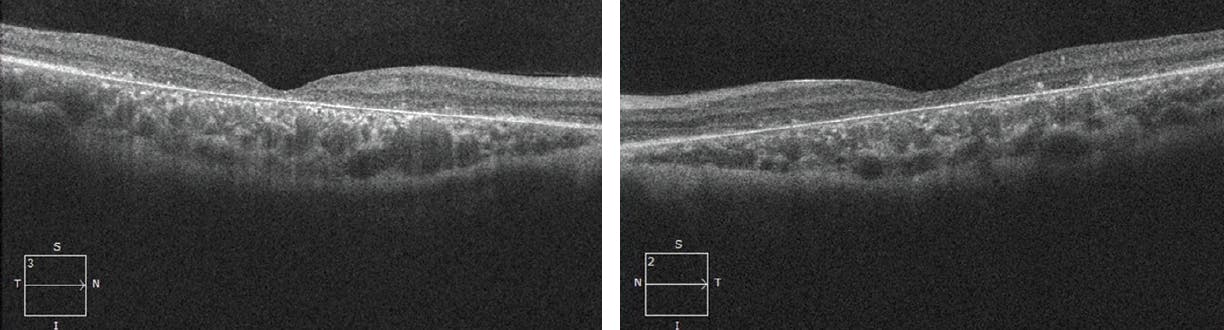
Figure 2. Gia’s OCT images show photoreceptor atrophy approximately 1 disc diameter around the fovea in each eye.
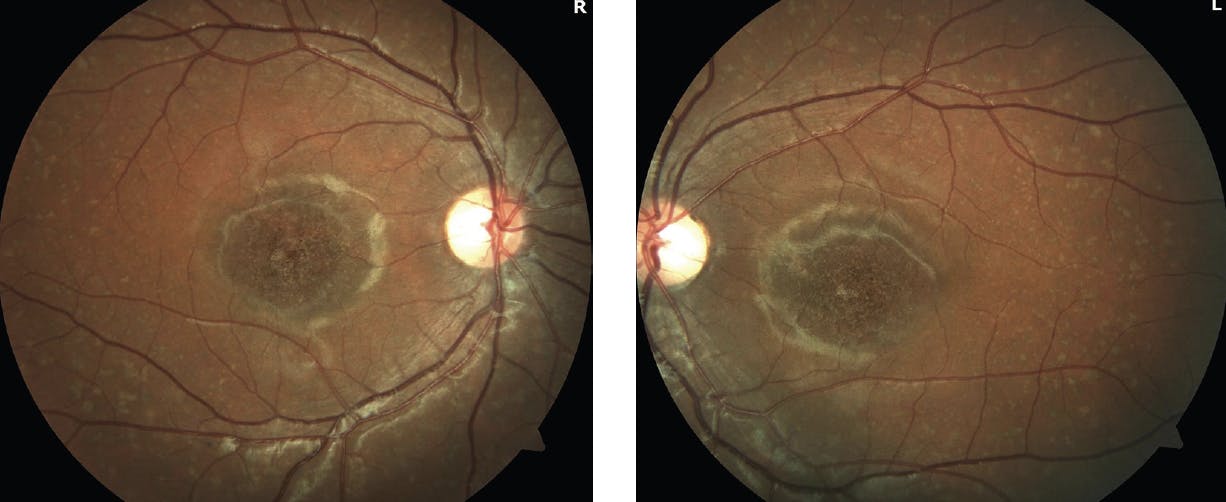
Figure 3. Her fundus photographs shows retinal pigment epithelial mottling around the fovea, indicative of photoreceptor thinning, as well as macular pisciform flecks, which are classic for Stargardt maculopathy.
“She was tested years ago, and the results were negative,” Dr. Mukkamala explained. “But we just got her new results back from the ID Your IRD panel [Invitae], and it shows that she has two mutations in the ABCA4 gene, confirming Stargardt and ruling out any differential such as a cone-rod dystrophy. It just goes to show how much the technology is changing and the importance of staying on top of these advances.”
Although no therapies are approved for Stargardt disease, a confirmed diagnosis with genetic testing still holds significant clinical value, according to Dr. Mukkamala. Documenting the genetic mutation could allow a patient like Gia to enter appropriate clinical trials or could demonstrate eligibility for treatment if a therapy is approved. It also can help patients and their parents better understand family planning options down the road and inform their decisions on whether to take certain supplements, such as vitamin A.2
SUPPORT IS KEY
Dr. Mukkamala’s counseling and ongoing communication has been invaluable to Alice and Gia, particularly after their earlier years of searching for answers. “Dr. Mukkamala is on top of everything, and he immediately educated us on potential gene therapies and our other options, including a referral to a low-vision specialist,” Alice said.
While Dr. Mukkamala keeps his ears to the ground for potential trial opportunities, Gia stands as a beacon of hope for all patients with vision loss. With a gold medal in hand, she offered sage advice for others living with Stargardt disease: “Don’t let this disease define or control you,” Gia said. “Anything is possible if you put your mind to it. Go for your dreams.”
1. Tanna P, Strauss RW, Fujinami K, Michaelides M. Stargardt disease: clinical features, molecular genetics, animal models and therapeutic options. BMJ Ophthalmol. 2017;101(1):25-30.
2. Federspiel CA, Bertelsen M, Line Kessel L. Vitamin A in Stargardt disease-an evidence-based update. Ophthalmic Genet. 2018;39(5):555-559.
Editor’s notes: The clinical data and images contained within this article were provided with full written permission from the patient and her parent. A version of this article was published ahead of print August 10, 2021.


-1_1638377570.jpg?auto=compress,format&w=70)


