


First developed in the 1980s for product manufacturing, 3D printing has evolved rapidly. Ophthalmology is now applying 3D printers to produce patient-tailored orbital prostheses, preoperative anatomical models, prescription spectacles, and intraocular devices.1-5 This technology is of particular interest to vitreoretinal surgery due to the possibility of quick, inexpensive production of surgical instruments that can be customized to a surgeon’s preferences and needs.
SURGICAL INSTRUMENTATION
The success of the 3D-printed medical device market, recently valued at $2.55 billion globally, can be attributed to its unique advantages over traditional manufacturing processes (see Printing Principles).6,7 For example, 3D printing significantly reduces prototyping time and cost compared with traditional production lines and can create complex geometric designs not possible with the latter. Such a low-cost production method enables the possibility of disposable instruments. 3D printing also promotes accessibility with affordable entry-level machines and, soon, access to a growing body of open-source designs.8
PRINTING PRINCIPLES
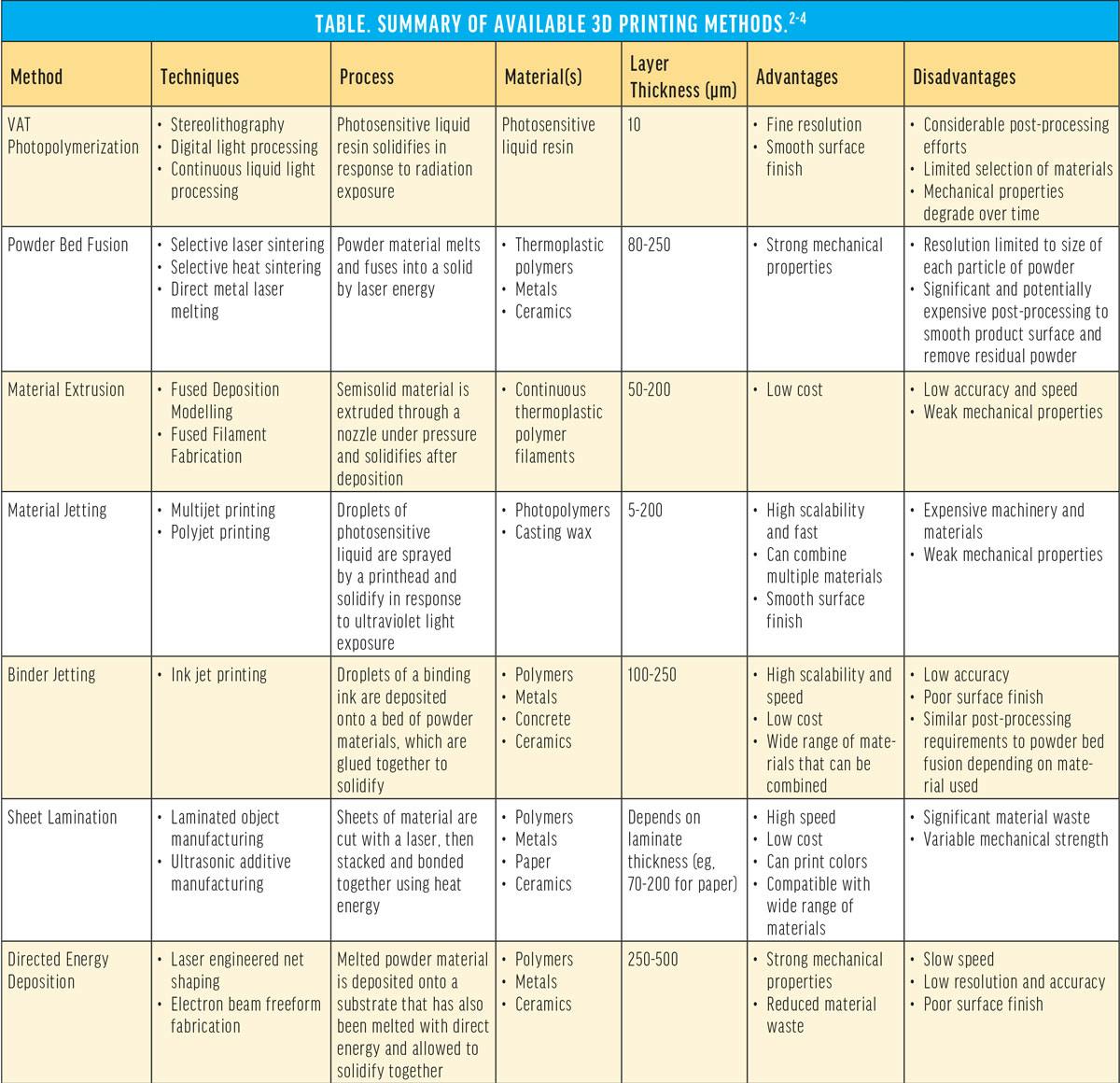
The American Society for Testing and Materials group recognizes seven categories of 3D printing technologies according to how the layers are created and the raw materials used (Table).1 The characteristics of 3D printers are essential in machine selection. Despite the range of technologies, all operate on a layer-by-layer printing principle according to the following generic steps:
Step No. 1: Digital Model Generation. A digital model is generated, often with a computer-aided design package, to describe the product’s geometry for printing.
Step No. 2: Printable File Conversion. The digital model is converted into a format that is compatible with the selected 3D printer, assessed for errors, processed by a slicing software into layer-by-layer instructions, and transferred to the 3D printer.
Step No. 3: Construction. Construction of the physical product begins—an automated process that can take several hours to days depending on the material and technology used, as well as the model’s size and design complexity.
Step No. 4: Removal. Once finished, the product is removed from the 3D printer by simply detaching it from the printing platform or through a more complicated method (eg, chemical or heat treatments).
Step No. 5: Post-Processing. A physical product may require additional processing before use. If internal supports were required for stability during the construction process, these must be removed prior to completion. In addition, some materials may require heat treatment, ultraviolet curing, or surface finishing for strength, safety, and aesthetics.
1. International Organization for Standardization. Additive manufacturing -- general principles -- fundamental and vocabulary. Published 2021. Accessed September 27, 2023. www.iso.org/obp/ui/#iso:std:iso-astm:52900:ed-2:v1:en
2. Gibson I, Rosen D, Stucker B, Khorasani M. Additive Manufacturing Technologies. Springer International Publishing; 2021.
3. Srivastava M, Rathee S. Additive manufacturing: recent trends, applications and future outlooks. Prog Addit Manuf. 2022;7(2):261-287.
4. Ngo TD, Kashani A, Imbalzano G, et al. Additive manufacturing (3D printing): A review of materials, methods, applications and challenges. Compos Part B Eng. 2018;143:172-196.
These principles have already been leveraged to produce instruments in general, orthopedic, oral, and maxillofacial surgical settings.9 Substituting basic surgical instruments with their 3D-printed counterparts has become a feasible option, and printed kits for dental surgery are already available for purchase.10,11
The ability to modify conventional instruments quickly and cost-effectively according to the patient, procedure, and/or surgeon’s needs truly illustrates the power of this technology. For example, patient-tailored endoscope caps with an enhanced field of view can be printed to target a specific esophagogastric lesion for therapy.12 Furthermore, laparoscopic devices have been designed according to a surgeon’s hand size and personal preferences for enhanced intraoperative ergonomics and comfort.13 3D printing also enables the production of novel instruments, such as a minimally invasive surgical system proposed for kidney tumor removal, which is automatically generated based on specific patient (eg, tumor size and distance from abdominal wall), task (eg, laparoscopy or endoscopy), and surgeon (eg, preferred force transmission or number of manipulator arms) parameters.14
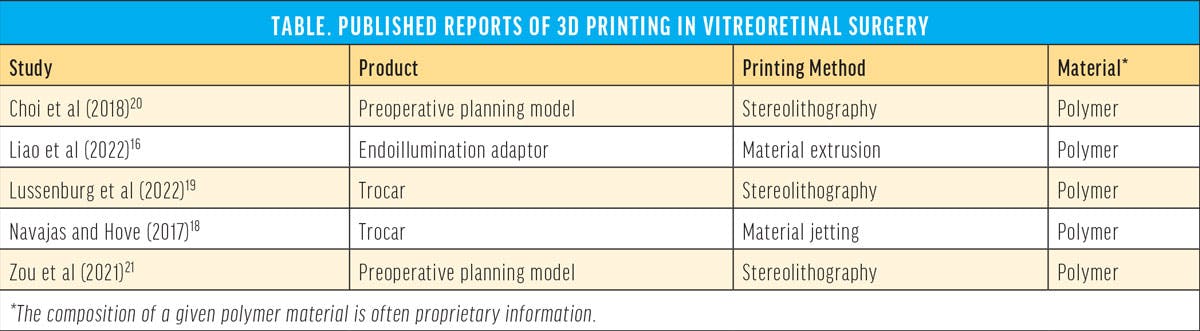
Despite the success of 3D-printed instrumentation in other fields, its potential in ophthalmic and vitreoretinal surgery is only just starting to be explored (Table). Initial research shows that the biocompatibility of most 3D-printed materials is well-primed to handle sensitive ocular tissues; researchers have already designed a storage device that preserves a donor cornea for transplantation.15 In fact, the first intraocular model of the Canabrava ring (AJL Ophthalmic), a pupil expansion device, was designed by 3D printing and is now mass-manufactured using thermoplastic polymethyl methacrylate.5 A 3D-printed adaptor for endoillumination during vitreoretinal surgery is an excellent example of a cost-effective solution to limited access.16
Within academic institutions, the relatively inexpensive and quick production timeline of this technology may offer unparalleled benefits in innovation and ergonomics when prototyping new instruments, such as customizable vitreoretinal forceps.17
These concepts are currently being applied to assess the feasibility of 3D-printed trocars for transconjunctival vitrectomy systems, with the opportunity for personalization according to both patient and surgeon needs.18,19
SURGICAL PLANNING
3D printed models also may be helpful during surgical planning. For example, 3D-printed globe models from CT and MRI data of more than 100 uveal melanomas allowed a recent study’s treatment team to better appreciate key structures (eg, IOLs, unusual tumor shapes) and optimize stereotactic radiosurgery.3 Finer pathology has also been 3D-modelled using OCT, such as a patient’s epiretinal membrane with adhesion and traction points, which helped identify where to start peeling during vitrectomy.20
This principle was further applied to 12 patients with myopic foveoschisis, whereby 3D printing was used to build globe models and macular buckles with an indentation height corresponding to the height of retinoschisis.21 Titanium stent macular buckles were shaped according to these models. Post-vitrectomy, all cases of macular schisis had resolved without postoperative complications.21
While work is already underway to address the printing costs of this technique and the additional operation required to mark extraocular muscles for modelling, its high safety and success rates showcase the strong potential that 3D printing has as a preoperative planning tool.
PRODUCTION IN THE CLINIC
Because medical-grade 3D printing technology is available at affordable prices, a small investment by a surgical center can secure enough printers to run in parallel and meet its production needs. The surgeon would be able to collaborate with an engineer ahead of each patient’s procedure to share ideas and/or modify existing tools, enabling the creation of single-use, procedure-specific, surgeon-matched instruments. These instruments are rendered and presterilized in-house, further reducing processing cost and time.
The performance of any novel design and/or procedure can be assessed preoperatively by printing patient-specific surgical models, which may also serve as useful aids in practicing and teaching. As these printers can also produce medical devices of interest to other departments, production and personnel costs can be shared to make this technology accessible within a range of institutional budgets.
CHALLENGES AND FUTURE DIRECTIONS
The lag in uptake of 3D-printed ophthalmic instruments is due, in part, to the processing limitations of current technologies. Accuracy is essential when producing ophthalmic surgical instrumentation, often millimeters in size, and, thus, vat polymerization techniques have found their way into the spotlight. However, prototype vitreoretinal trocars produced from an industry-standard stereolithography printer were too fragile and suffered from channel deformities.19 Printing with a thicker, ribbed helical design overcame these issues but required significantly more insertion force, posing a greater risk of intraoperative ocular trauma.
The opportunity to personalize ophthalmic instrumentation to patient and surgeon needs, such as customizing cannula length and valve design according to scleral thickness and procedure fluidics, respectively, is promising with advancements in 3D printing technologies, offering enhanced accuracy, resolution, and potential to combine different materials.22,23
Cost-effectiveness and medical regulation are important considerations with 3D printing for ophthalmic surgical instrumentation. While entry-level printers can be purchased for less than $5,000, advanced models are significantly more expensive.9 Further, the expertise of a software designer is often required for intricate geometries, with added labor costs. Of course, the benefits of 3D printing in reducing material, assembly, tools, and costs typically significantly outweigh those of traditional manufacturing, particularly in the setting of low-volume production of customizable targets.
One disadvantage is the uncertainty regarding how to sterilize 3D-printed products, which depends on the material.24 Thermoplastic polymers, for example, may be best sterilized using surface-based methods (eg, hydrogen peroxide gas) to avoid deformation by heat, but special care must be taken for areas of complex design that can trap leftover resin.
Ultimately, a detailed review of the target workflow and application is essential in successfully adopting this technology into intraocular surgery, particularly as printer manufacturers begin to optimize their materials and settings.
1. Fakhoury Y, Ellabban A, Attia U, et al. Three-dimensional printing in ophthalmology and eye care: current applications and future developments. Ther Adv Ophthalmol. 2022;14:251584142211066.
2. Ruiters S, Sun Y, de Jong S, et al. Computer-aided design and three-dimensional printing in the manufacturing of an ocular prosthesis. Br J Ophthalmol. 2016;100(7):879-881.
3. Furdová A, Sramka M, Thurzo A, Furdová A. Early experiences of planning stereotactic radiosurgery using 3D printed models of eyes with uveal melanomas. Clin Ophthalmol (Auckland, NZ). 2017;11:267.
4. Gawedzinski J, Pawlowski ME, Tkaczyk TS. Quantitative evaluation of performance of 3D printed lenses. Opt Eng. 2017;56(8).
5. Canabrava S, Diniz-Filho A, Schor P, et al. Production of an intraocular device using 3D printing: an innovative technology for ophthalmology. Arq Bras Oftalmol. 2015;78:393-394.
6. 3D Printing Medical Devices Market. Straits Research. Published 2019. Accessed September 27, 2023. straitsresearch.com/report/3d-printing-medical-devices-market
7. Bozkurt Y, Karayel E. 3D printing technology; methods, biomedical applications, future opportunities and trends. J Mater Res Technol. 2021;14:1430-1450.
8. Pakzaban P. A 3-dimensional-printed spine localizer: Introducing the concept of online dissemination of novel surgical instruments. Neurospine. 2018;15(3):242-248.
9. Culmone C, Smit G, Breedveld P. Additive manufacturing of medical instruments: A state-of-the-art review. Addit Manuf. 2019;27(April):461-473.
10. Kondor S, Grant G, Liacouras P, et al. On demand additive manufacturing of a basic surgical kit. J Med Devices. 2013;7(3):1-2.
11. Wong JY, Pfahnl AC. 3D printed surgical instruments evaluated by a simulated crew of a Mars mission. Aerosp Med Hum Perform. 2016;87(9):806-810.
12. Ko WJ, Song GW, Hong SP, et al. Novel 3D-printing technique for caps to enable tailored therapeutic endoscopy. Dig Endosc. 2016;28(2):131-138.
13. Culmone C, Lussenburg K, Alkemade J, et al. A fully 3D-printed steerable instrument for minimally invasive surgery. Materials (Basel). 2021;14(24):7910.
14. Krieger YS, Roppenecker DB, Stolzenburg J-U, Lueth TC. First step towards an automated designed multi-arm snake-like robot for minimally invasive surgery. In: 2016 6th IEEE International Conference on Biomedical Robotics and Biomechatronics. 2016:407-412.
15. Ruzza A, Parekh M, Ferrari S, et al. Preloaded donor corneal lenticules in a new validated 3D printed smart storage glide for descemet stripping automated endothelial keratoplasty. Br J Ophthalmol. 2015;99(10):1388-1395.
16. Liao X-L, Lin P-M, Chen H-Y. A simple, low-cost 3D printed adaptor for endoillumination in intraocular surgery. Int J Ophthalmol. 2022;15(7):1207-1208.
17. Garg SJ, Chow DK. 3D printed vitreoretinal forceps. American Academy of Ophthalmology. Published August 23, 2016. Accessed September 27, 2023. www.aao.org/interview/3d-printed-vitreoretinal-forceps
18. Navajas EV, Hove MT. Three-dimensional printing of a transconjunctival vitrectomy trocar-cannula system. Ophthalmologica. 2017;237(2):119-122.
19. Lussenburg K, Scali M, Sakes A, Breedveld P. Additive manufacturing of a miniature functional trocar for eye surgery. Front Med Technol. 2022;4:842958.
20. Choi SW, Kwon HJ, Song WK. Three-dimensional printing using open source software and JPEG images from optical coherence tomography of an epiretinal membrane patient. Acta Ophthalmol. 2018;96(3):e399-e402.
21. Zou J, Tan W, Li F, et al. Outcomes of a new 3-D printing-assisted personalized macular buckle combined with para plana vitrectomy for myopic foveoschisis. Acta Ophthalmol. 2021;99(6):688-694.
22. Mao M, He J, Li X, et al. The emerging frontiers and applications of high-resolution 3d printing. Micromachines. 2017;8(4):113.
23. Mangat AS, Singh S, Gupta M, Sharma R. Experimental investigations on natural fiber embedded additive manufacturing-based biodegradable structures for biomedical applications. Rapid Prototyp J. 2018;24(7):1221-1234.
24. Told R, Ujfalusi Z, Pentek A, et al. A state-of-the-art guide to the sterilization of thermoplastic polymers and resin materials used in the additive manufacturing of medical devices. Mater Des. 2022;223:111119.


