


AN OVERVIEW OF BIOMARKERS IN RETINAL DISEASE
To read part one of this series, see An Overview of Biomarkers in Retinal Disease.
Ocular biomarkers include molecular, histological, radiographical, and physiological characteristics indicative of a disease state or intervention response.1 In ophthalmology, the term biomarker often refers to OCT or OCT angiography (OCTA) findings in the context of retinal pathologies such as AMD, as addressed in part one of this two-part series.2 Retinal biomarkers on OCT, clinical examination, and fundus photography can also have major implications in systemic disease.1
Because many systemic conditions affect the eye, we can use fundus photography and advanced ophthalmic imaging to gain insight into the status, risk, and response of systemic disease.1 In the era of personalized medicine and improved prognostication, AI has been employed to develop novel biomarkers using retinal imaging.3 Through deep-learning algorithms, these programs can detect relevant features through saliency mapping.1,4 Here, we review updated retinal biomarkers with critical implications for systemic disease diagnosis, prognosis, treatment, and monitoring.
CARDIAC RISK
Cardiovascular disease (CVD) risk has traditionally been estimated using risk calculators such as the Framingham risk score and the systematic coronary risk evaluation (SCORE), which consider several criteria, including age, blood pressure, and cholesterol level.5-7 Many of these risk factors, along with CVD itself, are associated with retinal arteriolar narrowing, hemorrhage, and cotton-wool spots.5,8 Poplin et al predicted the risk of major adverse cardiac events using retinal images alone and reported similar accuracy to SCORE.5
Coronary artery calcium (CAC) score is a preclinical marker of atherosclerosis measured with cardiac CT. Rim et al developed a deep-learning algorithm model that analyzed fundus photography to predict the probability of CAC presence. The model generated a comparable score to that obtained with CT and better predicted the presence of CAC in three test sets compared with any individual cardiovascular risk factor investigated, the highest of which was age, followed by glucose level.7
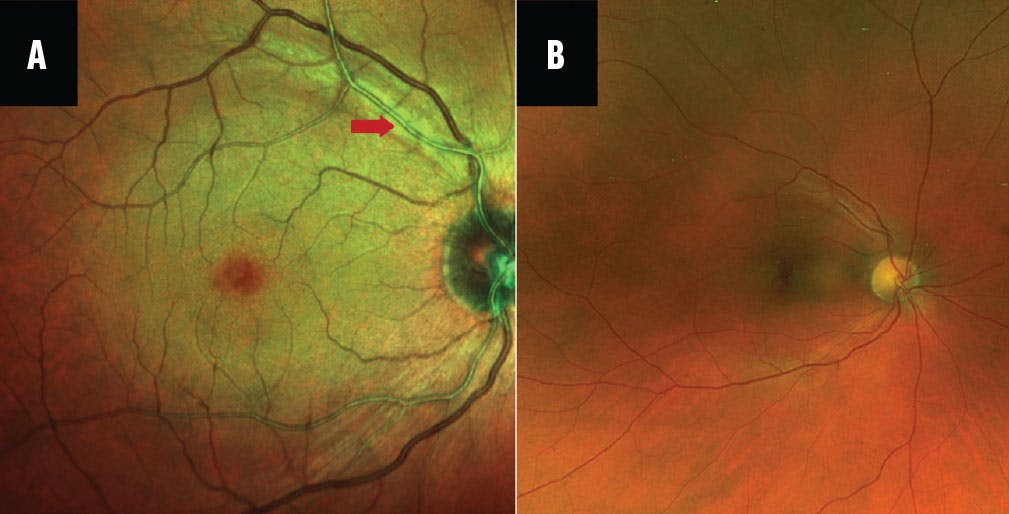
Figure 1. Pseudocolor images of hypertensive retinopathy (A, B) show vascular changes, including arteriolar narrowing, arteriovenous crossing, and arteriosclerosis with a silver wiring appearance of the vessels (red arrow).
HYPERTENSION
Hypertensive retinopathy presents with arteriolar narrowing, arteriovenous crossing, exudates, hemorrhages, and, at its most severe, papilledema (Figure 1).8,9 Recently, subtle retinal changes were used to prognosticate hypertensive end-organ damage, such as risk of CVD and stroke.3 Using deep-learning algorithms, hypertension can be detected using retinal fundus photos alone.10,11
Changes in the vasculature of distinct retinal layers can be found on OCTA.8.9 For example, the foveal avascular zone is enlarged in patients with hypertension compared with patients without hypertension. There may also be decreased vessel density in the superficial and deep capillary plexuses, although reports are inconsistent.8,9 Finally, flow deficits in the choriocapillaris have been described in patients with uncontrolled hypertension.8
The new field of adaptive optics imaging allows documentation of microscopic retinal changes, including the inner and outer diameter of arterioles.8 In patients with hypertension, there appears to be a smaller inner diameter with a thicker vessel wall, resulting in a larger wall-to-lumen ratio. This measure does not depend on absolute measurements, which can be helpful for comparison between patients and when monitoring progression.8
SLEEP APNEA
Obstructive sleep apnea (OSA) is characterized by chronic intermittent hypoxia, which can lead to retinal hypoxia.12 Research shows an association between OSA and retinal vein occlusion and central serous chorioretinopathy.13,14 Anatomical and vascular changes have also been detected on ophthalmic imaging in patients with OSA, even in the absence of pathology (Figure 2). Characterizing these retinal changes has proven difficult given varied measures of OSA severity, differences in baseline characteristics, and difficulties in determining disease duration.12,15,16
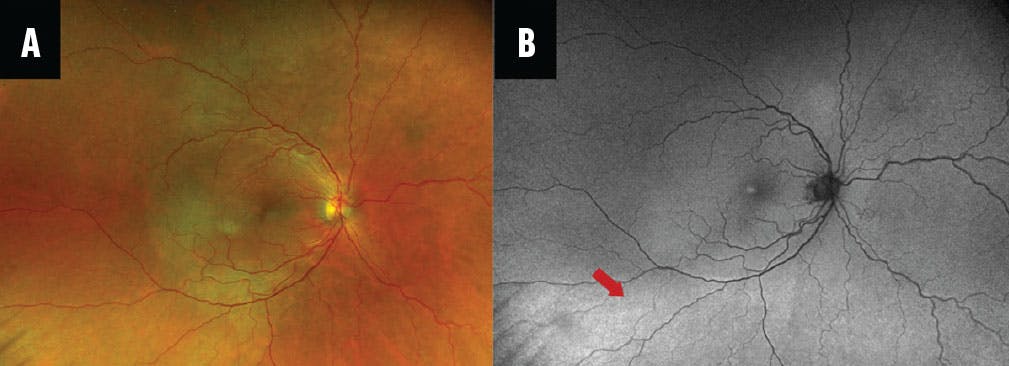
Figure 2. Pseudocolor imaging of OSA shows vascular changes, including diffusely increased venular and arteriolar tortuosity and arteriolar changes (A). Fundus autofluorescence imaging shows a diffuse area of hyperreflectivity inferiorly (B, red arrow).
Morphological vascular changes have been reported, including increased vascular tortuosity and arteriolar changes similar to mild hypertensive retinopathy (Figure 3).12,17 One case study of a patient with OSA included swept-source OCT and vascular perfusion mapping that confirmed vascular tortuosity in both the retinal arteries and the superficial capillary plexus veins of both eyes without leakage.17
Changes in choroidal thickness have been controversial, although a meta-analysis revealed that significantly thinner choroidal thicknesses were found in patients with moderate and severe OSA compared with patients in the control group.13 This is thought to be related to autonomic dysfunction and inflammation.13
There have been inconsistent reports of changes in the ganglion cell-inner plexiform layer (GCIPL) thickness in OSA, with some patients experiencing thickening and others experiencing thinning, highlighting the need for larger studies with similar baseline patient characteristics.15 Although results differ between studies, most show decreased vascular density in the deep capillary layer on OCTA.12,16 Using an AI neural network, risk of OSA has been associated with low retinal vascular density and fractal dimensions.18
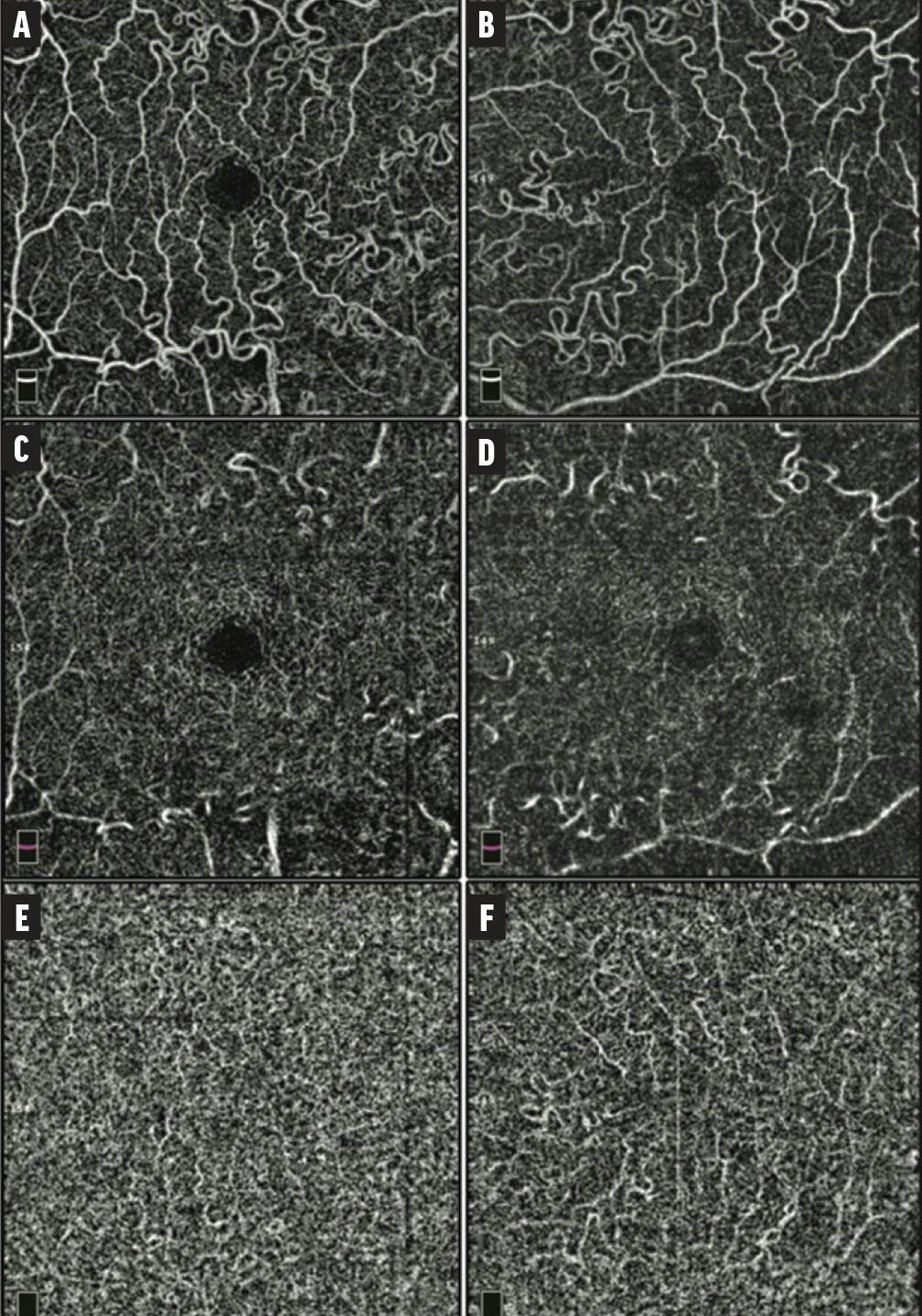
Figure 3. The en face OCTA of both eyes of an OSA patient shows vascular tortuosity in the superficial capillary plexus (A, B), deep capillary plexus (C, D), and choriocapillaris (E, F).
COGNITIVE FUNCTION
Researchers have continued to search for clinically valuable retinal biomarkers to detect and predict the risk of Alzheimer disease (AD).19-21 One study determined that ultra-widefield color photography and autofluorescence imaging actually have limited value in predicting an AD diagnosis, although the images included in the study likely were not able to capture an ultra-widefield view, as they were cropped to remove eyelid artifacts.22,23
OCT and OCTA measures are more valuable, particularly GCIPL thickness.22 On saliency mapping, superficial perfusion density and foveal avascular zone size were relevant to an AD diagnosis.22 Wang et al looked at OCTA scans of patients with AD with mild cognitive impairment and found that superficial vascular density was significantly lower in patients with AD compared with controls.20 Yan et al described significantly decreased vascular density in patients with AD compared with controls, and this measure correlated with cognitive scores, such as the mini mental status exam.21
MULTIPLE SCLEROSIS
Although the typical ophthalmic manifestation of multiple sclerosis (MS) is optic neuritis, subtle retinal changes seen on OCT can mirror neuro-axonal degeneration occurring in the brain.23 Through retrograde degeneration, the retinal nerve fiber layer composed of unmyelinated axons can thin and degenerate over time.23 The origin of these axons is the ganglion cell layer, which reflects in vivo conditions of the cells and is more susceptible to decreased perfusion.23
Even without optic neuritis, peripapillary retinal nerve fiber layer and GCIPL thickness appear to correlate with MS activity and progression.24 GCIPL thinning correlates with clinical progression and increased relapses.23 Radiologic progression with new lesions on MRI and increased rate of lesion development also correlate with accelerated GCIPL thinning. Furthermore, microcystic macular edema on OCT in patients with MS is associated with poorer visual and global disability scores.25 Given the established correlation between disease activity and progression with OCT measures, clinical trials of MS therapeutics have used OCT measures as a treatment efficacy outcome.23
TAKEAWAYS
The applicability of ophthalmic imaging in the prediction, detection, and prognosis of systemic disease is growing. Retinal biomarkers, such as measures of microvasculature, are now a research focus to determine what more can be learned from the eye. A wealth of ophthalmic data is collected daily in clinics around the world, and AI algorithms provide an exciting opportunity to gain novel, clinically valuable information to positively affect patient care.
1. Ranchod TM. Systemic retinal biomarkers. Curr Opin Ophthalmol. 2021;32(5):439-444.
2. Sodhi SK, Pucchio A, Choudhry N. An overview of biomarkers in retinal disease. Retina Today. 2022;16(3):46-48.
3. Wagner SK, Fu DJ, Faes L, et al. Insights into systemic disease through retinal imaging-based oculomics. Transl Vis Sci Technol. 2020;9(2):6.
4. Rim TH, Lee G, Kim Y, et al. Prediction of systemic biomarkers from retinal photographs: development and validation of deep-learning algorithms. Lancet Digit Health. 2020;2(10):e526-e536.
5. Poplin R, Varadarajan AV, Blumer K, et al. Prediction of cardiovascular risk factors from retinal fundus photographs via deep learning. Nat Biomed Eng. 2018;2(3):158-164.
6. Son J, Shin JY, Chun EJ, Jung KH, Park KH, Park SJ. Predicting high coronary artery calcium score from retinal fundus images with deep learning algorithms. Transl Vis Sci Technol. 2020;9(2):1-9.
7. Rim TH, Lee CJ, Tham YC, et al. Deep-learning-based cardiovascular risk stratification using coronary artery calcium scores predicted from retinal photographs. Lancet Digit Health. 2021;3(5):e306-e316.
8. Tan W, Yao X, Le TT, Tan B, Schmetterer L, Chua J. The new era of retinal imaging in hypertensive patients. Asia Pacific J Ophthalmol. 2022;11(2):149-159.
9. Dziedziak J, Zaleska-Zmijewska A, Szaflik JP, Cudnoch-Jedrzejewska A. Impact of arterial hypertension on the eye: a review of the pathogenesis, diagnostic methods, and treatment of hypertensive retinopathy. Med Sci Monit. 2022;28:1-12.
10. Zhang L, Yuan M, An Z, et al. Prediction of hypertension, hyperglycemia and dyslipidemia from retinal fundus photographs via deep learning: a cross-sectional study of chronic diseases in central China. PLoS One. 2020;15(5):e0233166.
11. Dai Id G, He W, Xu L, et al. Exploring the effect of hypertension on retinal microvasculature using deep learning on East Asian population. PLoS One. 2020;15(3):e0230111.
12. Colak M, Ozek D, Ozcan KM, et al. Evaluation of retinal vessel density and foveal avascular zone measurements in patients with obstructive sleep apnea syndrome. Int Ophthalmol. 2021;41:1317-1325.
13. Wu CY, Riangwiwat T, Rattanawong P, Nesmith BLW, Deobhakta A. Association of obstructive sleep apnea with central serous chorioretinopathy and choroidal thickness: a systematic review and meta-analysis. Retina. 2018;38(9):1642-1651.
14. Nakayama LF, Tempaku PF, Bergamo CV, et al. Obstructive sleep apnea and the retina: a review. J Clin Sleep Med. 2021;17(9):1947-1952.
15. Chalkiadaki E, Andreanos K, Karmiris E, et al. Ganglion cell layer thickening in patients suffering from obstructive sleep apnea-hypopnea syndrome with long mean apnea-hypopnea duration during sleep. Int Ophthalmol. 2021;41:923-935.
16. Ava S, Erdem S, Karahan M, et al. Evaluation of the effect of obstructive sleep apnea syndrome on retinal microvascularity by optical coherence tomography angiography. Photodiagnosis Photodyn Ther. 2022;38:102761.
17. Li DQ, Golding J, Choudhry N. Swept-source optical coherence tomography angiography and vascular perfusion map findings in obstructive sleep Apnea. Ophthalmic Surg Lasers Imaging Retina. 2016;47(9):880-884.
18. Zekavat SM, Raghu VK, Trinder M, et al. Deep Learning of the retina enables phenome- and genome-wide analyses of the microvasculature. Circulation. 2022;145:134-150.
19. Lee MJ, Abraham AG, Swenor BK, Sharrett AR, Ramulu PY. Application of optical coherence tomography in the detection and classification of cognitive decline. J Curr Glaucoma Pract. 2018;12(1):10-18.
20. Wang X, Zhao Q, Tao R, et al. Decreased retinal vascular density in Alzheimer’s disease (AD) and mild cognitive impairment (MCI): an optical coherence tomography angiography (OCTA) study. Front Aging Neurosci. 2021;12:1-10.
21. Yan Y, Wu X, Wang X, et al. The retinal vessel density can reflect cognitive function in patients with Alzheimer’s disease: evidence from optical coherence tomography angiography. J Alzheimers Dis. 2021;79:1307-1316.
22. Wisely CE, Wang D, Henao R, et al. Convolutional neural network to identify symptomatic Alzheimer’s disease using multimodal retinal imaging. Br J Ophthalmol. 2022;106:388-395.
23. Lambe J, Saidha S, Bermel RA. Optical coherence tomography and multiple sclerosis: Update on clinical application and role in clinical trials. Mult Scler J. 2020;26(6):624-639.
24. Mehmood A, Ali W, Song S, et al. Optical coherence tomography monitoring and diagnosing retinal changes in multiple sclerosis. Brain Behav. 2021;11(e2302):1-19.
25. Graves JS. Optical coherence tomography in multiple sclerosis. Semin Neurol. 2019;39:711-717.


