


In March 2025, revakinagene taroretcel-lwey (Encelto, Neurotech Pharmaceuticals) was approved by the FDA for the treatment of adults with idiopathic macular telangiectasia type 2. This encapsulated cell-based gene therapy, designed to continuously release human ciliary neurotrophic factor into the vitreous cavity, is implanted using a surgical approach that falls within every retina surgeon’s skillset.
To begin the implantation procedure, a 7 mm x 7 mm conjunctival limbal peritomy is performed in an inferior quadrant (although not required, a limbal traction suture is recommended to rotate the eye and improve access). Dissect Tenon capsule from the bare sclera and ensure meticulous hemostasis with wet-field cautery.
A 3-mm sclerotomy should be made 3.75 mm posterior and parallel to the limbus. This full-thickness incision can be achieved using a 20-gauge microvitreoretinal blade, followed by further enlargement with a 15° asymmetric blade. If required, apply cautery to ensure hemostasis within the scleral incision.
Prior to insertion, revakinagene taroretcel-lwey should be rinsed with at least 5 mL of sterile balanced salt solution to remove the cell medium, with continuous rinsing every 10 minutes to prevent dehydration of the implant.
A 9-0 polypropylene double-armed suture is passed through the titanium fixation loop located at the end of the implant. The sclerotomy incision is gently opened using toothed forceps, and the implant is inserted perpendicular to the globe, ensuring that the fixation loop remains exposed. Direct the implant toward the optic nerve, avoiding the lens. The implant is released into the sclerotomy by squeezing the gripper at the designated area (Figure 1).
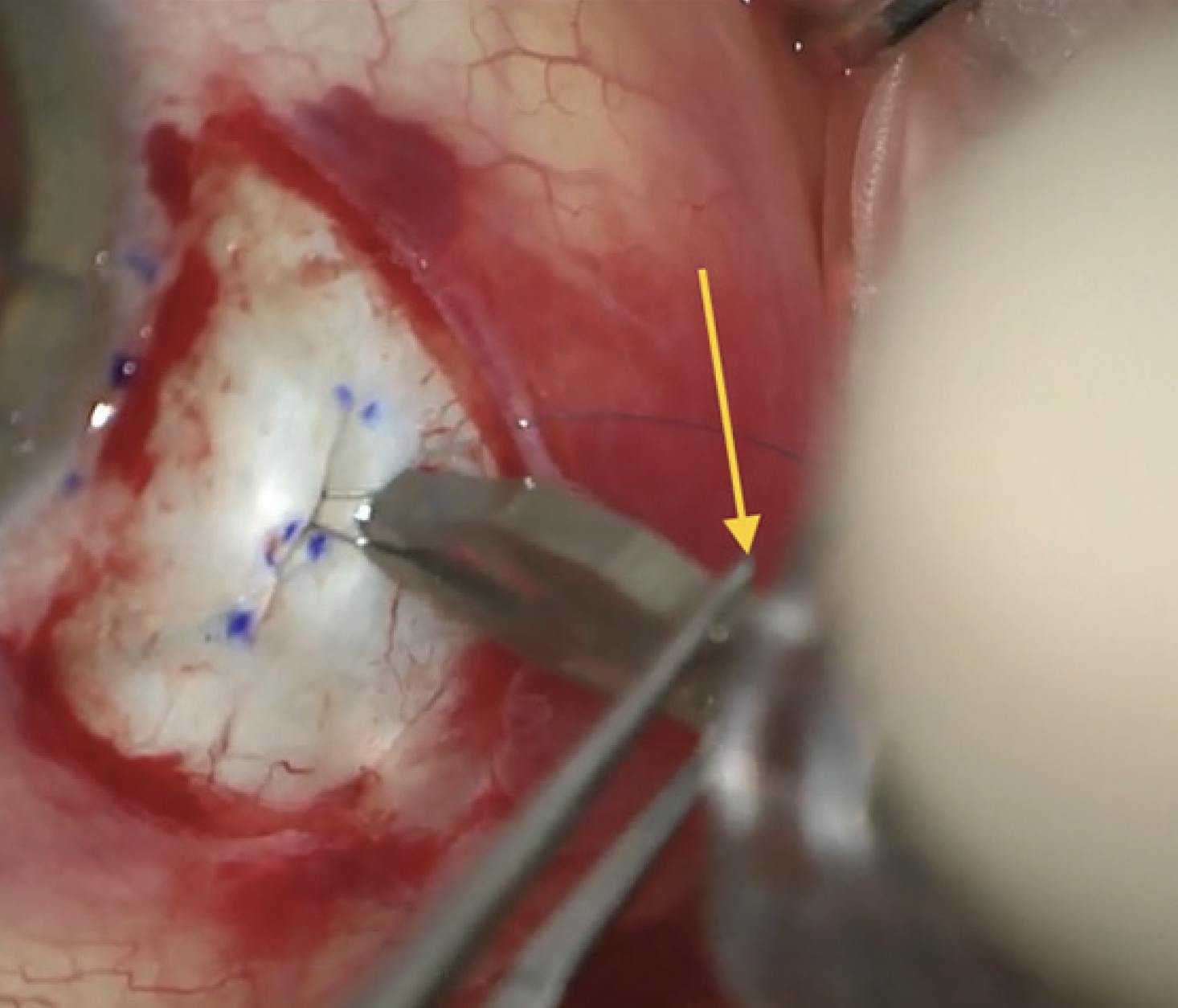
Figure 1. To release the revakinagene taroretcel-lwey implant, squeeze the gripper at the designated area, as shown here. Image courtesy of Neurotech and Charles C. Wykoff, MD, PhD.
Keeping both needles attached, an anchor knot (3-1-1) is used to secure the polypropylene suture to the fixation loop. The knot should be placed at the apex of the fixation loop, ensuring tight, locking throws. Each end of the suture is then passed through the sclera at 90% depth such that the fixation knot and apex of the titanium loop rest just inside the scleral incision (Figure 2). Tie the polypropylene suture down to the sclera with a 3-1-1 episcleral knot. Optimally, the knot is positioned away from the incision. Leave the needles attached to the polypropylene suture to be used for the final closure.
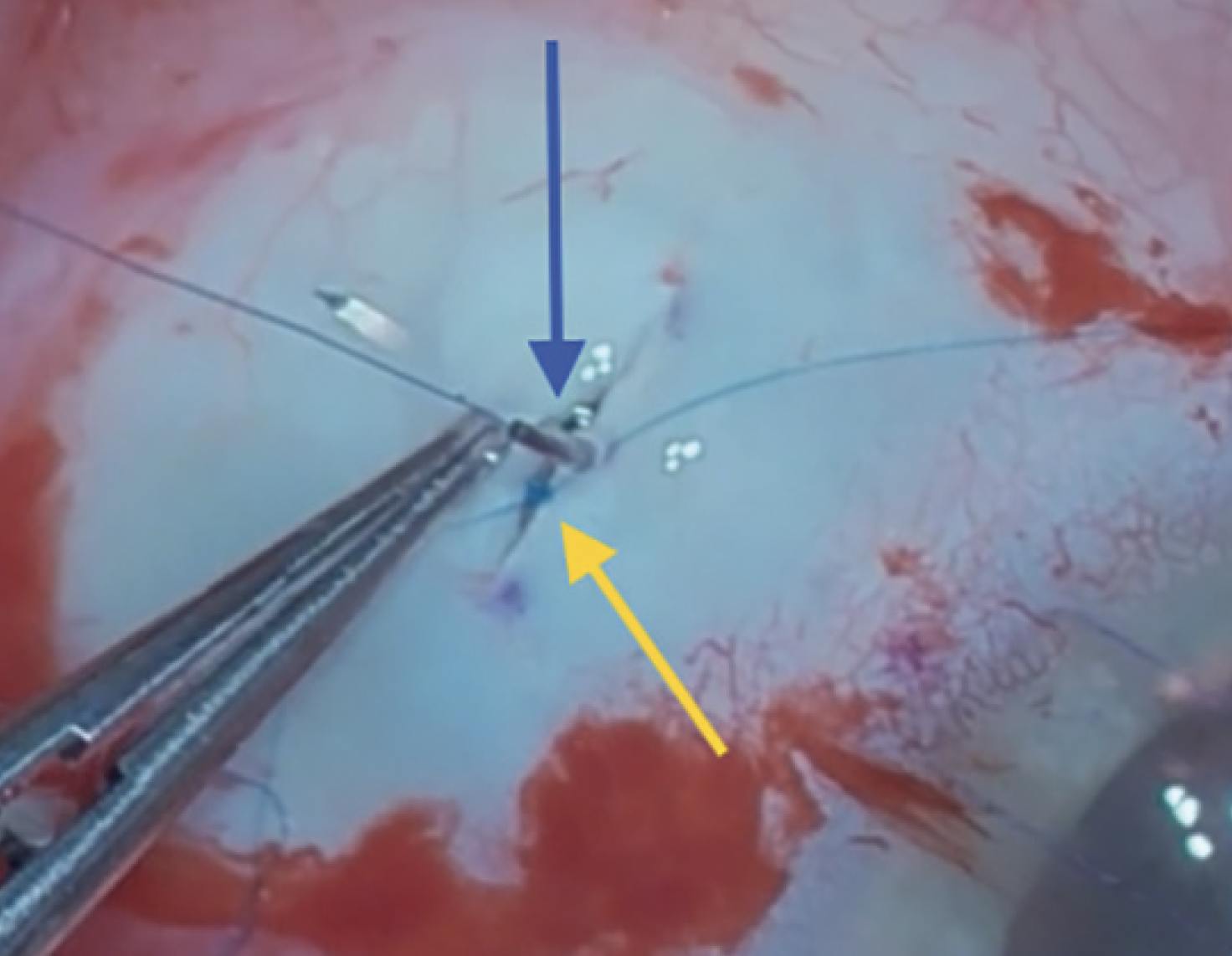
Figure 2. The polypropylene suture is passed at 90% scleral wound depth (blue arrow). The 3-1-1 polypropylene fixation knot sits at the apex of the titanium loop (yellow arrow). Image courtesy of Neurotech and Liliya Sutherland, DO.
With the needles still attached, bury the polypropylene suture into the sclera by taking at least a 2.0-mm long bite of the sclera at 50% to 75% depth beyond the end of the sclerotomy (Figure 3). This minimizes the risk of the polypropylene suture tails eroding through the conjunctiva. Keep the needles attached until the wound is fully closed.
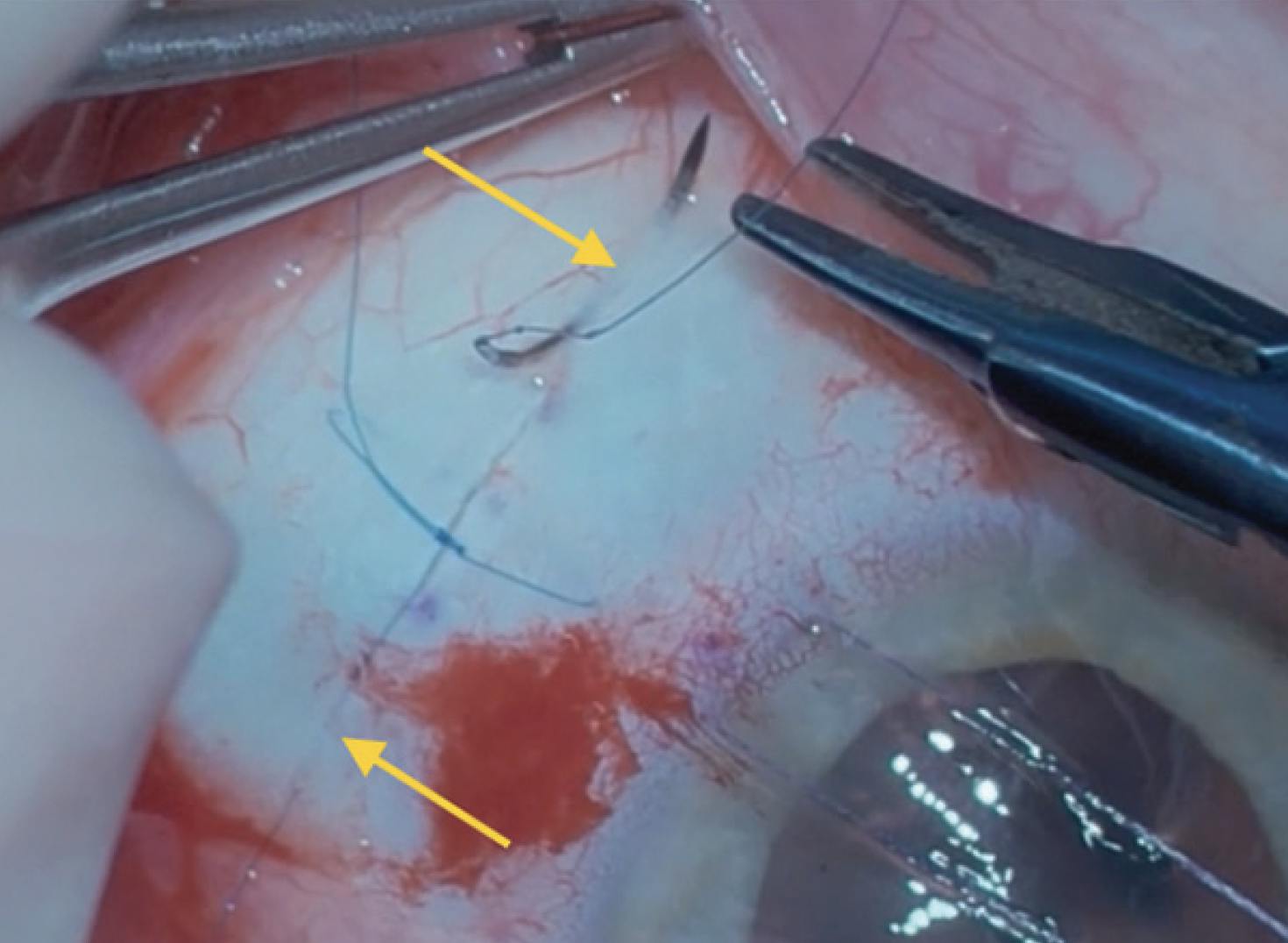
Figure 3. Bury the polypropylene suture tails into the sclera at 50% to 75% depth beginning just beyond the end of the scleral wound. Image courtesy of Neurotech and Liliya Sutherland, DO.
The scleral incision should be closed using 9-0 nylon sutures, ensuring a watertight closure. To ensure there is no internal wound gape, each nylon suture should be passed at a depth of 75% to 80%, with the knots rotated into the sclera. If the knot cannot be buried in the sclera, replace the suture and use a 1-1-1 “Dangle” style knot. When closing the scleral wound, divide the wound into thirds, essentially ignoring the polypropylene suture. The nylon sutures should be closer to the polypropylene suture than to the end of the scleral wound. Once the wound is closed, the polypropylene suture is cut flush to the sclera.
Close the conjunctiva and Tenon capsule using 6-0 plain gut or chromic sutures, or 7-0 vicryl suture with a three-point fixation. Ensure the closure is secure to prevent conjunctival retraction and exposure of the scleral sutures.
What-if Scenarios
While rare, the polypropylene suture can break. If the suture breaks while tying the fixation knot to the apex of the titanium loop, the suture must be replaced. Pass a new double armed 9-0 polypropylene suture through the islet, then remove the broken suture and proceed as described above. If the suture breaks after the polypropylene suture has been passed through the edges of the scleral wound, complete the episcleral 3-1-1 knot, thereby securing the revakinagene taroretcel-lwey implant and keeping the broken suture tail long. Capture the tail with the closing nylon sutures and consider adding another nylon suture to keep the polypropylene suture tail flat on the sclera.
NEW CHALLENGES IN THE OR
A new surgical implant such as revakinagene taroretcel-lwey might not challenge your skillset, but you can be successful by paying attention to the details of the surgery and maintaining a focus on surgical best practices.


-1%20(1)_1769020986.jpg?auto=compress,format&w=70)
%20FINAL-1_1771612597.jpg?auto=compress,format&w=70)


