


AT A GLANCE
- Observation is indicated in the early stages of myopic traction maculopathy (MTM), as mild foveoschisis often remains stable and carries a low risk of rapid progression.
- Surgery is indicated to preserve or improve vision in eyes with moderate-to-severe MTM with visual impairment or in those at high risk for macular hole or macular hole retinal detachment.
- Visual acuity is an important factor when deciding on surgery, since it reflects the severity of schisis, which can also be documented on OCT imaging.
Myopic traction maculopathy (MTM) is characterized by a spectrum of macular pathologies, including retinoschisis, lamellar macular hole (LMH), and foveal retinal detachment (RD), resulting from anteroposterior and tangential traction in highly myopic eyes. In its early stages, MTM presents as mild foveoschisis, which remains stable for months to years.
However, with persistent traction, the schisis may gradually extend, and the outer retina may separate from the retinal pigment epithelium, resulting in outer LMH and foveal RD. With progression, subsequent rupture of the overlying inner retina leads to a full-thickness macular hole (FTMH) and eventual macular hole RD (MHRD; Figure 1).
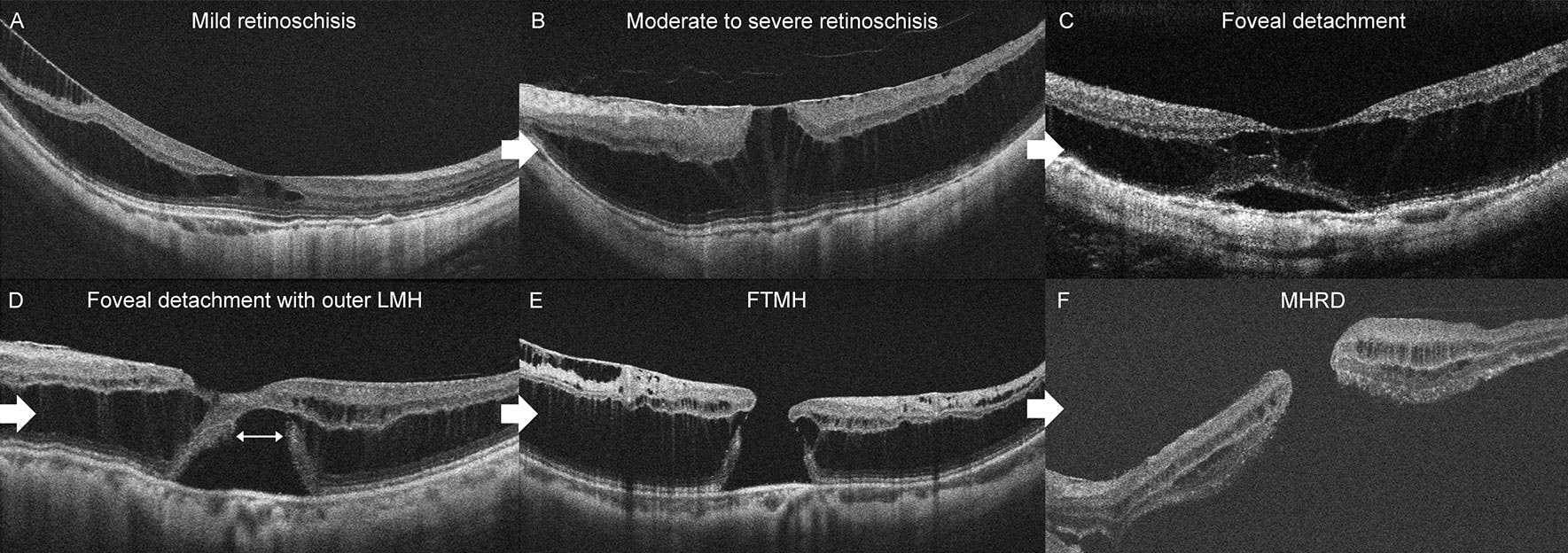
Figure 1. These OCT images document mild retinoschisis with a VA of 20/25 (A), moderate-to-severe retinoschisis without foveal RD with a VA of 20/40 (B), foveal RD without outer LMH and a VA of 20/50 (C), foveal RD with LMH and a VA of 20/60 (D), FTMH with a VA of 20/100 (E), and MHRD with a VA of 20/400 (F). Surgery may be indicated in all cases except A.
Although MTM typically progresses slowly, it may result in severe vision loss if left untreated, highlighting the importance of timely surgery to preserve vision and prevent disease progression. However, because surgery to treat MTM also carries risks, including postoperative FTMH formation,1 the timing of surgical intervention should be determined carefully.
This review focuses on the optimal surgical timing for the management of MTM without FTMH.
OBSERVATION VERSUS SURGERY
Observation is indicated in the early stages of MTM (Figure 1A), as mild foveoschisis without foveal RD often remains stable and carries a low risk of rapid progression. The proportion of eyes showing progression is much lower in mild MTM (6.7% over 3 years) than in severe MTM (43% over 3 years), and spontaneous resolution may occur in some mild cases (18.9% over 55 months).2,3
Clinicians should follow patients with mild MTM every 3 to 6 months, and patients should be advised to visit the clinic earlier if visual symptoms worsen. In eyes that maintain good visual acuity (20/25 or better), or even in those with obvious schisis but preserved vision (20/30 or better) and no symptoms, there is no clear indication to recommend surgery.
Surgery is indicated in eyes with moderate-to-severe MTM with visual impairment or in those at high risk for MH or MHRD. No guidelines have been established for surgical decision making, and the decision often depends on the combination of visual acuity, retinal morphology on OCT, and the patient’s subjective worsening of symptoms.
THE VALUE OF VISUAL ACUITY IN DECISION MAKING
Visual acuity is an important factor when deciding on surgery, as it reflects the severity of schisis. Visual acuity in eyes with MTM ranges widely from 20/20 or better to worse than 20/200.
In our recent study of 193 patients who underwent pars plana vitrectomy (PPV) for MTM, the mean visual acuity significantly improved from 20/76 preoperatively to 20/53 at 12 months (P < .001).4 Postoperative visual acuity correlated with preoperative visual acuity, and more than 80% of the patients in our study achieved postoperative vision equal to or better than their preoperative vision. This raises the question of whether early surgery should be recommended for certain patients with good vision (ie, 20/25 or better).
In general, early surgery is not recommended because approximately 10% to 15% of patients may experience postoperative vision loss of 3 lines or more due to complications, especially postoperative FTMH.4 Therefore, surgeons must discuss the potential risk of vision loss and reoperation with every patient, as this may significantly affect patient satisfaction.
Surgery should be considered only in appropriate cases that show evidence of ongoing visual deterioration. Anecdotally and based on our study, the risks and benefits of surgery seem optimally balanced for cases with moderate visual impairment of 20/30 to 20/200 (ideally 20/40 to 20/50), as surgery at that time facilitates visual improvement while maintaining relatively good postoperative vision.4
Nevertheless, patients who present with very low preoperative vision (worse than 20/200) may still benefit from surgery because they are more likely to experience meaningful visual improvement with minimal risk of further vision loss. Thus, PPV for MTM is generally effective across a wide range of preoperative vision levels.4 However, eyes with poor preoperative vision may experience lower postoperative vision than those with better preoperative vision. Taken together, surgery should be performed at an appropriate time to avoid operating too early or too late.
THE ROLE OF RETINAL MORPHOLOGY
The severity of schisis seen on OCT imaging is also critical for surgical planning. Although eyes with foveoschisis without foveal RD can often be observed, persistent schisis may cause gradual worsening of vision, even without foveal RD, likely due to cumulative damage to the retina (Figure 1B). In these cases, vitrectomy may be indicated to prevent further vision loss.
In eyes with a gradual MTM progression to foveal RD with worsening vision (Figure 1C and Figure 2), PPV is strongly recommended to prevent progression to FTMH and further vision loss.
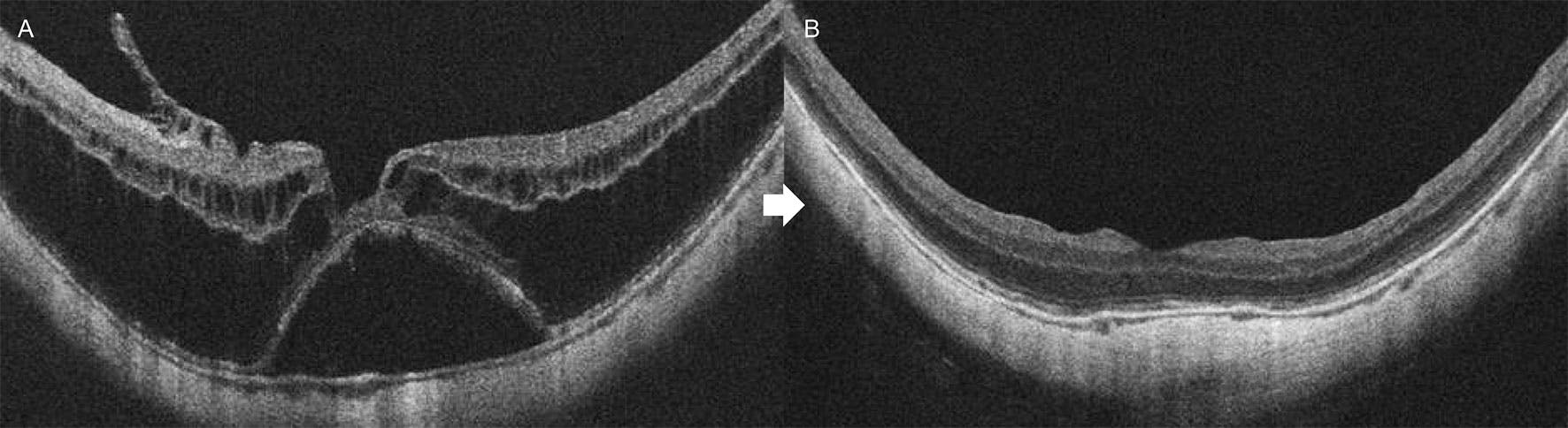
Figure 2. This eye with MTM, foveal RD, and a very thin fovea (A) was treated with PPV, fovea-sparing ILM peeling, and no tamponade (B). VA improved from 20/80 to 20/50 with complete schisis resolution.
MTM with foveal RD and outer LMH, particularly when the fovea is extremely thin, carries a high risk of FTMH formation; therefore, surgery should be considered within 1 to 2 months of diagnosis (Figure 1D).
The chance of visual improvement is substantially lower when MH is present before surgery.5 Thus, surgery before MH formation is beneficial in eyes with MTM. Close monitoring with serial OCT imaging is essential to determine whether FTMH has developed, as the detection of FTMH alters the surgical approach—favoring fovea-sparing internal limiting membrane (ILM) peeling for MTM and an inverted ILM flap for myopic MH (Figure 1E and F).
SPECIAL CONSIDERATIONS
Some eyes have longstanding MTM or FTMHs with severe macular atrophy, a condition in which visual improvement after surgery is unlikely. In such cases, the benefit of surgery may be minimal, and careful observation may be indicated until the risk of MHRD increases. In cases with MTM in the only-seeing eye, surgical timing should be determined with caution after thorough discussion with the patient, and it should be considered only in cases with a risk of MH or MHRD.
MANAGEMENT OPTIONS
The 2025 Preferences and Trends survey conducted by the American Society of Retina Specialists highlighted current management options for MTM without FTMH. In a scenario involving a 48-year-old man with high myopia (-18 D) and progressive unilateral vision loss from myopic macular schisis (VA declining from 20/40 to 20/200), most retina specialists favored surgical management.
Among US surgeons, PPV with broad ILM peeling was most commonly selected (49.7%), followed by PPV with fovea-sparing ILM peeling (33.5%), observation (11.8%), and macular buckle (2.9%).
In contrast, international surgeons favored PPV with fovea-sparing ILM peeling (57.2%), followed by broad ILM peeling (30.2%), macular buckle (6.1%), and observation (5.2%).
These results indicate PPV as the most common surgical approach, with some variations in ILM peeling techniques and in the use of macular buckle. The goal of PPV is to relieve the traction by removing vitreous cortex remnants, epiretinal membrane, and ILM, thereby achieving schisis resolution and preserving vision.
Tamponade choice has also been debated, but our recent study showed that MTM can be successfully treated without tamponade, with better visual outcomes than those achieved with gas or air tamponade.6
The major concern in MTM surgery is postoperative MH formation, which can occur in any type of MTM.1 The incidence of postoperative MH is approximately 10% after conventional complete ILM peeling compared with approximately 1% to 2% after fovea-sparing ILM peeling. Therefore, PPV with fovea-sparing ILM peeling is preferred. Some surgeons use an ILM flap or ILM peeling and reposition, but their indications and efficacy should be evaluated in future studies. In complex cases such as postoperative MHRD and deep posterior staphyloma, additional techniques—including ILM flap, amniotic membrane, autologous retinal transplantation, and macular buckle—may be considered.
TIMING QUICK TIPS
With MTM, optimal surgical timing is often challenging because of the variations in severity and progression patterns. Observation is indicated in mild cases with stable vision, whereas surgery is considered in eyes with moderate-to-severe MTM before FTMH develops, particularly those with foveal RD, VA of 20/30 or worse, or a high risk of MH formation. However, surgical decisions should be individualized based on subjective symptoms, underlying myopic maculopathy, fellow eye status, and the patient’s understanding of risks and benefits. PPV with fovea-sparing ILM peeling is recommended to reduce the risk of postoperative FTMH.
1. Wakabayashi T, Shiraki N, Tsuboi K, et al. Risk factors and outcomes of postoperative macular hole formation after vitrectomy for myopic traction maculopathy SCHISIS report No. 2. Ophthalmol Retina. 2023;7(9):779-787.
2. Shimada N, Tanaka Y, Tokoro T, Ohno-Matsui K. Natural course of myopic traction maculopathy and factors associated with progression or resolution. Am J Ophthalmol. 2013;156(5):948-957.e1.
3. Goudot M, Couturier A, Beaumont W, Gaudric A, Tadayoni R, Philippakis E. Retinal and vitreous changes associated with spontaneous improvement in myopic macular schisis. Ophthalmol Retina. 2024;8(12):1192-1199.
4. Suzue M, Wakabayashi T, Abe K, et al. Predicting visual outcomes after vitrectomy based on baseline visual acuity and timing of surgery for myopic traction maculopathy (SCHISIS report No.3). Graefe’s Arch Clin Exp Ophthalmol. 2025;263(9):2505-2513.
5. Ikuno Y, Sayanagi K, Soga K, Oshima Y, Ohji M, Tano Y. Foveal anatomical status and surgical results in vitrectomy for myopic foveoschisis. Jpn J Ophthalmol. 2008;52(4):269-276.
6. Wakabayashi T, Tsuboi K, Oshima Y, et al. Efficacy of vitrectomy with tamponade versus no tamponade for myopic traction maculopathy: a multicenter study (SCHISIS Report No.1). Am J Ophthalmol. 2023;254:182-192.


-1%20(1)_1769020986.jpg?auto=compress,format&w=70)


_1773249222.png?auto=compress,format&w=75)


