





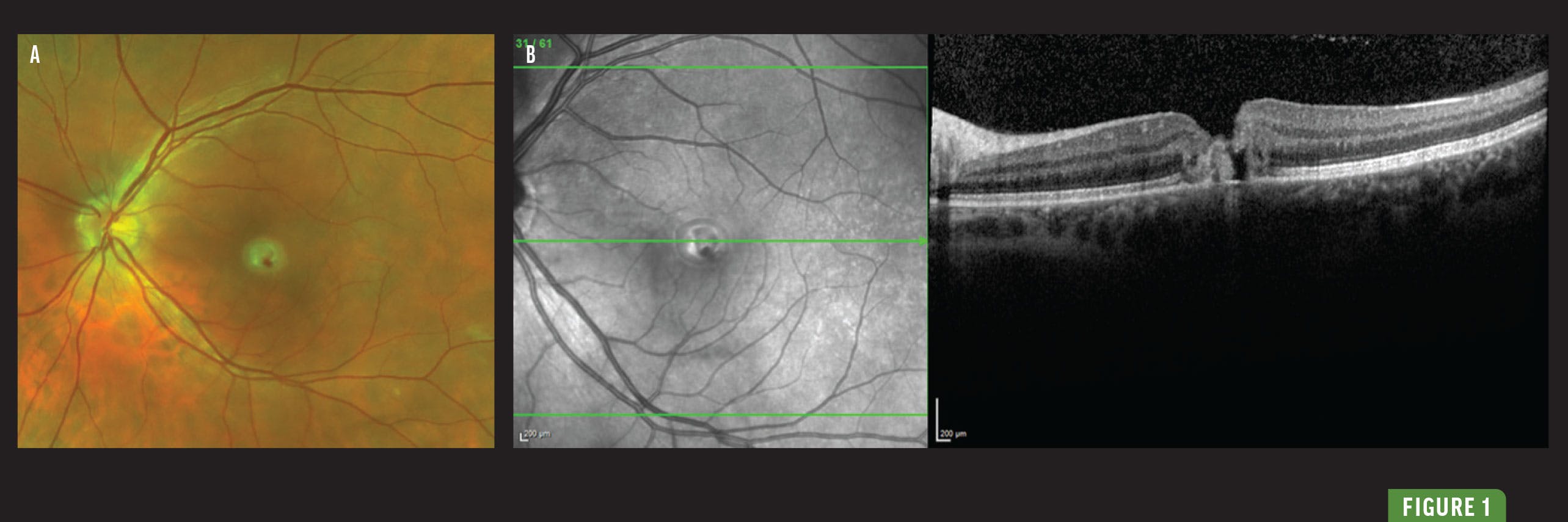
A 34-year-old woman working as a beauty spa technician presented with a central black spot in her left eye following an accidental injury while using a 1,064-nm Q-switched Nd:YAG laser to perform laser hair removal. Her VA was 20/20 OD and counting fingers OS. Slit-lamp examination and IOPs were unremarkable. Fundus examination showed a ~.75 disc-diameter yellow-white circular lesion with a small intraretinal hemorrhage in the central macula (Figure 1A) and an inferior vitreous hemorrhage. OCT of the left eye (Figure 1B) showed central ellipsoid zone and outer retinal loss, increased hyperreflectivity, and disorganization of retinal layers, raising concern for an impending full-thickness macular hole (FTMH). OCT of the right eye was normal.
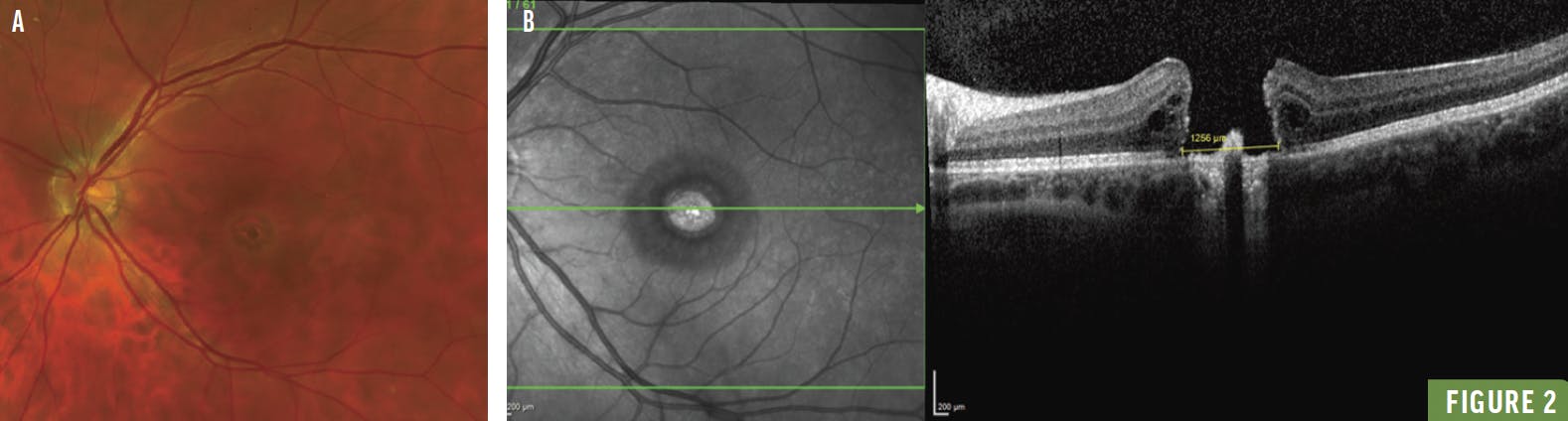
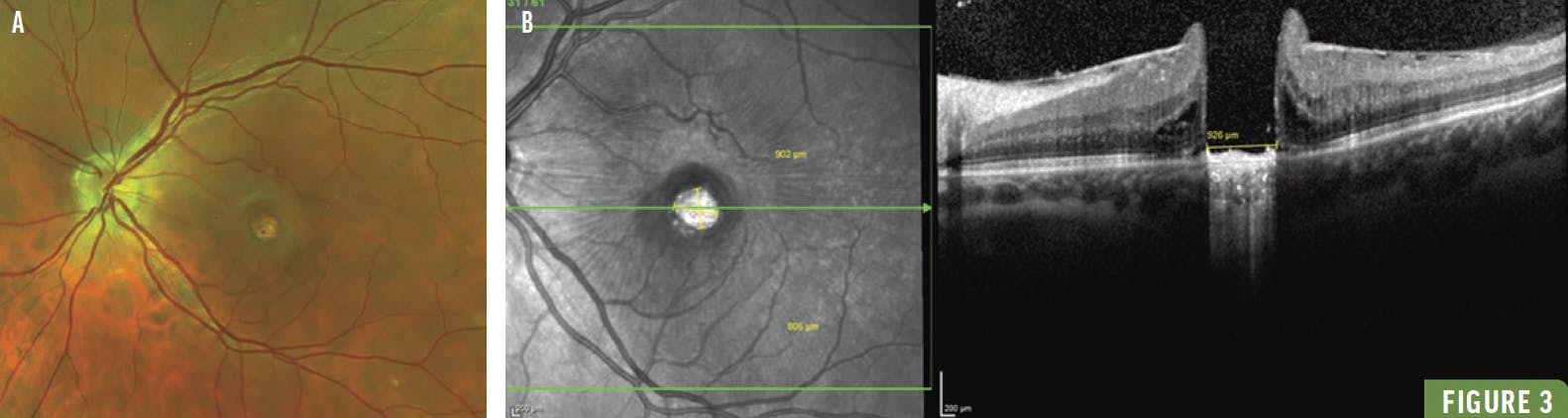
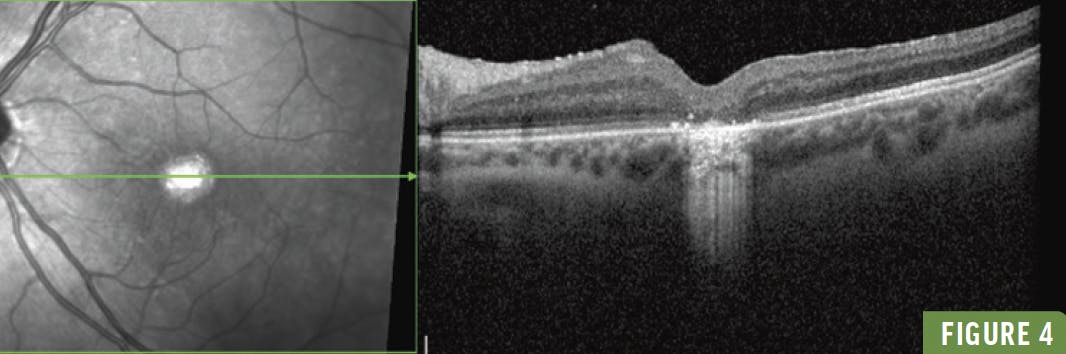
Two weeks after her injury, a FTMH had developed on fundus imaging and OCT (Figure 2A, B). Six weeks after the injury, a progressive tractional epiretinal membrane (ERM) was noted (Figure 3A, B). The patient underwent pars plana vitrectomy and internal limiting membrane peel with rosette creation and 12% C3F8 tamponade. One month postoperatively, the FTMH was closed (Figure 4). Nine months later, it remained closed, and her final VA was 20/600 OS.
LASER-INDUCED FTMH
While most FTMHs are idiopathic,1 they may also occur secondary to trauma, including accidental laser exposure. Traumatic MHs result from direct photothermal or photomechanical disruption of the foveal architecture. Unlike idiopathic FTMHs, spontaneous closure is relatively common, particularly in younger patients, making initial observation a reasonable approach.2,3
Laser-induced macular injury is a distinct subset of traumatic maculopathies. Accidental exposure to Q-switched Nd:YAG lasers, which are widely used in dermatologic and cosmetic procedures, can cause immediate photothermal and photodisruptive retinal damage.4,5 Clinical findings often include foveal whitening, small intraretinal hemorrhages, and outer retinal disruption on OCT. Secondary complications, such as FTMH formation or chorioretinal scarring, may develop over days to weeks. Although some traumatic MHs may close spontaneously, surgical intervention should be considered when closure is unlikely or delayed, particularly in the presence of additional factors, such as progressive traction from an ERM, large hole size, or persistent visual deficit.4-6
OBSERVATION VERSUS SURGERY
This case underscores the importance of using protective eye wear and following safety protocols while using cosmetic laser devices. Bear in mind that even with successful anatomic closure, visual recovery may remain limited due to the severity of initial photothermal injury with subsequent chorioretinal scarring. Careful OCT monitoring is essential to guide management and optimize outcomes.
1. Duker JS, Kaiser PK, Binder S, et al. The International Vitreomacular Traction Study Group classification of vitreomacular adhesion, traction, and macular hole. Ophthalmology. 2013;120(12):2611-2619.
2. Helmy YAH, El Nahry AG, Zein OE, et al. Pediatric and adolescent traumatic macular hole: a systematic review. Am J Ophthalmol. 2024:265:165-175.
3. Uwaydat SH, Mansour A, Ascaso FJ, et al. Clinical characteristics of full thickness macular holes that closed without surgery. Br J Ophthalmol. 2022;106(10):1463-1468.
4. Ciulla TA, Topping TM. Surgical treatment of a macular hole secondary to accidental laser burn. Arch Ophthalmol. 1997;115(7):929-930.
5. Wang X, Zhang T, Jiang R, Xu G. Vitrectomy for laser-induced full-thickness macular hole. BMC Ophthalmol. 2021;21(1):135.
6. Tsai CY, Hsieh YT, Yang CM. Epiretinal membrane-induced full-thickness macular holes: the clinical features and surgical outcomes. Retina-J Ret Vit Dis. 2016;36(9):1679-1687.


%20FINAL-1_1771612597.jpg?auto=compress,format&w=70)

-1%20(1)_1769020986.jpg?auto=compress,format&w=70)


