





Retinal folds related to vitreous traction are uncommon and may occur when the vitreous is trapped in a corneal wound, exerting posterior traction on the retina.1 This tension affects areas of strong vitreoretinal adhesion, causing the retina to fold, which may lead to serious, vision-threatening complications.1 The treatment strategy varies based on the underlying cause; pars plana vitrectomy (PPV), is required in some cases.
Here, we present a case of a young man who experienced vision loss after cranial injury from a motorcycle accident and was found to have retinal folds in his right eye.
CASE REPORT
An 18-year-old man presented with significant loss of vision in his right eye after he sustained cranial trauma in a motorcycle fall. The patient was first admitted to the emergency department; during a thorough evaluation, he was found to be hemodynamically and neurologically stable. His initial cerebral CT scan revealed a subarachnoid hemorrhage with a fractured left parietal bone and a parieto-parietal disjunction. He was closely monitored, and no neurosurgery was required.
The patient’s VA at presentation was counting fingers at near OD and 20/20 OS. External examination of the orbits revealed that oculomotricity and the anterior segment were unremarkable for each eye. Fundus examination of the right eye was occluded by vitreous hemorrhage and was normal for the left eye.
B-scan ultrasonography of the right eye showed multiple echoes in the vitreous cavity with a suspected retinal detachment at the posterior pole (Figure 1).
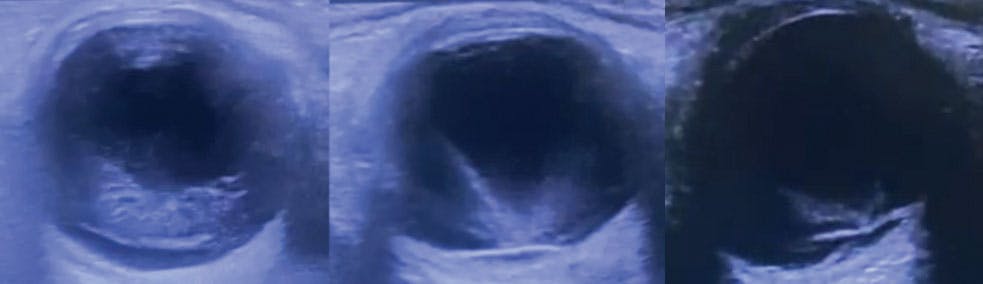
Figure 1. B-scan ultrasonography of the right eye documented the suspected retinal detachment at the posterior pole.
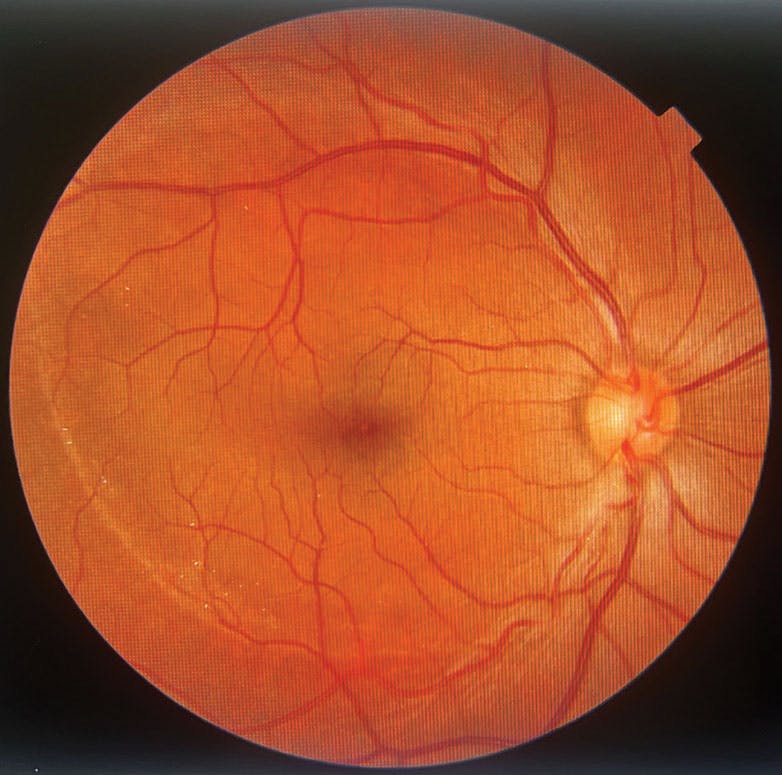
Surgery was scheduled but later postponed due to technical reasons. A 23-gauge PPV took place 4 months later, during which we observed an organized vitreous hemorrhage with vitreoretinal traction along the superotemporal and inferotemporal vascular arcades. The retina at the posterior pole was folded in an annular shape. The PPV was completed with the release of all retinal traction, and no tears were noted. The patient’s VA improved to 20/200 OD 2 weeks postoperatively with persistence of the annular retinal folds at the posterior pole (Figure 2). The patient continues to be monitored at an outpatient facility.
ABOUT RETINAL FOLDS
The pathophysiology behind retinal folds is thought to be due to detachment of the vitreous located posteriorly to an area of firmer adherence to the retina.1 One study evaluated this mechanism by reporting on perimacular retinal folds found in the postmortem eyes of three pediatric trauma patients.2 Within the clinical and forensic records and the systemic and ocular findings from the autopsies, no signs of direct ocular trauma were detected. Furthermore, in each case, the vitreous had partially separated from the retina but remained attached to the internal limiting membrane at the apices of the folds and the vitreous base, implicating vitreoretinal traction in the pathogenesis of these folds. The authors concluded that perimacular folds may develop without trauma as a result of vitreoretinal traction.2
BEWARE OF Ocular EFFECTs OF TRAUMATIC INJURY
Retinal folds may develop after trauma by means of vitreoretinal traction. Consider this possible cause of vision loss when caring for a patient who has experienced a traumatic injury.
1 Green WR, Sebag J. Retinal folds. In: Retina [Internet]. 4th ed. Elsevier; 2006:921‑989. www.sciencedirect.com/topics/medicine-and-dentistry/retina-fold
2. Massicotte SJ, Folberg R, Torczynski E, Gilliland MGF, Luckenbach MW. Vitreoretinal traction and perimacular retinal folds in the eyes of deliberately traumatized children. Ophthalmology. 1991;98(7):1124‑1127.
-1%20(1)_1769020986.jpg?auto=compress,format&w=70)


%20FINAL-1_1771612597.jpg?auto=compress,format&w=70)


