


Age-related macular degeneration (AMD) is a leading cause of irreversible vision loss in older adults. The prevalence is estimated to be 11 to 19 million in the United States and about 170 million globally.1,2 By 2050, prevalence rates are estimated to increase to 22 million and 288 million for the US and global populations, respectively.3,4 Intermediate AMD (iAMD) represents a pivotal stage in this disease where drusen and retinal pigment epithelium (RPE) abnormalities can lead to the development of geographic atrophy (GA). In clinical practice, timely recognition of functional symptoms and identification of high-risk imaging biomarkers in iAMD can help clinicians to intervene earlier and prepare patients for the realities of a chronic, progressive macular disease.

Patient-Reported Symptoms and Functional Red Flags
When a patient arrives to the clinic with functional complaints—difficulty driving, problems recognizing faces, and reduced reading speed or inconsistent clarity despite preserved distance acuity—an examination to determine possible progression from iAMD to advanced AMD is warranted. Such symptoms may correlate with foveal-involving disease, which significantly impacts daily activities, or disease that is encroaching on the fovea, even if not fully involving it yet.

Key Biomarkers for GA Progression and Imaging Modalities
Monitoring patients with iAMD for progression to GA is important. In my follow-up visits, I examine the fellow eye to better understand the expected disease trajectory and risk of progression. I also look for structural biomarkers that indicate a higher risk of GA development, including incomplete retinal pigment epithelium (RPE) and outer retinal atrophy (iRORA) and abnormal pigmentation within the macula. I remain alert for subtle signs of choroidal neovascularization, as well as high-risk drusen characteristics like large drusen, pigment migration, and large elevated drusenoid pigment epithelial detachments (PED).
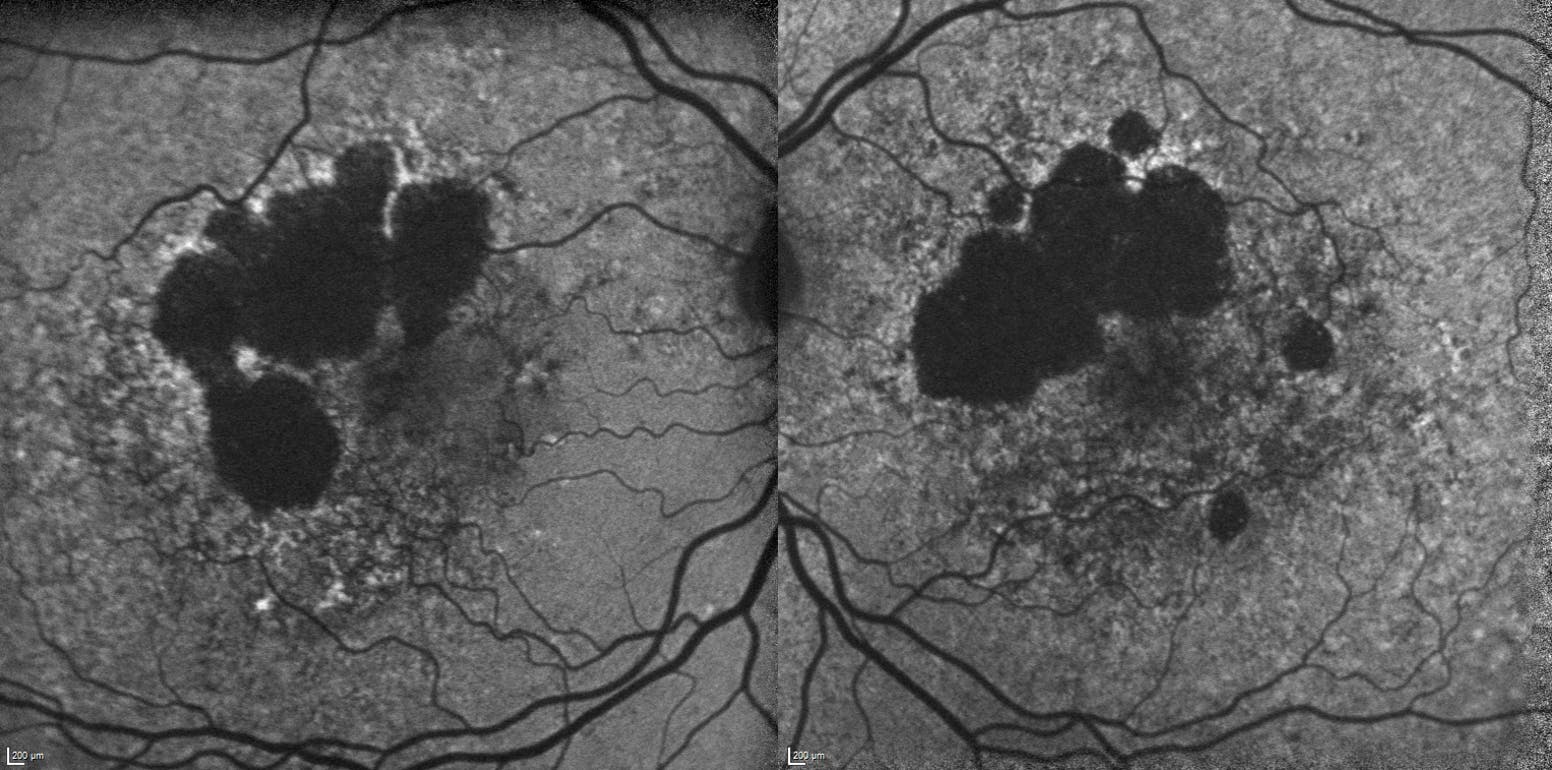
Imaging tools such as OCT and fundus autofluorescence (FAF) are an important adjunct to the clinical exam. With OCT, I can evaluate macular topography and drusen characteristics, assess the presence of iRORA or complete RPE and outer retinal atrophy (cRORA), and characterize PEDs. FAF is used extensively to follow GA progression and foveal involvement, and to evaluate the macula surrounding the GA lesions. These imaging modalities provide longitudinal structural data, support early detection of atrophic changes, and allow retina specialists to compare images across visits (Figure).

Importance of Early Referral
Early collaboration between comprehensive providers and retina specialists is key to optimizing long-term outcomes for patients living with iAMD and those at risk for GA. Early referral offers several advantages: confirming the diagnosis; avoiding misclassification; and conducting a comprehensive baseline exam with multimodal imaging. The baseline visit is also an opportunity to set expectations regarding prognosis, to describe the chronic nature of the disease, and to establish a long-term follow-up plan. Importantly, many patients equate AMD with “going blind,” and an early retina specialist visit with me allows me to contextualize the diagnosis, discuss any potential clinical trials for which they may be eligible, and to reassure them that many individuals maintain good vision for quite some time.

Treatment Landscape and Unmet Needs in GA
GA remains an area of significant unmet need. Current therapies have been shown to slow disease progression to a modest extent but they do not restore vision that has already been lost. This can be disappointing for patients who are hoping for vision improvement, so expectation-setting is essential. I explain that preserving remaining vision and delaying further functional loss can have a meaningful impact on quality of life, particularly when the fovea is still spared.
1. Pennington KL, DeAngelis MM. Epidemiology of age-related macular degeneration (AMD): associations with cardiovascular disease phenotypes and lipid factors. Eye Vis (Lond). 2016;3:34.
2. Rein DB, Wittenborn JS, Burke-Conte Z, et al. Prevalence of age-related macular degeneration in the US in 2019. JAMA Ophthalmol. 2022;140(12):1202-1208.
3. Rein DB, Wittenborn JS, Zhang X, et al; Vision Health Cost-Effectiveness Study Group. Forecasting age-related macular degeneration through the year 2050: the potential impact of new treatments. Arch Ophthalmol. 2009;127(4):533-540.
4. Wong WL, Su X, Li X, et al. Global prevalence of age-related macular degeneration and disease burden projection for 2020 and 2040: a systematic review and meta-analysis. Lancet Glob Health. 2014;2(2):e106-16.

%20FINAL-1_1771612597.jpg?auto=compress,format&w=70)


-1%20(1)_1769020986.jpg?auto=compress,format&w=70)


