

KEY TAKEAWAYS
- Following the 2019 Centers for Medicare and Medicaid Services decision permitting Medicare Advantage plans to impose step therapy for Part B drugs, many insurers adopted a bevacizumab (Avastin, Genentech/Roche)-first approach to intravitreal anti-VEGF therapy.
- Step therapy introduces several safety risks that extend beyond administrative burden and can have direct implications for patient outcomes.
- DRCR Retina Network Protocol T data show that treatment with aflibercept (Eylea, Regeneron) led to improved resolution of edema compared with bevacizumab at 1 and 2 years for patients with lower presenting visual acuity (20/50 to 20/320).
- Advocacy efforts in ophthalmology highlight the persistence of step therapy and the challenges of influencing federal and state policy.
In ophthalmology, step therapy has become increasingly relevant with anti-VEGF injections for various indications such as wet AMD, diabetic macular edema (DME), and retinal vein occlusion (RVO). Following the 2019 Centers for Medicare and Medicaid Services (CMS) decision permitting Medicare Advantage plans to impose step therapy for Part B drugs, many insurers adopted a bevacizumab (Avastin, Genentech/Roche)-first approach. Although bevacizumab is effective for many patients, alternatives such as ranibizumab (Lucentis, Genentech/Roche), aflibercept 2 mg/8 mg (Eylea/Eylea HD, Regeneron), and faricimab-svoa (Vabysmo, Genentech/Roche) are FDA-approved for intravitreal use and can provide superior outcomes for certain patients (Figures 1–3).
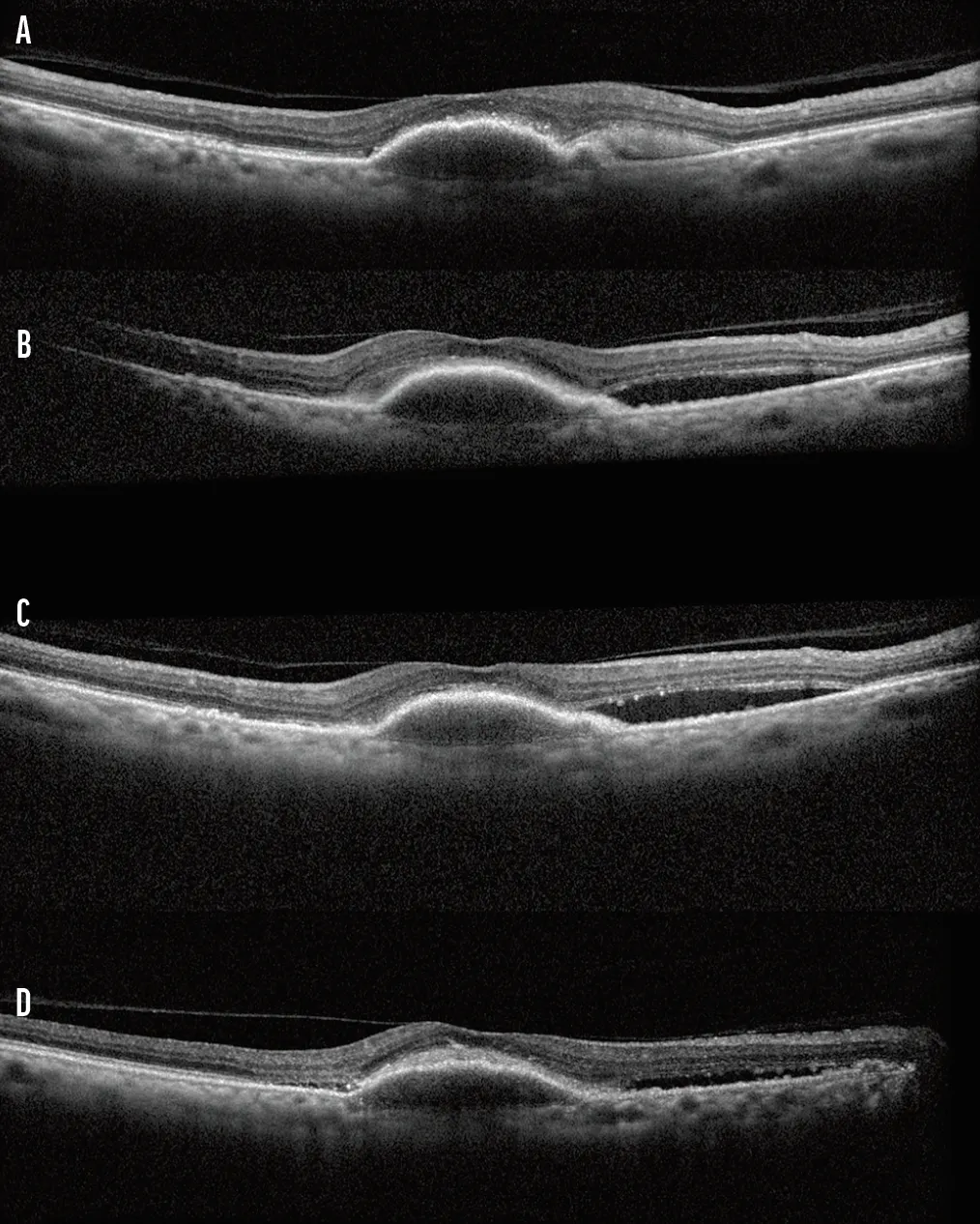
Figure 1. Sequential OCT images of the right eye in a patient with wet AMD illustrate the disease course under step therapy: baseline imaging prior to initiation of bevacizumab with subretinal hemorrhage (A); persistent/worsening fluid after 4 months of continued bevacizumab (B); no improvement 3 months later (C); improvement in subretinal fluid 6 months after transitioning to aflibercept (D). BCVA remained 20/100 throughout.
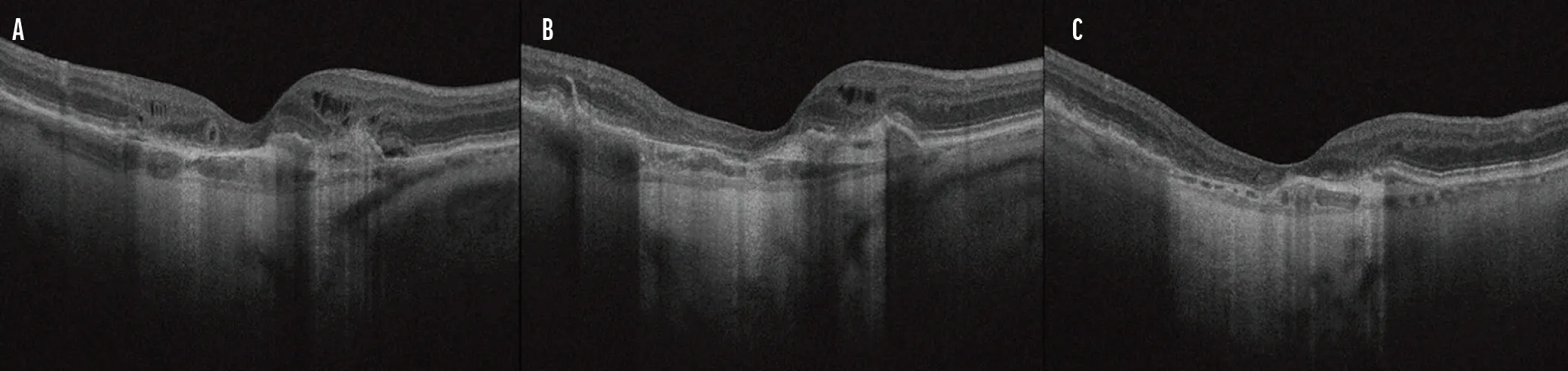
Figure 2. OCT images of the left eye in a patient with wet AMD after loss of response to long-term bevacizumab given every 10 weeks (A). Aflibercept was subsequently denied by the patient’s insurance. Exudation remained stable on bevacizumab given every 6 weeks (B). Once step therapy was completed and aflibercept was approved, exudation was persistently resolved at 10 weeks after the second dose (C). VA remained stable at 20/40.
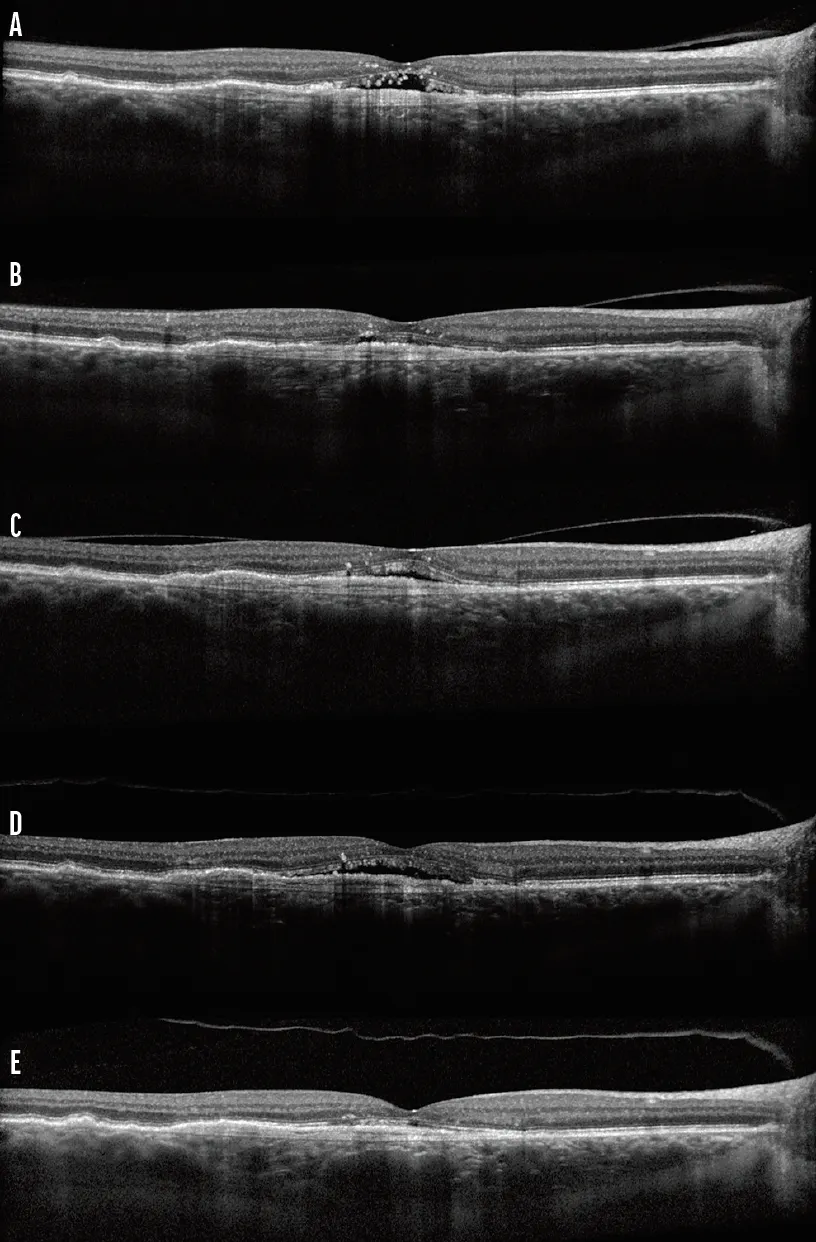
Figure 3. OCT images of the left eye in a patient with wet AMD after loss of response to long-term bevacizumab given every 10 weeks (A). Aflibercept was subsequently denied by the patient’s insurance. Exudation remained stable on bevacizumab given every 6 weeks (B). Once step therapy was completed and aflibercept was approved, exudation was persistently resolved at 10 weeks after the second dose (C). VA remained stable at 20/40.
We reviewed the developments in this space between 2019 and 2024, beginning with the CMS policy change that permitted step therapy for Medicare Advantage Part B drugs. We included US-based policy articles, clinical studies directly related to ophthalmology, and advocacy statements from the AAO and the American Society of Retina Specialists (ASRS).
Here, we highlight our findings, including the clinical outcomes, safety concerns, and evolving practice patterns that have emerged under step therapy, as well as potential next steps from an advocacy standpoint.
SAFETY CONSIDERATIONS AND PRACTICE PATTERNS
Step therapy introduces several safety risks that extend beyond administrative burden and can have direct implications for patient outcomes. For example, a 2024 multicenter study found that nearly 60% of prior authorization requests for anti-VEGF therapy led to treatment delays, despite a 96% eventual approval rate.1 These delays required a median of 100 minutes of staff time per request and, more importantly, postponed time-sensitive treatment of conditions, such as wet AMD and DME, for which even short interruptions can result in irreversible vision loss.1 Furthermore, in busy retina practices, this additional administrative burden diverts resources away from direct patient care.
In addition, with rigid fail-first protocols, patients are often required to receive three monthly bevacizumab injections before a switch can be approved. Because injections cannot be given more frequently than every 4 weeks, clinicians face an inflexible treatment window. To complicate matters further, some payers have mandated that if any of the three monthly payer-preferred drug injections fall outside a 4- to 6-week window, the process must be restarted. In progressive diseases with potentially severe sequelae such as macular subretinal hemorrhage in wet AMD, waiting periods can be harmful, leaving patients at risk of irreversible vision loss.
Reliance on compounded bevacizumab also exposes patients to supply chain instability. The AAO and ASRS highlighted this risk as early as 2021 when outsourcing facilities faced sterility and regulatory issues, and the problem intensified in 2024 with the discontinuation of bevacizumab production from Optum Specialty Pharmacy, the facility responsible for 45% of bevacizumab repackaging in the United States.2,3
These disruptions underscored the fragility of a system dependent on a single, repackaged first-line drug, particularly when policy requires its use before alternatives can be offered. At the peak of those supply chain issues, many patients were unable to receive treatment due to the payer step therapy requirement for bevacizumab first, which was often unavailable.
Together, these issues demonstrate that step therapy not only increases administrative burden but also introduces structural vulnerabilities into care delivery. By limiting flexibility, delaying access, and depending on a fragile supply chain, step therapy protocols create risks that compromise both patient safety and practice efficiency.
CLINICAL OUTCOMES
Numerous comparative studies have been conducted since newer generation anti-VEGF agents have arrived on the market, highlighting how initial agent selection and treatment delays can affect outcomes.
The DRCR Retina Network Protocol T compared outcomes of aflibercept, bevacizumab, and ranibizumab in DME treatment and showed similar visual outcomes in patients with mild baseline vision loss at 2 years; however, treatment with aflibercept led to improved resolution of edema compared with bevacizumab at 1 and 2 years for patients with lower presenting visual acuity (20/50 to 20/320). Additionally, laser photocoagulation was less frequently required in the aflibercept group.4 These findings suggest that a bevacizumab-first approach may disadvantage certain patients with more advanced disease.
Another randomized controlled trial directly compared bevacizumab-first therapy with aflibercept monotherapy. Although 2-year visual outcomes were similar, nearly 70% of patients in the step therapy group required switching to aflibercept to achieve comparable outcomes, and they underwent more injections overall.5 This demonstrates that noninferior vision can come at the cost of a greater treatment burden, and a potential gap between what is acceptable from a payer perspective and what is practical clinically.
Cao et al compared aflibercept and bevacizumab in wet AMD using a treat-extend-pause/monitor approach. Patients who received aflibercept injections were more often weaned off therapy at 1 year (43% vs 15%), required fewer injections, and achieved longer treatment intervals. Visual acuity was similar, but aflibercept showed less vision loss and better fluid resolution on OCT, supporting its role in reducing treatment burden and maintaining more consistent disease control.6 For patients and providers, these differences translate into fewer visits, lower treatment fatigue, and greater disease stability over time.
Li et al also found that faricimab-svoa demonstrated noninferiority in achieving improved central subfoveal thickness compared with other anti-VEGF therapies at extended dosing intervals.7 This may ultimately reduce payer costs when considering the number of injections received in a year per patient.
Thus, while step therapy may not always compromise long-term visual acuity, it often increases treatment burden, prolongs therapy, and risks undertreatment in patients with severe disease.
ADVOCACY RESPONSES
Advocacy efforts in ophthalmology have highlighted both the persistence of step therapy and the challenges of influencing federal and state policy. In 2018, more than 200 organizations, including the AAO, warned that fail-first protocols would delay care and jeopardize outcomes.8,9 The AAO later supported the Improving Seniors’ Timely Access to Care Act to curb prior authorization and step therapy requirements in Medicare Advantage plans.10
Despite the push to streamline prior authorization and reduce barriers to care, these measures have produced only incremental change.
Advocacy has led to small regulatory adjustments to existing step-therapy policies. In November 2021, CMS issued new guidance prohibiting Medicare Advantage plans from mandating the use of bevacizumab-bvzr (Zirabev, Pfizer) or bevacizumab-awwb (Mvasi, Amgen)—biosimilars not FDA-approved for ophthalmic use—as substitutes for repackaged bevacizumab. However, CMS maintained that FDA-approved biosimilars could be used in step therapy programs. While this acknowledged the safety concerns raised by the AAO and ASRS, it stopped short of addressing the broader risks inherent in bevacizumab-first policies, such as cost-centricity and minimal long-term safety data on biosimilars.11,12
The ASRS and AAO directed advocacy efforts when clinical care was disrupted by bevacizumab supply shortages. Their 2024 petition followed the discontinuation of Optum Specialty Pharmacy’s bevacizumab production and underscored how policies mandating a single, repackaged drug could leave patients without timely treatment, particularly if step therapy is required.3 Despite these advocacy efforts, CMS policies remained unchanged.
Overall, advocacy has raised awareness and achieved modest safeguards, but the lack of decisive federal action continues to leave patients vulnerable. Without stronger policy alignment, reliance on state-level reforms and piecemeal adjustments may perpetuate fragmented access to sight-saving therapy.
WHAT YOU CAN DO
Despite years of coordinated advocacy efforts in ophthalmology, policy inertia at the federal level has left clinicians and patients navigating treatment algorithms that may not reflect current clinical standards, or account for patient-specific risk.
Although some randomized and real-world data show that step therapy can result in comparable long-term outcomes for select patients, these findings must be contextualized against the practical burdens of care delays, administrative requirements, and rigid scheduling restrictions. In the clinic, requiring clinicians to rely on first-generation anti-VEGF agents leaves many populations (including seniors) vulnerable to compliance issues and loss-to-follow-up.
To ensure equitable access and optimal clinical outcomes, future policies must be guided by clinical nuance, real-world outcomes, and collaborative dialogue between providers, payers, and policymakers. Continued advocacy, combined with transparent data collection and evidence-based reform, will be essential to aligning step therapy with the principles of patient-centered care.
1. Dang S, Parke DW III, Sodhi GS, et al. Anti-VEGF pharmaceutical prior authorization in retina practices. JAMA Ophthalmol. 2024;142(8):716-721.
2. Awh C. Letter to Aetna regarding repackaged Avastin supply and step therapy policy. American Society of Retina Specialists; AAO. June 14, 2021. Accessed March 26, 2026. info.mmitnetwork.com/hubfs/Letter%20to%20Aetna%20regarding%20repackaged%20Avastin%20supply-1.pdf
3. American Society of Retina Specialists. ASRS, AAO meet with CMS to seek suspension of avastin-first step therapy. Published November 12, 2024. Accessed April 19, 2025. www.asrs.org/advocacy/updates/10395/asrs-aao-meet-with-cms-to-seek-suspension-of-avastin-first-step-therapy
4. Wells JA, Glassman AR, Ayala AR, et al; Diabetic Retinopathy Clinical Research Network. Aflibercept, bevacizumab, or ranibizumab for diabetic macular edema: two-year results from a comparative effectiveness randomized clinical trial. Ophthalmology. 2016;123(6):1351-1359.
5. Jhaveri CD, Glassman AR, Ferris FL III, et al. Aflibercept monotherapy versus bevacizumab-first for diabetic macular edema. N Engl J Med. 2022;387(8):692-703.
6. Cao X, Castillo Sanchez J, Patel TP, et al. Aflibercept more effectively weans patients with neovascular age-related macular degeneration off therapy compared with bevacizumab. J Clin Invest. 2023;133(2):e159125.
7. Li G, Zhu N, Ji A. Comparative efficacy and safety of Faricimab and other anti-VEGF therapy for age-related macular degeneration and diabetic macular edema: A systematic review and meta-analysis of randomized clinical trials. Medicine (Baltimore). 2023;102(50):e36370.
8. Alliance for Patient Access; American Academy of Ophthalmology; American College of Rheumatology; et al. Letter to congressional leadership opposing CMS guidance on Medicare Advantage step therapy. September 12, 2018. Accessed April 18, 2025. aafa.org/wp-content/uploads/2022/08/aafa-sign-on-letter-opposing-medicare-advantage-step-therapy-for-drug-coverage.pdf
9. AAO. New step therapy policy threatens Medicare Advantage patients’ timely access to sight-saving treatments. Issue Brief. April 2019. Accessed December 29, 2025. www.aao.org/Assets/49750d8e-32d5-4c7b-8672-95e2ac98a54b/636892252135170000/step-therapy-issue-brief-2019-final-pdf?inline=1
10. AAO. The American Academy of Ophthalmology commends Congress for reaching significant milestone on prior authorization reform bill. News Releases. May 12, 2022. Accessed December 29, 2025. www.aao.org/newsroom/news-releases/detail/academy-commends-congress-on-reform-bill
11. Mott M. Step therapy: clinicians’ concerns and challenges; D.C. fighting to reverse step therapy. EyeNet Mag. April 2022:26-28.
12. Aljuhani HS, Hubayni RA, Qedair J, et al. Efficacy and safety of aflibercept biosimilars relative to reference aflibercept therapy for neovascular age-related macular degeneration: a systematic review and meta-analysis. Clin Ophthalmol. 2025;19:1911-1918.