KEY TAKEAWAYS
- Drug-drug interactions (DDIs) can result in subtherapeutic exposure, leading to treatment failure and increased risk of autoimmune flare-up, and/or dangerously high drug levels in the patient’s serum, leading to toxicity.
- Managing patients on immunosuppressive therapy requires careful consideration of DDIs, particularly those mediated by CYP3A4 isoenzyme and P-glycoprotein.
- Retina specialists should routinely monitor serum drug levels whenever possible and thoroughly understand the patient’s OTC drug usage, herbal remedies, and dietary habits, in addition to their prescribed medications.
Immunosuppressive agents are indispensable in treating autoimmune diseases, and their use is part of the daily routine for every uveitis specialist. However, their narrow therapeutic index and intricate metabolic pathways render them highly susceptible to drug-drug interactions (DDIs).1 These interactions can result in subtherapeutic exposure, leading to treatment failure and increased risk of autoimmune flare-up, or dangerously high drug levels in the patient’s serum, leading to toxicity (eg, nephrotoxicity, hepatotoxicity, neurotoxicity).
DDIs can affect the pharmacokinetics, absorption, distribution, metabolism, elimination, and pharmacodynamics (ie, biological effects) of immunosuppressive agents. These effects are often mediated because multiple drugs have similar metabolic pathways, most commonly through the cytochrome P450 (CYP450) enzyme system, particularly the CYP3A4 isoenzyme, and drug transporters, such as P-glycoprotein (P-gp). Certain pharmacologic agents are CYP3A4 inducers, meaning they increase the activity of the CYP3A4 enzyme, while others are CYP3A4 inhibitors, which slow down or prevent the activity of the CYP3A4 enzyme.
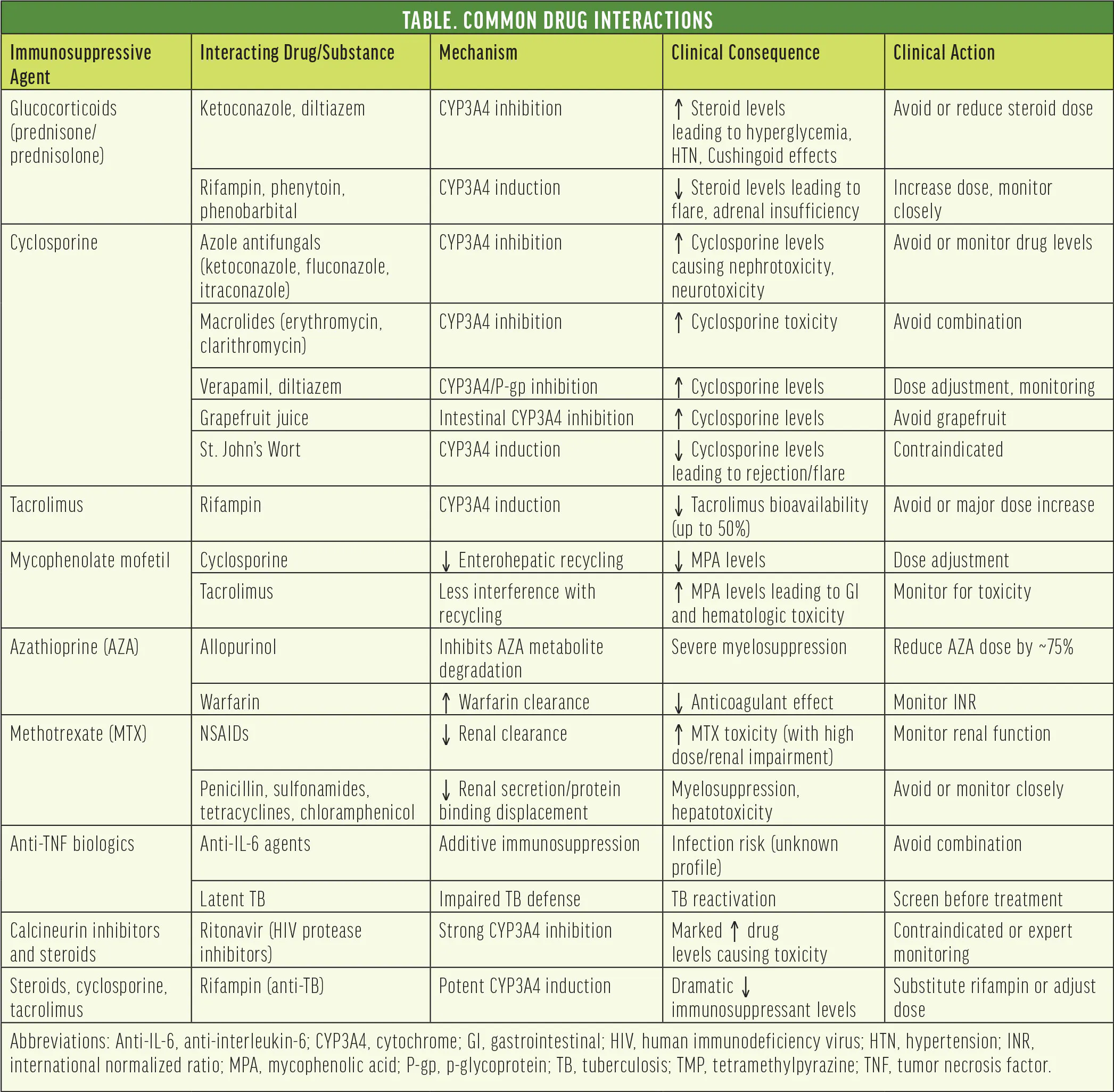
The toxic relationship between immunosuppressants and various coadministered medications necessitates a careful, informed approach. This article reviews several major categories of immunosuppressive agents, their metabolic pathways, and clinically significant DDIs to avoid (Table).
IMMUNOSUPPRESSIVE AGENTS
Glucocorticoids
As a first-choice agent to treat severe intraocular inflammation, glucocorticoids are metabolized via the CYP3A4 enzyme. Prednisone, a pro-drug, requires conversion to prednisolone after oral administration to become active. This conversion and subsequent metabolism involve CYP3A4 enzymes. As such, inhibitors of CYP3A4, such as ketoconazole and diltiazem, can increase glucocorticoid serum levels, heightening the risk of adverse effects such as hyperglycemia, hypertension, and immunosuppression.
Conversely, inducers of CYP3A4, such as rifampin, phenytoin, and phenobarbital, can reduce glucocorticoid efficacy by accelerating metabolism, potentially leading to disease relapse or adrenal insufficiency.
Cyclosporine
Cyclosporine is extensively metabolized by CYP3A4 in both the intestinal wall and liver and is a substrate for P-gp. Drugs that inhibit CYP3A4 or P-gp can increase cyclosporine serum levels, potentially leading to nephrotoxicity, hepatotoxicity, or neurotoxicity. Drugs that inhibit CYP3A4 include azole antifungals (eg, ketoconazole, fluconazole, itraconazole), macrolide antibiotics (eg, erythromycin, clarithromycin), and calcium channel blockers (eg, verapamil, diltiazem).
In addition, certain dietary habits can affect cyclosporine serum levels, such as drinking grapefruit juice. It has been shown that grapefruit juice inhibits the metabolism of cyclosporine briefly after consumption via the inhibition of CYP450 enzymes, mainly in the gut wall.2 St. John’s Wort, a popular herbal supplement, induces CYP3A4 and has been associated with reduced cyclosporine levels in the literature.3
Tacrolimus
Tacrolimus is also metabolized by CYP3A4 enzymes. Coadministration with rifampin has been shown to significantly increase its clearance and reduce oral bioavailability by up to 50%, requiring close therapeutic monitoring or dose adjustments (Figure).
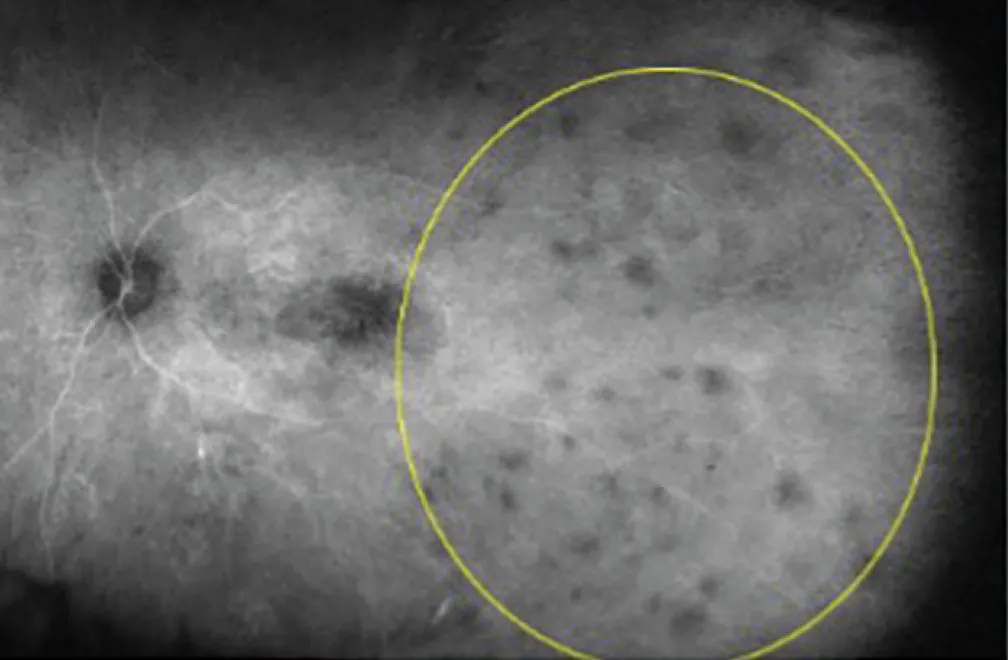
Figure. This image of a 17-year-old patient diagnosed with TB-related choroiditis and treated with rifampin and tacrolimus shows activity of the choroiditis (hypofluorescent dark dots on ICG angiography in the yellow circle) due to increased clearance of tacrolimus by rifampin.
Mycophenolate Mofetil
Mycophenolate mofetil is hydrolyzed to mycophenolic acid (MPA), its active form, which is metabolized primarily via glucuronidation. MPA levels are influenced by the coadministered calcineurin inhibitor: Combining mycophenolate mofetil with tacrolimus yields higher MPA levels than those with cyclosporine, likely due to differences in enterohepatic recycling interference. This interaction highlights the importance of selecting compatible immunosuppressive regimens and adjusting doses accordingly,1,4 as higher levels of MPA in the serum increase the risk of side effects.
Azathioprine
Azathioprine (AZA) is metabolized by thiopurine methyltransferase (TPMT) and inhibits the proliferation of T and B lymphocytes via DNA/RNA synthesis inhibition. There are genetic polymorphisms that could affect this enzyme’s activity and are correlated with variations in sensitivity and toxicity to drugs metabolized by TPMT, including AZA. Approximately one in 300 individuals will be deficient for the enzyme, so its activity should be tested before AZA administration.5
Drug interactions that affect AZA metabolism can lead to serious hematologic toxicities; for example, allopurinol significantly increases AZA toxicity by inhibiting the degradation of its active metabolites. AZA dose should be reduced by 75% when used concurrently. On the other hand, AZA may increase the clearance of warfarin, thus reducing its anticoagulant effect and necessitating careful monitoring.1
Methotrexate
Methotrexate (MTX) has a complex interaction profile. It competes for renal tubular secretion and protein-binding sites with multiple drugs, potentially increasing toxicity. Common NSAIDs, for example, can decrease renal clearance of MTX, although routine use typically does not cause clinical toxicity unless renal function is compromised or a high dose of MTX is used. Certain antibiotics (eg, penicillin), sulphonamides (eg, trimethoprim), tetracyclines, and chloramphenicol agents can increase free MTX levels, thus risking myelosuppression and hepatotoxicity.6,7
BIOLOGICS
Biological immunosuppressants exhibit fewer known pharmacokinetic interactions.8 However, caution is advised when combining agents with overlapping immunosuppressive effects. Rituximab, anti-interleukin (IL)-1, and anti-IL-6 agents currently have no well-documented drug interactions, but anti-tumor necrosis factor alpha agents should not be combined with anti-IL-6 due to potential additive immunosuppressive effects and unknown risk profiles. Anti-tumor necrosis factor alpha agents impair defenses against tuberculosis (TB) which can be fatal; thus, TB activity should be investigated before administration.
ANTIRETROVIRAL AND ANTI-TUBERCULOSIS AGENTS
Protease inhibitors used in the treatment of human immunodeficiency virus, such as ritonavir, are strong CYP3A inhibitors and can substantially increase systemic concentrations of corticosteroids and calcineurin inhibitors, increasing the risk of toxicity.9
Certain rare intraocular inflammatory conditions, such as TB-related serpiginous-like choroiditis, require concomitant anti-TB treatment and immunosuppression to halt progression.10 However, treatment with rifampin, a potent CYP3A4 inducer, can dramatically lower the plasma levels of prednisone, tacrolimus, and cyclosporine and increase the hepatic metabolism of these drugs, necessitating either substitution of rifampin or major dose adjustments with close monitoring.1,8
DON’T BREAK ONE THING TO FIX ANOTHER
Managing patients with retinal disease who are on immunosuppressive therapy requires careful consideration of DDIs, particularly those mediated by CYP3A4 and P-gp. Retina specialists should routinely monitor serum drug levels whenever possible and thoroughly understand the patient’s OTC drug usage, herbal remedies, and dietary habits (eg, eating grapefruit). Medication reconciliation during each clinical visit is critical. Whenever possible, consult with pharmacists or clinical pharmacologists for complex regimens to prevent DDIs.
1. Warrington JS, Shaw LM. Pharmacogenetic differences and drug-drug interactions in immunosuppressive therapy. Expert Opin Drug Metab Toxicol. 2005;1(3):487-503.
2. Hollander AA, van Rooij J, Lentjes GW, et al. The effect of grapefruit juice on cyclosporine and prednisone metabolism in transplant patients. Clin Pharmacol Ther. 1995;57(3):318-324.
3. Barone GW, Gurley BJ, Ketel BL, Lightfoot ML, Abul-Ezz SR. Drug interaction between St. John’s wort and cyclosporine. Ann Pharmacother. 2000;34(9):1013-1016.
4. Seifeldin R. Drug interactions in transplantation. Clin Ther. 1995;17(6):1043-1061.
5. Dean L. Azathioprine therapy and TPMT and NUDT15 genotype. September 20, 2012 [updated August 5, 2020]. In: Pratt VM, Scott SA, Pirmohamed M, Esquivel B, Kattman BL, Malheiro AJ, ed. Medical Genetics Summaries [Internet]. Bethesda (MD): National Center for Biotechnology Information (US); 2012.
6. Nozaki Y, Kusuhara H, Endou H, Sugiyama Y. Quantitative evaluation of the drug-drug interactions between methotrexate and nonsteroidal anti-inflammatory drugs in the renal uptake process based on the contribution of organic anion transporters and reduced folate carrier. J Pharmacol Exp Ther. 2004;309(1):226-234.
7. Levêque D, Santucci R, Gourieux B, Herbrecht R. Pharmacokinetic drug-drug interactions with methotrexate in oncology. Expert Rev Clin Pharmacol. 2011;4(6):743-750.
8. Armanious M, Vender R. A review of drug-drug interactions for biologic drugs used in the treatment of psoriasis. J Cutan Med Surg. 2021;25(1):38-44.
9. Izzedine H, Launay-Vacher V, Baumelou A, Deray G. Antiretroviral and immunosuppressive drug-drug interactions: an update. Kidney Int. 2004;66(2):532-541.
10. Papasavvas I, Jeannin B, Herbort CP Jr. Tuberculosis-related serpiginous choroiditis: aggressive therapy with dual concomitant combination of multiple anti-tubercular and multiple immunosuppressive agents is needed to halt the progression of the disease. J Ophthalmic Inflamm Infect. 2022;12(1):7.