KEY TAKEAWAYS
- The 54th annual Aspen Retinal Detachment Society meeting included two talks by Tara A. McCannel, MD, PhD, providing comprehensive framework for managing uveal melanoma.
- Prognostic biopsy, while useful, is only one factor that can influence surveillance frequency.
- When counseling patients with a new cancer diagnosis, use precise language, favoring “vision change” over “vision loss,” and remember that a patient’s mindset is learned and can be intentionally revised.

The 54th annual Aspen Retinal Detachment Society meeting, held February 28 – March 4, 2026, in Snowmass Village, Colorado, was a feat of education with lectures on everything from surgical delivery of gene therapy and AI to diagnosing uveitis and surgical approaches to schisis detachments. This year, Tara A. McCannel, MD, PhD, delivered two lectures that offered a comprehensive framework for managing uveal melanoma: one grounded in the molecular science of risk stratification, the other in the psychology behind the diagnosis (Figure).
PROGNOSTIC BIOPSY IN UVEAL MELANOMA
Dr. McCannel opened with a case of a 56-year-old man with choroidal melanoma whose cytogenetic biopsy results—monosomy 3, chromosome 1p loss, and 6p gain—suggested an approximately 50% 5-year metastatic mortality risk. Twenty years later, the patient is alive and metastasis-free. The case served as a reminder that probabilistic data cannot predict individual outcomes.
ABOUT THE SPEAKER

Tara A. McCannel, MD, PhD
• Director, Ophthalmic Oncology Center, University of California, Los Angeles Stein Eye Institute of the David Geffen School of Medicine, Los Angeles
• Financial disclosure: Co-Founder (Seyhart Wellness)
She traced the origins of prognostic biopsy to a 1990 paper by Valerie White, MD, which first linked monosomy 3 to metastatic death.1 Dr. McCannel began performing prognostic biopsy routinely and presented her early experience at the Retina Society in 2005, where she encountered significant opposition. The field has since shifted substantially with a growing body of literature published in the past 2 decades.
Limitations and Risks
Dr. McCannel devoted substantial attention to the limitations of prognostic biopsy. Tumor heterogeneity, sampling error, and inter-platform discordance all compromise accuracy. A 2015 study by the Augsburger group found that 16% of patients biopsied at two separate tumor sites received discordant gene expression profile results.2 Her group also documented that 20% of Class 1A patients harbored monosomy 3 by molecular testing, and that choroidal metastases from systemic primaries can return Class 1 or Class 2 results—underscoring that gene expression profiles cannot substitute for clinical and pathologic diagnosis.
She raised concern about using biopsy results to determine whether to treat a lesion. With the number of practicing ocular oncologists increasing, many are seeing fewer new melanomas. Dr. McCannel disagreed with the practice of deferring treatment of growing lesions pending a Class 2 result and performing multiple repeat biopsies for triaging purposes, arguing this contributes to larger tumors, higher radiation doses, greater vision loss, and higher mortality.
When counseling patients, she deliberately downplays the biopsy result, framing it as one factor that may influence surveillance frequency rather than a definitive verdict. She avoids quoting survival percentages and emphasizes that outcomes are multifactorial. For example, a 2020 analysis demonstrated that marital status is an independent prognostic variable in uveal melanoma, underscoring how much remains unexplained by tumor biology alone.3
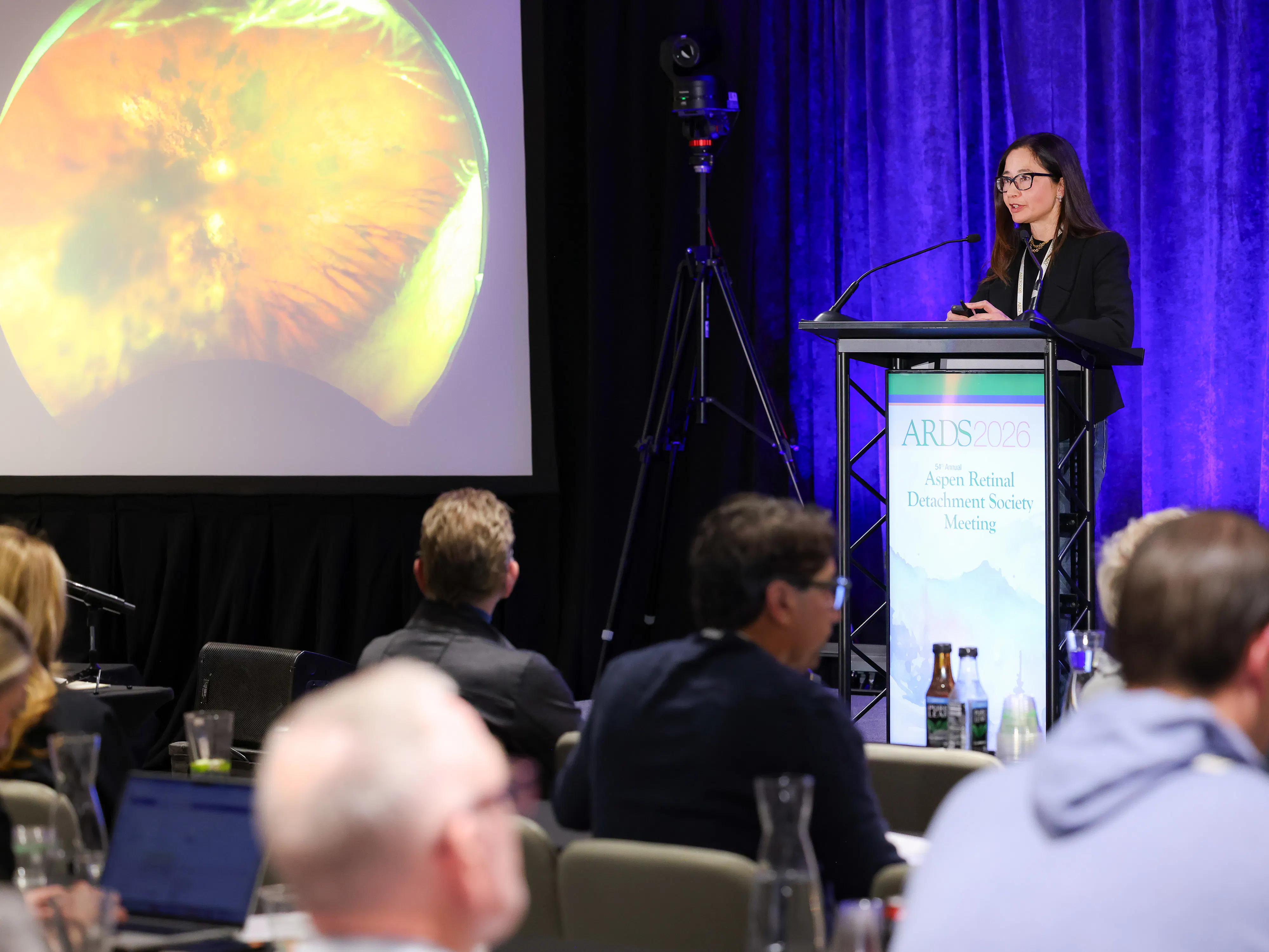
Figure. Dr. McCannel tackled the humanistic aspects of ocular oncology, including the implications of a prognostic biopsy and the patient’s mindset during the cancer journey. Image courtesy of Kevin Caldwell Photography.
REFRAMING MINDSETS IN OCULAR CANCER AND VISION LOSS
Dr. McCannel’s second lecture addressed the psychological dimensions of uveal melanoma care. Using the case of a 48-year-old woman presenting with photopsias and decreased vision, she catalogued the catastrophic thoughts that typically accompany a cancer diagnosis: fear of financial and functional loss, anticipatory dread of the future, and hypervigilance to new systemic symptoms, to name a few. She noted that referring physicians, often themselves distressed, may inadvertently amplify these fears through language emphasizing blindness, organ loss, and therapeutic futility.
She grounded these observations in published data. A 2016 survey study found that nearly half of more than 2,000 respondents considered vision loss the worst possible health outcome.4 A 2024 JAMA meta-analysis of more than five million patients found that visual impairment is associated with significantly elevated rates of suicidal ideation.5 Her central arguments were: 1) It is not visual impairment itself that causes harm, but the fear surrounding it, and 2) That mindset is modifiable.
The Science of Mindset
Dr. McCannel drew on three bodies of research to support a mindset-based approach to patient care. Carol Dweck’s work on growth versus fixed mindset demonstrated that children who view challenges as learning opportunities perform better and recover more readily from setbacks than those who view ability as fixed.6 Crum et al demonstrated that beliefs produce concrete physiologic changes: Hotel workers who were told their daily tasks constituted meaningful exercise showed measurable reductions in weight and blood pressure within 4 weeks.7 In a second study, subjects who believed they were consuming a high-calorie shake suppressed the hunger hormone more than those told the identical shake was low-calorie.8
A 2023 randomized trial by Zeidman et al evaluated a seven-module mindset intervention in newly diagnosed nonmetastatic cancer patients and found significantly improved quality of life, coping, and engagement in the intervention group.9 Dr. McCannel described a parallel pilot study at her own institution using mindset-oriented video education for uveal melanoma patients.
SAVE THE DATE:
55th Annual Aspen Retinal Detachment Society Meeting
February 27 – March 3, 2027, Snowmass, CO
Clinical Translation
Dr. McCannel advocated for precise language, favoring “vision change” over “vision loss,” the latter of which carries an implicit finality that can undermine resilience. She described vision as a binocular, brain-mediated experience rather than a Snellen acuity, and reassures patients that the brain adapts with remarkable fidelity to altered visual input. She cautioned against allowing OCT findings to define a patient’s visual identity, noting that the macula represents only a fraction of the retina and functional sight. She called for clinicians to perform a personal mindset inventory before attempting to shift their patients’, noting that mindsets are learned and can be intentionally revised.
Discussion centered on the clinician’s informal role as therapist, the importance of teaching empathy alongside technical skill, and the risks of peer support communities that overrepresent poor outcomes. Dr. McCannel encouraged pausing during clinic to model humanistic pearls to trainees.
Course Director Timothy G. Murray, MD, MBA, closed with a reflection that a fellow’s tears at a melanoma diagnosis moved the patient more than any clinical counsel, a reminder that our humanity is core to our work as physicians.
1. Horsman DE, Sroka H, Rootman J, White VA. Monosomy 3 and isochromosome 8q in a uveal melanoma. Cancer Genet Cytogenet. 1990;45(2):249-253.
2. Augsburger JJ, Corrêa ZM, Augsburger BD. Frequency and implications of discordant gene expression profile class in posterior uveal melanomas sampled by fine needle aspiration biopsy. Am J Ophthalmol. 2015;159(2):248-256.
3. Cai W, Fan J, Shen T, Yu J. The Influence of Marital Status on the Survival of Patients with Uveal Melanoma. J Ophthalmol. 2020;2020:7012940.
4. Scott AW, Bressler NM, Ffolkes S, Wittenborn JS, Jorkasky J. Public attitudes about eye and vision health. JAMA Ophthalmol. 2016;134(10):1111-1118.
5. Kim CY, Ha A, Shim SR, Hong IH, Chang IB, Kim YK. Visual impairment and suicide risk: a systematic review and meta-analysis. JAMA Netw Open. 2024;7(4):e247026.
6. Dweck CS. Mindset: The New Psychology of Success. Random House; 2007.
7. Crum AJ, Langer EJ. Mind-set matters: exercise and the placebo effect. Psychol Sci. 2007;18(2):165-167.
8. Crum AJ, Corbin WR, Brownell KD, Salovey P. Mind over milkshakes: mindsets, not just nutrients, determine ghrelin response. Health Psychol. 2011;30(4):424-431.
9. Zion SR, Schapira L, Berek JS, Spiegel D, Dweck CS, Crum AJ. Changing cancer mindsets: A randomized controlled feasibility and efficacy trial. Psychooncology. 2023;32(9):1433-1442.