



KEY TAKEAWAYS
- There will always be a push to find new revenue streams, but it may behoove you to also ensure that your current revenue streams are performing their best.
- To confirm that your internal processes are functioning as intended, it is important to review written procedures and determine whether they are being followed.
- Coding errors stemming from outdated references, missed modifiers, or misapplied guidelines could cause denials or audit failures.
As the year winds down, many retina specialists are anticipating another round of reimbursement cuts from payers. Practices face the continual challenge of having to do more with less while trying to remain profitable. There will always be a push to find new revenue streams, but it may behoove you to also ensure that your current revenue streams are performing their best. Taking a close look for both human and process errors could improve your bottom line.
Start with a broad look at your revenue cycle process. Remember, everyone in the practice is involved, not just your billing and coding staff. From patient intake to back-end claims, there are many areas to investigate for process improvement opportunities (Figure).
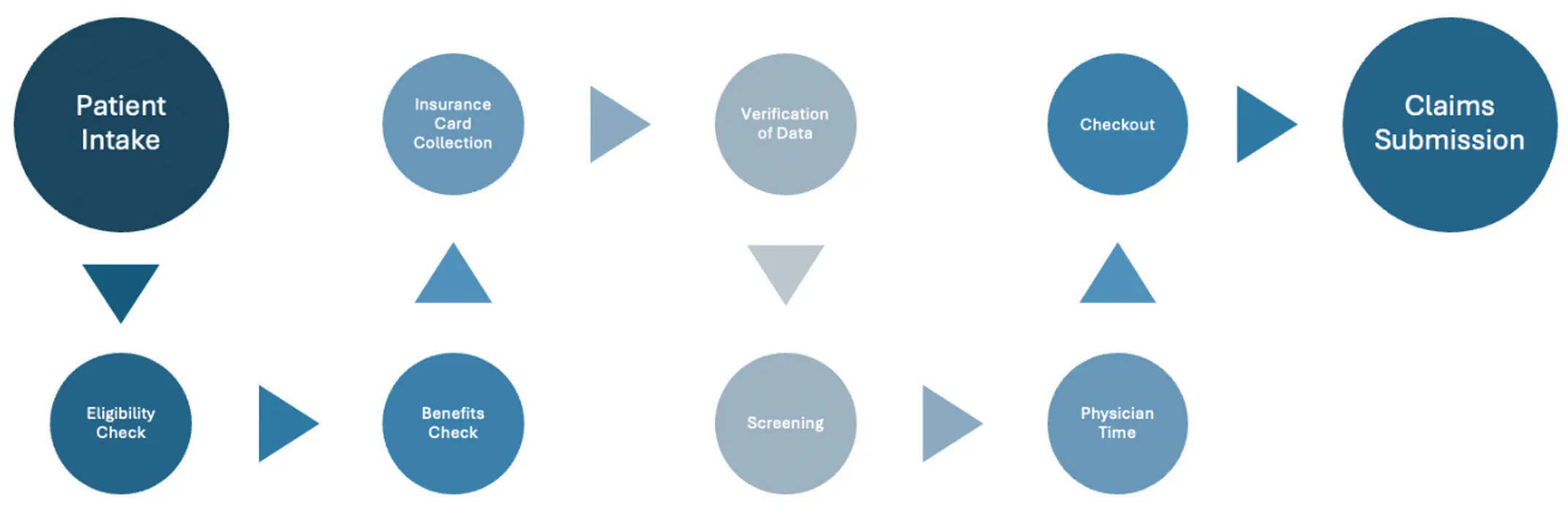
Figure. Explore your full revenue cycle process to ensure continuity and look for areas that need improvement.
REVIEW INTERNAL PROCESSES
To confirm that your internal processes are functioning as intended, it is important to review written procedures and determine whether they are being followed. These may include patient intake, insurance card collection, technician screening, or billing and coding. In addition, even if they are being followed as written, it is possible that the procedures in place are no longer serving their original intent and, thus, causing process issues.
A good starting point would be to a review your historical write-offs and claim denials. Recurring patterns in these areas often reveal where a process is quietly failing—a step that is being skipped, a change in a payer’s rule that is not reflected, or a particular workflow that no longer aligns with how the practice operates. Following these trends back to their sources will often point you toward the processes most in need of attention.
If there is an internal process to write off bundled denials without a coding review, you may be leaving reimbursement on the table. For example, at one point payers were inappropriately denying examination services when billed with diagnostic testing. Any claim that included a retina OCT, CPT 92134, was receiving a denial for the examination, stating it was bundled with the special ophthalmic services. Identifying a payer issue such as this one early would enable prompt action, consistent internal tracking, and faster reimbursement once resolved.
IDENTIFY WEAK POINTS
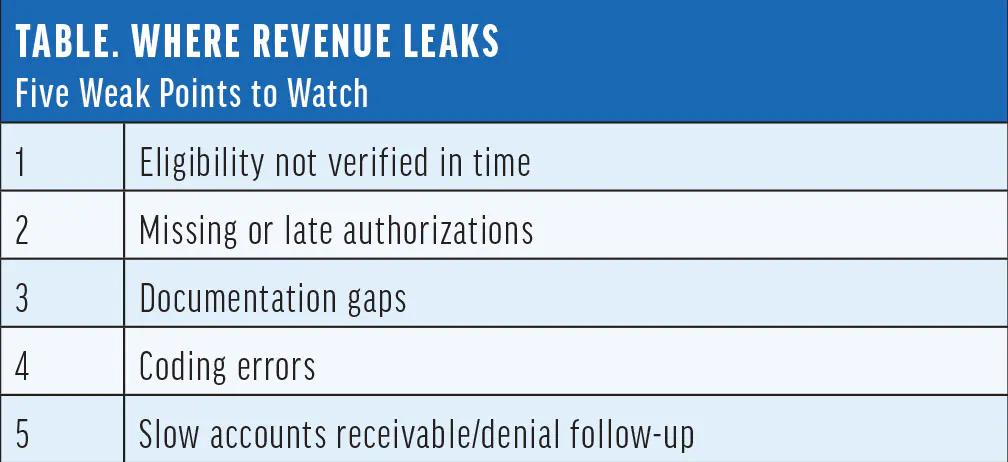
Once you understand how your processes flow, look closely at the points where revenue tends to leak (Table). A common example of a weak point is eligibility checks that are not run in a timely manner, which leave claims exposed to preventable denials due to change or termination of insurance. Authorizations obtained too late or missed entirely for the services that require them could leave a practice responsible for high drug costs if not reimbursed.
Other examples include documentation gaps for screenings or physician time that prevents billing a higher-level Evaluation and Management or Eye code the encounter would otherwise support. For example, if a physician is deciding whether to bill CPT 99213 or CPT 92014, but confrontational visual field testing or motility was not performed as required for a comprehensive examination, the only option left may be the one that reimburses less.
Confirm your team is using the most updated resources. Coding errors stemming from outdated references, missed modifiers, or misapplied guidelines could cause denials or audit failures. A common retina claim error is a claim denial for unit of measure. Billing for intravitreal anti-VEGF drugs, for example, often requires an “ML” unit of measure in box 24a of the claim, reported as a liquid medication measuring the volume in mL. Often, something as simple as a default system setting that incorrectly populates “ME” for milligram can cause a denial for N816 (“Missing/Incomplete/Invalid NDC Unit of Measure”). This small systems error can lead to significant recoupments or future denials.
Lastly, denial work that is queued too slowly, allowing claims to age past timely filing and appeal deadlines, may lead to lost revenue that cannot be recovered.
MAKE IT A HABIT
Process improvement should not be a one-time project. Invite the end users to participate in improvement activities, as those doing the work every day often spot the breakdowns first and come up with the most practical fixes. Foster a culture that always looks to do better and consider taking advantage of new tools such as AI automation to assist in flagging eligibility gaps, coding patterns, and prioritizing denials for follow-up.
FINAL TIPS FOR SUCCESS
A revenue cycle audit is only as valuable as the changes it drives. Keep these principles in mind as you turn your findings into results:
- Clarify priorities—address the denials and write-offs costing you the most in lost revenue before chasing smaller issues.
- Assign clear ownership for each fix, with a deadline and quantitative measure of success.
- Document your updated processes and train each team member in the practice, not just the billing and coding staff.
- Track key metrics, such as clean claim rate, denial rate, and days in accounts receivable on a regular basis, not just at year-end.
- Make the review a recurring habit so small problems get caught before they compound.
A healthy revenue cycle is not the result of a single fix, but rather the payoff of steady attention.
AI disclosure: Claude Sonnet 5 (Anthropic) was used to review grammar and check for spelling. Content was otherwise created, reviewed, and approved by the author.


