


KEY TAKEAWAYS
- When evaluating a partnership-track offer, look beyond the starting salary. Understand how compensation and ownership are structured, who makes financial decisions, and whether you will share in the value you help create.
- Some practices offer partnership-track positions when they primarily need help with call, satellite coverage, overflow clinics, and other burdens. Ask whether the group has both enough patient volume and a concrete plan to support your progress to partner-level earnings and ownership.
- An associate period should not mean being indefinitely subordinate, chronically overburdened, and excluded from the value you help create. In the right practice, it can be a genuine transition to shared responsibility, ownership, and long-term opportunity.
Choosing a first job in retina can be one of the most exciting yet unsettling transitions in your career. Until now, most major decisions have been shaped by the structure of medical school, residency, and fellowship. The first job is different. For the first time, you have real control over your career and your life.
It is easy to reduce the job search to a few requirements: salary, geography, call, and the contract itself. These factors are important, of course, but there are also a number of other critically important questions that have a larger influence on how your career will take shape, such as who makes decisions for the practice, how much control you will have over your own schedule, and how compensation and ownership structure affect your long-term economic outlook. This article gives an overview of factors to consider when evaluating contracts for partnership-track positions.
THINK BEYOND SALARY
Young retina specialists should not evaluate offers based on salary alone. A high guaranteed salary does not necessarily mean an associate is being fairly compensated for the value they bring to the practice. A lower starting salary may still be a good deal if the practice is transparent, the overhead is efficient, and the path to ownership is real. The point is not just what you make in year 1, but who controls your long-term earning potential. In a serious partnership-track position, transparency means understanding the business. You should clarify a wide range of economic factors before you commit to a job, paying particular attention to practice revenue, overhead allocation, total partner compensation, and what the buy-in purchases (Figure).
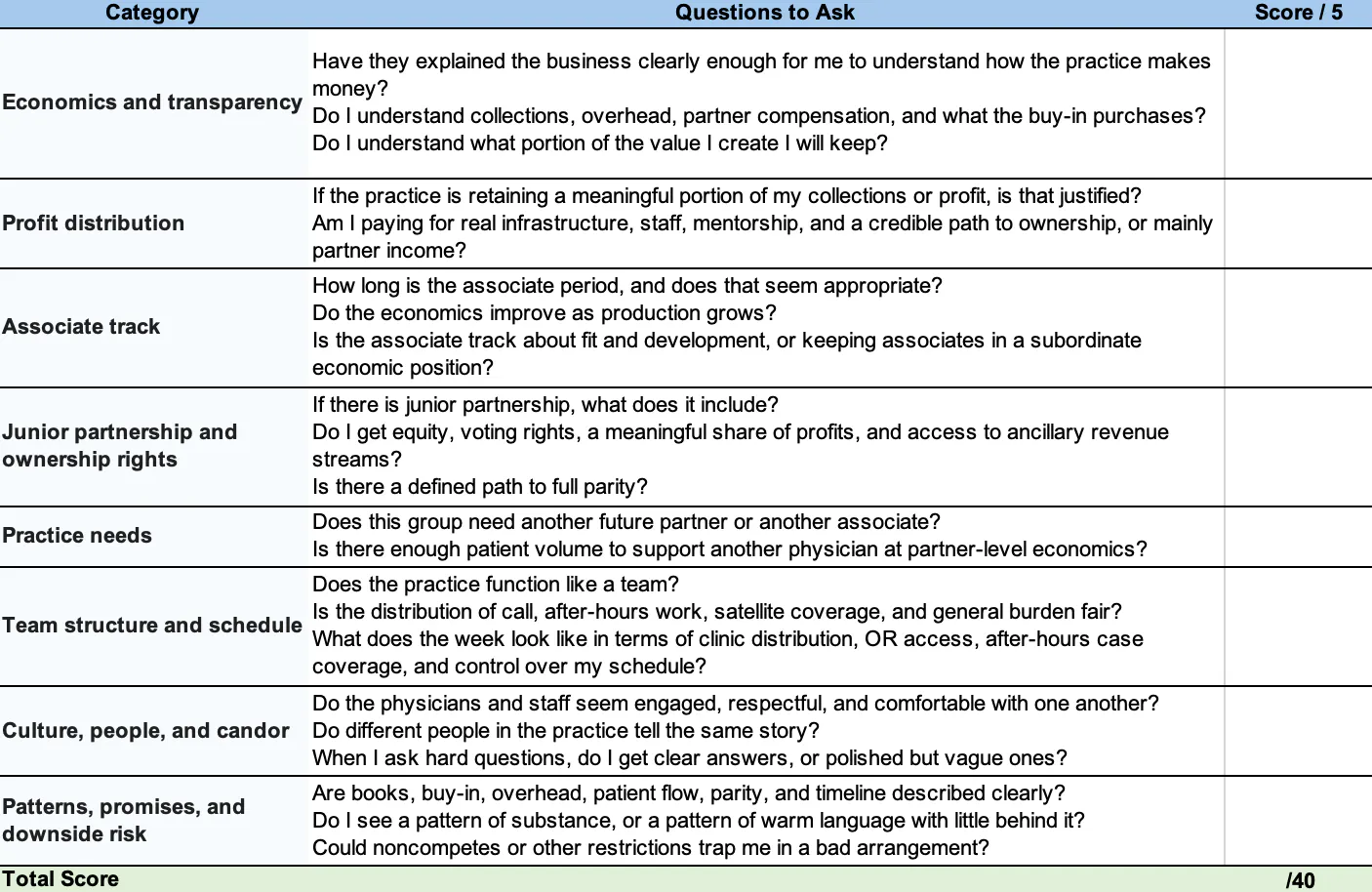
Figure. When a job sounds good on paper, it helps to score it the same way. Look past the headline salary and ask whether the economics, autonomy, and ownership path are fair. Use the following metrics to complete this scorecard: 1 = major concern, 3 = acceptable but with reservations, and 5 = clear strength.
The core economic questions are simple: what value are you producing, what portion of that value are you keeping, and where is the rest going? An associate’s worth to a practice is not an abstract number. It is tied directly to the revenue, clinical labor, surgical volume, call coverage, drug margins, and the overall economic value you produce. In a physician-owned practice, the closest benchmark is often partner-level economics, adjusted for volume and ramp-up period. If an associate is producing a meaningful share of partner-level work, the compensation structure should reflect that value.
ASK WHAT YOU ARE PAYING FOR
In a multi-partner group, profit retained from an associate’s work may add relatively little to each partner’s income while representing a substantial loss to the associate. That does not automatically make the arrangement unfair, but the associate should ask whether the tradeoff makes sense. If the practice is keeping a substantial portion of the associate’s profits, that retained value should be explained. It may be reasonable, for example, if the practice provides infrastructure, staff, referral relationships, equipment, management, mentorship, and a path to partnership.
BE WARY OF LONG ASSOCIATE TRACKS
A long associate track deserves real skepticism. There may be legitimate reasons to have one, such as time to assess judgment, work ethic, clinical quality, and long-term fit, but “we are still evaluating you” should not be confused with “we are still keeping a large share of what you produce for no clear reason.” If a practice truly needs a long time to assess fit, it can still design compensation such that the associate moves closer to production-based pay as their production grows.
This issue extends far beyond compensation. You should consider whether the practice behaves as a team, or whether new associates are expected to absorb disproportionate call, after-hours work, satellite coverage, and other practice burdens without meaningful support or fair compensation.
BE CAREFUL WITH JUNIOR PARTNERSHIP
Junior partnership can be reasonable, but in some cases, it is merely a label that makes limited economics sound more generous than they are. If a contract offers junior partnership, ask yourself:
- Do I have real equity?
- Do I have voting rights?
- Will I get a meaningful share of profits?
- Will I have access to ancillary revenue streams?
- Is there a defined path to full parity?
Ask whether the partnership being offered includes the same financial and voting rights the senior partners hold. For example, an earlier partner may have accepted several years of reduced associate earnings in exchange for full participation in practice profits and decisions. However, these initial sacrifices made in the associate period represent a substantially different proposition if a new physician receives only a limited profit share, little voting authority, or no access to ancillary ownership opportunities available to senior partners. Before accepting the same tradeoff, ask whether you will receive the same benefits.
FIND OUT IF THERE IS ROOM FOR A NEW PARTNER
A practice that truly needs a future partner will have a plan for helping the new physician build volume. It will direct patients, share opportunities, and explain how the new associate reaches parity, and it should be able to explain how the market supports taking on a new partner.
The truth is some practices do not need another partner. They need another associate to help with call, satellite coverage, overflow clinics, and other burdens, but they may not have enough work to support another physician at partner-level economics. In those settings, the associate may find themselves competing with established partners for new patients, all while being told partnership will come “eventually.” Reaching parity in these circumstances may take many years, if it happens at all. Thus, as a potential new associate, you should understand clinic distribution, satellite burden, OR access, after-hours coverage, and how much control you will have over the structure of your days. These details are easy to wave away during the interview process but hard to ignore once you are living with them.
PAY ATTENTION TO CULTURE
You are choosing your new colleagues as much as you are choosing a contract. How do the physicians and staff feel about working there? Do people seem engaged, respectful, and comfortable with one another? You will spend a lot of time in the practice environment, and the tone of it will significantly shape your day-to-day life.
With that being said, warm language about partnership, fairness, and future opportunity means very little if the details are vague. If basic questions about books, buy-in, overhead, patient flow, parity, or timeline are difficult to answer clearly, that’s a sign to dig deeper.
THE CENTRAL QUESTION
Every conversation should circle back to the same question: Is this practice looking for its next partner or its next associate? Not every position needs to end in equal partnership. However, if a job is sold as a partnership-track opportunity while being structured to preserve existing partner economics, offload work, split call, and capture associate production, it is best to know before you sign.
An associate period should not mean being indefinitely subordinate, chronically overburdened, and excluded from the value you help create. In the right practice, it can be a transition to shared responsibility, real ownership, and long-term opportunity.


