


AT A GLANCE
- Whether to observe mildly symptomatic ERM or proceed to surgery remains unclear.
- As prognostic factors for ERM, integrity of the ellipsoid and interdigitation zones and length of the photoreceptor outer segment have limited value.
- Cases presented here illustrate the usefulness of a staging classification for ERMs in determining when to perform surgery.
Epiretinal membrane (ERM) was described more than 150 years ago.1 It is a common finding in people older than 50 years and constitutes a common indication for vitreoretinal surgery.2 The increasing availability of spectral-domain (SD) OCT in routine clinical practice has led to more frequent detection of ERM. Many patients are asymptomatic or mildly symptomatic and rarely progress, whereas others may progress despite being asymptomatic. Because of this variability, it is unclear when to observe and when to intervene surgically.
Several investigators have assessed the usefulness of preoperative SD-OCT outer retinal biomarkers, such as the integrity of the ellipsoid and interdigitation zones and the length of the photoreceptor outer segments, as possible postoperative prognostic factors.3-6 However, a major limitation of this approach is that the evaluation of the outer retinal structures on SD-OCT may be hindered by common imaging artifacts.7 Others have focused, instead, on inner retinal findings, in particular the presence of ectopic inner foveal layers.
Govetto et al recently published a staging classification for ERMs based on these inner retinal layers.8 In this article we present case reports describing our management of two patients with ERM based on this staging classification.
CASE No. 1
A healthy 49-year-old woman noted a sudden onset of metamorphopsia and decreased visual acuity in her left eye. Refraction indicated a VA of 20/40 OS. Macular OCT revealed a stage 2 ERM (Figure 1A).
The patient underwent vitrectomy with membrane peel. Four months after the vitrectomy, her VA had improved to 20/25 OS, and her metamorphopsia had mostly disappeared. Macular OCT showed a normalization of her foveal architecture (Figure 1B).
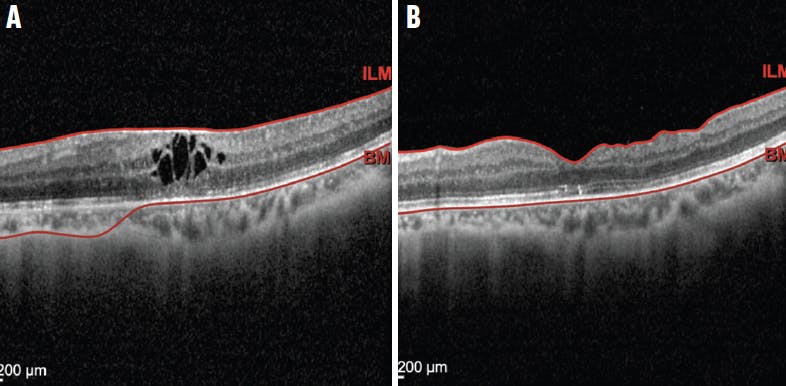
Figure 1. With this stage 2 ERM, notice the loss of the foveal pit. The retinal layers are well-defined and there are no ectopic inner foveal layers. Intraretinal hyporeflective spaces are also present (A). Postoperative SD-OCT shows the reconstitution of the foveal pit and the disappearance of the intraretinal hyporeflective spaces (B).
CASE No. 2
A healthy 65-year-old man who had undergone refractive lens exchange 3 years earlier started complaining of metamorphopsia and decreased visual acuity in his left eye. His VA was 20/50 OS, and macular OCT revealed a stage 2 ERM with a cotton-ball sign (Figures 2A and 2B). He underwent surgical repair, and 10 months later his VA had improved to 20/25 and most of his metamorphopsia had resolved (Figures 2C and 2D).
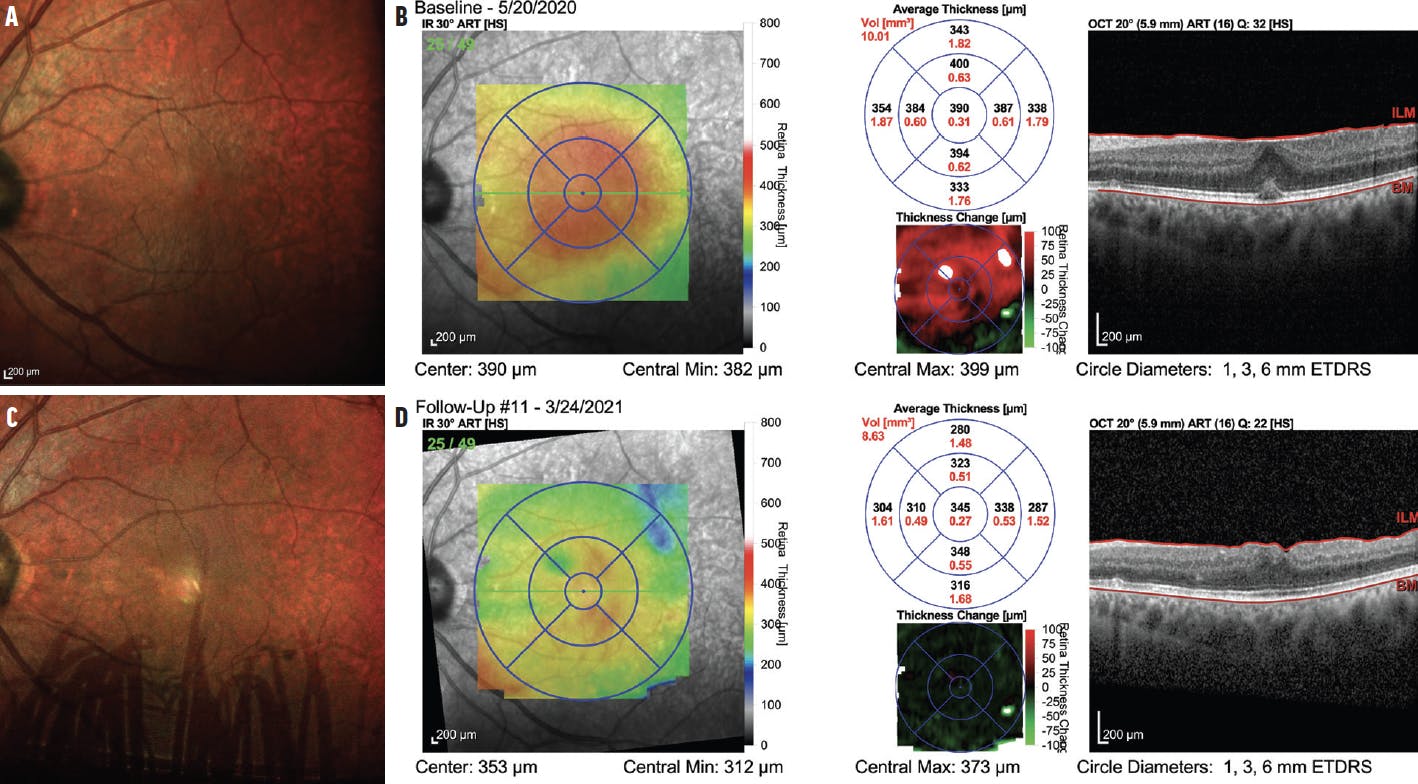
Figure 2. Multicolor imaging demonstrates the presence of a stage 2 ERM (A). Notice the loss of the foveal pit. The retinal layers are well-defined and there are no ectopic inner foveal layers. A cotton-ball sign is also present (B). Postoperative multicolor imaging shows the absence of the ERM (C). Postoperative SD-OCT confirms the absence of an ERM. The foveal pit has not reconstituted but the visual acuity improved to 20/25 (D).
DISCUSSION
In the classification system described by Govetto et al, stage 1 ERM is characterized by the presence of the foveal pit with well-defined retinal layers. In stage 2, the foveal pit is absent, but the retinal layers remain well-defined. In stage 3, the foveal pit is absent and the retinal layers remain well-defined, but ectopic inner foveal layers are present. Finally, in stage 4 eyes, the foveal pit is absent, the retinal layers are disrupted, and ectopic inner foveal layers are present.8 The presence of ectopic inner foveal layers was found to be a negative functional and anatomic prognostic factor for eyes undergoing surgical repair.9
Gonzalez-Saldivar and colleagues retrospectively analyzed a series of surgical results according to this staging classification.10 They reported that 92% of stage 2 eyes achieved postoperative BCVA ≥ 20/40, compared with 42% of stage 3 and 5% of stage 4 eyes. These results were in line with those reported by Govetto et al.9
Likewise, the two cases reported here clearly illustrate the usefulness of this classification scheme. We are continuing to use this staging classification and will consider surgical intervention in patients once stage 2 ERM is diagnosed.
1. Iwanoff A. Beiträge zur Normalen und Pathologischen Anatomie des Auges. Graefes Arch Clin Exp Ophthalmol. 1865;11:135-70.
2. Fraser-Bell S, Guzowski M, Rochtchina E, et al. Five-year cumulative incidence and progression of epiretinal membranes: the Blue Mountains Eye Study. Ophthalmology. 2003;110(1):34-40.
3. Falkner-Radler CI, Glittenberg C, Hagen S, et al. Spectral-domain optical coherence tomography for monitoring epiretinal membrane surgery. Ophthalmology. 2010;117(4):798-805.
4. Hashimoto Y, Saito W, Saito M, et al. Retinal outer layer thickness increases after vitrectomy for epiretinal membrane, and visual improvement positively correlates with photoreceptor outer segment length. Graefes Arch Clin Exp Ophthalmol. 2014;252(2):219-226.
5. Hosoda Y, Ooto S, Hangai M, et al. Foveal photoreceptor deformation as a significant predictor of postoperative visual outcome in idiopathic epiretinal membrane surgery. Invest Ophthalmol Vis Sci. 2015;56(11):6387-6393.
6. Shiono A, Kogo J, Klose G, et al. Photoreceptor outer segment length: a prognostic factor for idiopathic epiretinal membrane surgery. Ophthalmology. 2013;120(4):788-794.
7. Rii T, Itoh Y, Inoue M, Hirakata A. Foveal cone outer segment tips line and disruption artifacts in spectral-domain optical coherence tomographic images of normal eyes. Am J Ophthalmol. 2012;153(3):524-529e1.
8. Govetto A, Lalane RA, 3rd, Sarraf D, et al. Insights into epiretinal membranes: presence of ectopic inner foveal layers and a new optical coherence tomography staging scheme. Am J Ophthalmol. 2017;175:99-113.
9. Govetto A, Virgili G, Rodriguez FJ, et al. Functional and anatomical significance of the ecoptic inner foveal layers in eyes with idiopathic epiretinal membranes: surgical results at 12 months. Retina. 2019;39(2):347-357.
10. Gonzalez-Saldivar G, Berger A, Wong D, et al. Ectopic inner foveal layer classification scheme predicts visual outcomes after epiretinal membrane surgery. Retina. 2020;40(4):710-717.
-1_1638377570.jpg?auto=compress,format&w=70)


