


The 2023 International Retinal Imaging Symposium (IntRIS) was held on March 31-April 1, at the Luskin Conference Center in Los Angeles. The 2-day meeting, organized by David Sarraf, MD; Amani A. Fawzi, MD; K. Bailey Freund, MD; and SriniVas R. Sadda, MD, convened in person for the first time since the COVID-19 pandemic. And it was worth the wait. The program was packed with exciting sessions and stimulating talks, delivered by leading experts (Figure), and covered a broad array of topics and the newest innovations in retinal imaging. Here, we share some of the key topics presented.
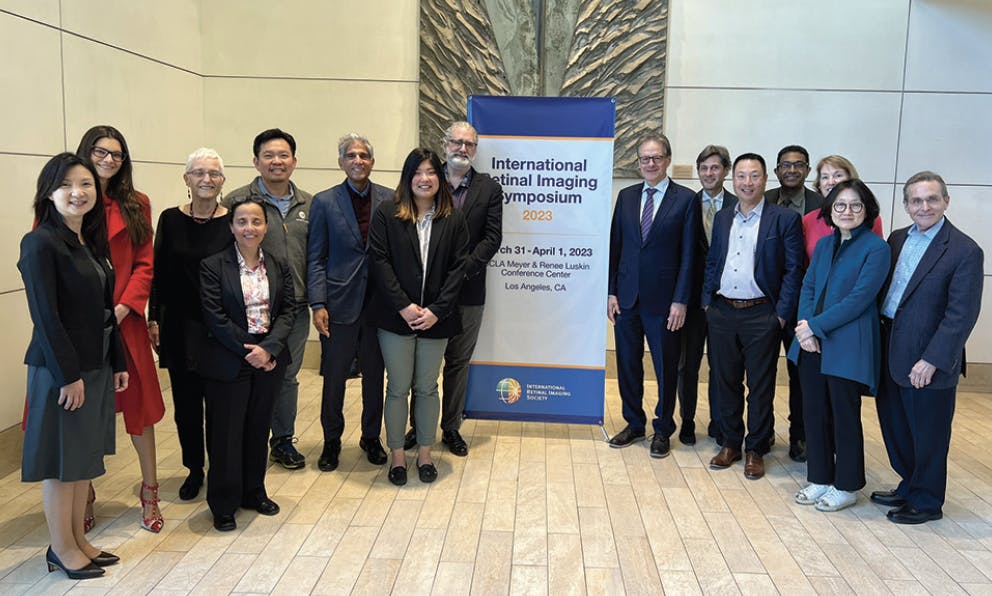
Figure. This year’s International Retinal Imaging Symposium boasted a robust roster of speakers from around the world. Pictured here (left to right) are Gemmy Cheung, MD; Marion R. Munk, MD, PhD; Christine A. Curcio, PhD; Amani A. Fawzi, MD; David Huang, MD, PhD; David Sarraf, MD; Monica Kim; K. Bailey Freund, MD; Richard F. Spaide, MD; Giuseppe Querques, MD, PhD; Michael S. Ip, MD; SriniVas R. Sadda, MD; Barbara Blodi, MD; Seung-Young Yu, MD; and Philip J. Rosenfeld, MD, PhD.
TECHNOLOGY INNOVATIONS
The first day started with lectures that introduced novel imaging systems and promising developments in artificial intelligence. Topics included adaptive optics scanning light ophthalmoscopy, which can enable in vivo microscopy with better photoreceptor identification, according to Richard B. Rosen, MD. David Huang, MD, PhD, discussed split spectrum OCT optoretinography, and Amitha Domalpally, MD, PhD, shared her expertise on artificial intelligence algorithms for the measurement of geographic atrophy (GA). Emanuele Crincoli, MD, FEBO, touched on deep learning for the automatic prediction of early activation of treatment-naïve quiescent macular neovascularization in AMD.
NOVEL RETINAL DISEASES
The meeting made it clear that innovative retinal imaging and advanced technology allow recognition and detection of novel retinal entities. Dr. Freund presented on the distinctive multimodal imaging features of stellate multiform amelanotic choroidopathy, the recognition of which may avoid unnecessary diagnostic testing and interventions. Next, Dr. Sarraf illuminated the audience on the common pathogenetic pathway of vitelliform lesions and introduced the novel entity of pachyvitelliform maculopathy.
UPDATES ON COMMON RETINAL PATHOLOGIES
After the excitement of novel technologies and pathologies, the next few sessions focused on another useful clinical topic: the newest retinal imaging insights into already well-established retinal diseases, such as wet and dry AMD, retinal vascular disease, and myopic degeneration. Christine A. Curcio, PhD, discussed the role of drusen versus subretinal drusenoid deposits in the pathophysiology of AMD and presented new insights into the associated photoreceptor, retinal pigment epithelium, and choroidal changes. Philip J. Rosenfeld, MD, PhD, proposed that the onset and growth of persistent hypertransmission defects detected on en face OCT images of eyes with intermediate AMD can serve as stand-alone primary endpoints in clinical trials designed to test if new therapies slow disease progression.
Speaking of those new therapies, the controversial topic of treating GA with complement inhibition was addressed by Richard F. Spaide, MD, who questioned the need for investigating treatment with no proven functional benefit. He presented a mathematical formula that raised questions about the anatomical benefit as well. This provoked a lively and somewhat heated debate among the participants.
Next, Jeremy A. Lavine, MD, PhD, discussed the cellular dynamics in diabetic retinopathy (DR). He showed that there is an increase in retinal surface macrophages in advanced forms of DR. Dr. Fawzi then used adaptive optics scanning light ophthalmoscopy to show a loss of pericytes early in the disease course and how protecting these cells may play a role in DR prevention.
A few interesting questions were answered during the conclusion of the day. For example, when asked if GA is better characterized by multicolor imaging or fundus autofluorescence, Dr. Crincoli said that it depends on what we want to evaluate. Foveal sparing is best shown with multicolor imaging, whereas atrophy extension is better evaluated with fundus autofluorescence. And what is PEDCI? Jay Chhablani, MD, explained the origin of pigment epithelial detachment composition indices, which is a novel OCT biomarker to evaluate wet AMD activity that may be integrated with future deep learning models.
ADVANCES IN RETINAL IMAGING
The second day of the meeting began with the fascinating image embossing technique introduced by Dr. Sadda, who showed that applying it to flash color fundus images can enhance detection of subtle abnormalities such as reticular pseudodrusen, even if done retrospectively in historical datasets. Steven D. Schwartz, MD, provided a glimpse into the development of an eccentric OCT adaptive optics system for a high-resolution imaging of the far peripheral retina.
BREAKTHROUGHS
Sessions regarding macular telangiectasia type 2, inherited retinal diseases, central serous chorioretinopathy, and polypoidal choroidal vasculopathy showed how much progress has been made in understanding various retinal diseases. Some of the most memorable talks included one by Paul S. Bernstein, MD, PhD, who presented the results of a multimodal retinal imaging study (including fluorescence lifetime imaging ophthalmoscopy) of adults with Down syndrome who had macular telangiectasia type 2. Anita Agrawal, MD, showed minimal to mild phenotype progression in most patients with peripherin/retinal degeneration slow dystrophy. Gemmy Cheung, MD, presented surprising similarities between wet AMD and polypoidal choroidal vasculopathy in terms of choroidal venous alterations and vascular remodelling. Prithvi Ramtohul, MD, discussed en face ultra-widefield OCT of the vortex vein system in central serous chorioretinopathy, outlining our recent understanding of the venous outflow congestion mechanism of the disease.
THE ANNUAL YANUZZI AWARD LECTURE
The highlight of the second day was the 4th annual Lawrence A. Yannuzzi award lecture. This year, the IntRIS leadership recognized Cynthia A. Toth, MD, who pioneered both the first hand-held spectral-domain OCT system for infant examination and the first intraoperative OCT-guided ophthalmic surgical system with heads-up display. Following a detailed and amusing introduction by Dr. Spaide, Dr. Toth provided a thorough review of the evolution of OCT systems and a beautiful presentation of current and future perspectives that will be essential in extending the boundaries of OCT imaging into the next era of retinal imaging.
MEMBERS-IN-TRAINING PRESENTATIONS
A refreshing addition to the IntRIS meeting this year was the integration of members-in-training as presenters during two special sessions dedicated to the younger generation of retinal imaging researchers. Judging by the audience reactions and the lively discussions and debates that followed, this was the beginning of a wonderful tradition. The sessions were filled with top-notch lectures, covering key topics in retinal imaging innovations, such as: adaptive optics flood illumination imaging; OCT angiographic features of early phase type 3 neovascularization; evaluation of the activity of microaneurysms by combining OCT angiography and OCT images; morphometrics of drusen in AMD and normal aging eyes using OCT; progression of pentosan polysulfate maculopathy; and a memorable glimpse into the future of retinal surgery with a presentation of an intraocular A-scan probe with 1-µm precision.
UNTIL NEXT YEAR
The robust program provided a great platform for learning, discussion, and further research. It showcased the integral role of innovative retinal imaging in the evaluation and management of retinal disease and highlighted the importance of a meeting dedicated solely to retinal imaging. To the organizers, presenters, and participants, one wish remains: repeat the success of this innovative meeting next year in Los Angeles!


