


The standard for evaluating the peripheral retina is a dilated fundus examination with scleral depression. However, there are some cases of a non-dilating pupil where examination using an ophthalmoscope is impossible. In these cases, scanning laser ophthalmoscope (SLO)-based multimodal fundus imaging could give clinicians a fundus view that is not possible clinically.
In this article, we present the cases of six patients with a non-dilating pupil after instilling tropicamide for a 30-minute period. After performing refraction, IOP assessment, and a slit-lamp examination, we used SLO-based multimodal imaging to capture widefield color photographs, fundus autofluorescence (FAF), fluorescein angiography (FA), ICG angiography (ICGA), and OCT.1
CASE NO. 1
A 54-year-old man presented with decreased vision in his left eye for 1 month and a VA of counting fingers at 2 m. On anterior segment examination, we saw multiple keratic precipitates at the back of the cornea with a muddy iris (Figure 1A). The pupil measured 3 mm after instilling topical mydriatic tropicamide for 30 minutes. We also noted mild vitritis.
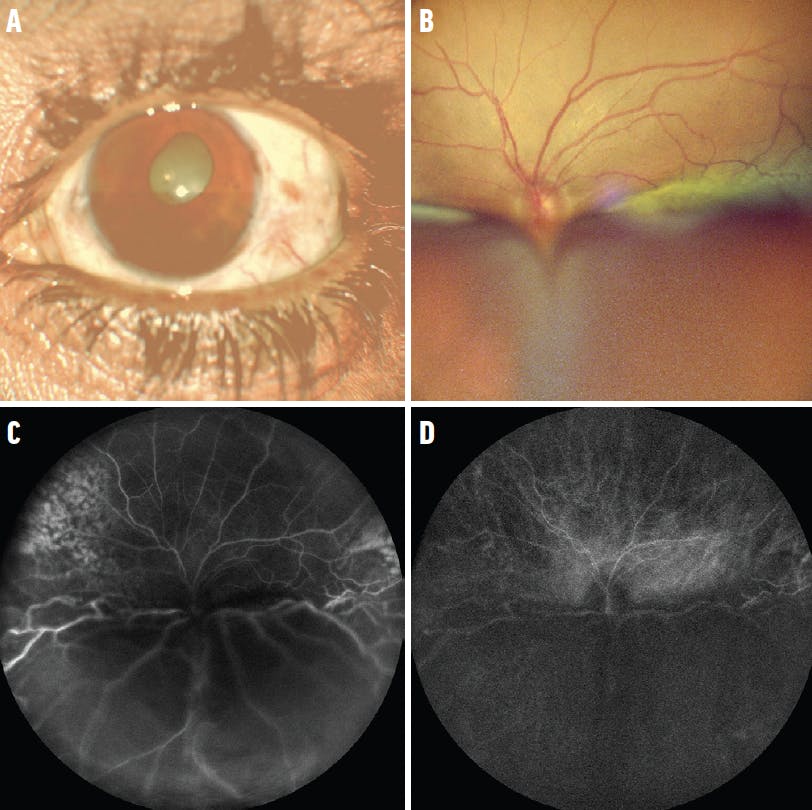
Figure 1. Anterior segment examination revealed keratic precipitates and a muddy iris (A). Widefield imaging showed an exudative RD (B). FA revealed an altered foveal avascular zone and leakage (C). ICGA showed hypocyanscence (D).
The widefield imaging showed an exudative retinal detachment (RD) involving 180° of the inferior retina (Figure 1B). FA revealed an altered foveal avascular zone and leakage (Figure 1C), and ICGA showed hypocyanscence (Figure 1D). We advised intravenous methylprednisolone for 5 days followed by oral steroids in a tapering manner prescribed using the patient’s weight. The patient’s vision did not improve, and we advised bimanual vitrectomy with silicone oil infusion. The patient’s VA improved to 6/24 postoperatively.
CASE NO. 2
A 30-year-old man presented with decreased vision in his left eye for 5 days and a VA of 6/12 in his left eye. His right eye had already been lost due to past ocular trauma. His ocular history was remarkable for cryotherapy in the left eye and bimanual vitrectomy with silicone oil infusion for the treatment of a temporal RD with a giant retinal tear 8 years prior with silicone oil removal performed 6 months postoperatively.
At presentation, the pupil measured 2 mm after instilling topical mydriatic tropicamide for 30 minutes. We noted pseudophakia with an iridotomy at the 12 clock position during the anterior segment examination (Figure 2A). Widefield imaging showed disc pallor with cryotherapy marks at the 5 clock position and a 360° retinectomy (Figure 2B). The patient was observed without further treatment. The retina was well-attached, and the disc was pale, suggestive of optic atrophy.
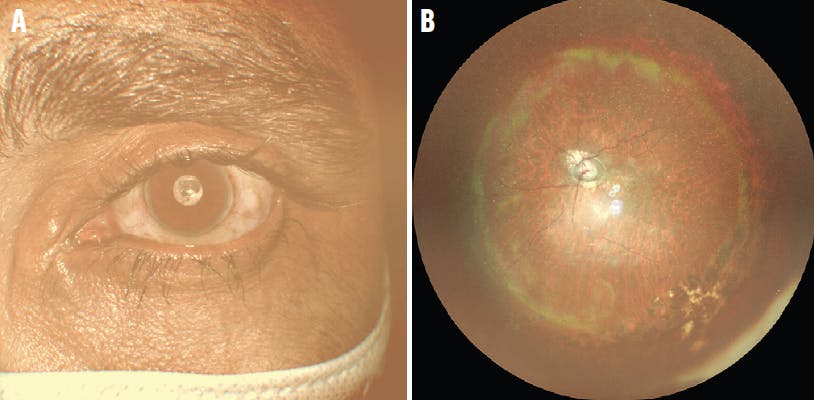
Figure 2. The anterior segment examination showed pseudophakia with an iridotomy (A). Widefield imaging showed disc pallor with cryotherapy marks as well as a 360° retinectomy (B).
CASE NO. 3
A 50-year-old man presented with decreased vision in his right eye for 1 month and a VA of counting fingers at 2 m. The anterior segment examination revealed a small non-dilating pupil (Figure 3A). OCT showed a fairly maintained foveal contour with choroidal thickening (Figure 3B). FA revealed multiple areas of hyperfluorescence in the foveal region increasing in size and intensity from the early to late phase, suggestive of leakage (Figure 3C). ICGA showed this area to be hypocyanscent from the early to late phase (Figure 3D). FAF showed areas of hypo- and hyperautofluorescence in the peripapillary and foveal regions (Figure 3E).
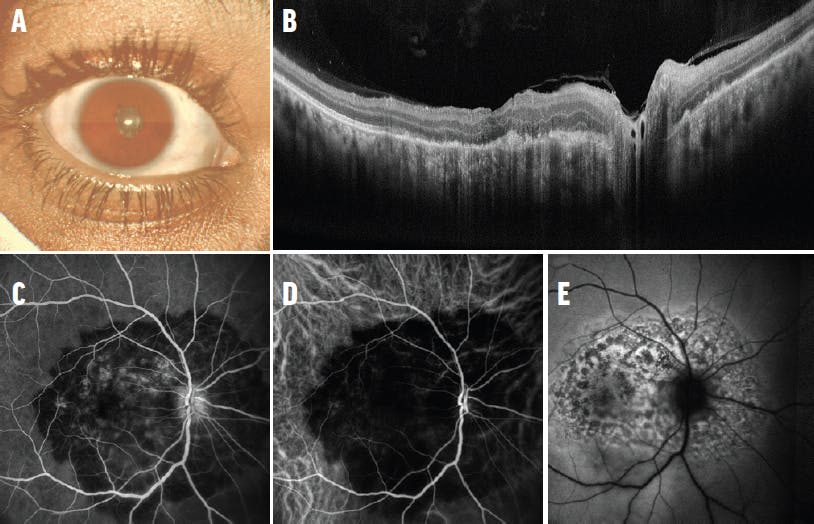
Figure 3. The anterior segment examination showed a small non-dilating pupil (A). OCT showed a fairly maintained foveal contour with choroidal thickening (B). FA showed hyperfluorescence (C). ICGA showed a hypocyanscent in the foveal region (D), and FAF showed hyper- and hypoflourescence (E).
We recommended a complete uveitis workup and started the patient on intravenous methylprednisolone for 3 days followed by oral steroids. The eye responded to the course of steroids, and the inflammation subsided by the 1 month follow up.
CASE NO. 4
A 73-year-old woman presented with decreased vision in her left eye for 15 days and a VA of counting fingers at 1 m. The pupil measured 3.5 mm after instilling topical mydriatic tropicamide for 30 minutes (Figure 4A). The widefield color photography showed asteroid hyalosis with subretinal blood at the fovea and a juxtapapillary membrane (Figure 4B). OCT imaging of the left eye showed a fairly maintained foveal contour with pigmentary changes in the retinal pigment epithelium with a subfoveal subretinal fluid pocket suggestive of a choroidal neovascular membrane (Figure 4C). After three intravitreal anti-VEGF injections, the patient’s VA improved to 6/9 OS.
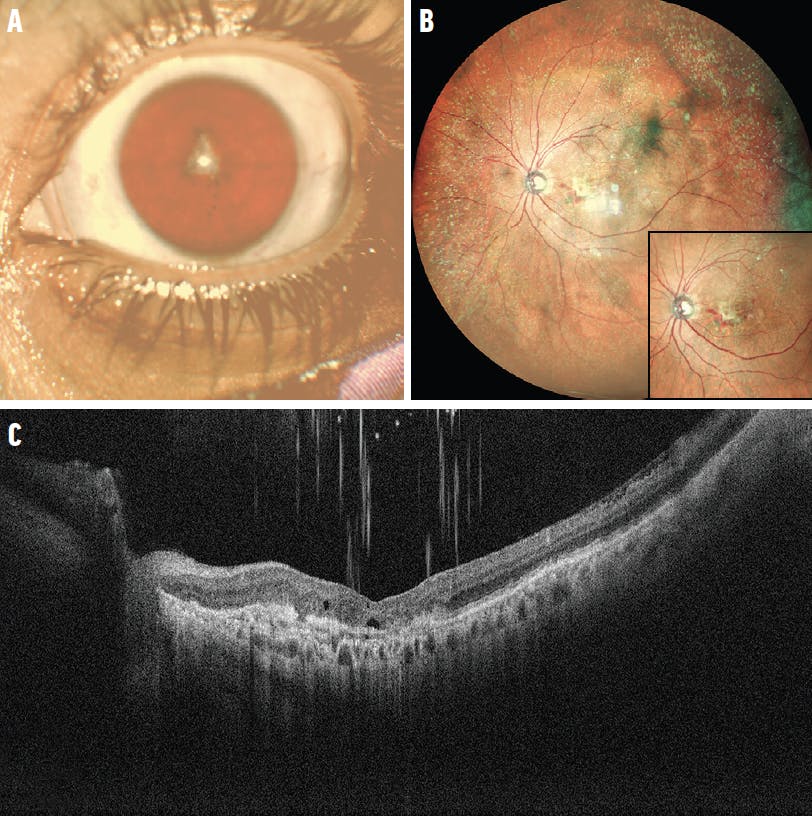
Figure 4. The pupil measured 3.5 mm after instilling topical mydriatic tropicamide for 30 minutes (A). Widefield imaging showed asteroid hyalosis with subretinal blood at the fovea and a juxtapapillary membrane (B). OCT imaging showed a fairly maintained foveal contour with pigmentary changes in the retinal pigment epithelium with a subfoveal subretinal fluid pocket (C).
CASE NO. 5
A 22-year-old man presented with decreased vision in his left eye for 7 days, a VA of light perception, and projection of rays accurate in all four quadrants. During the anterior segment evaluation, we observed microcornea with a typical iris coloboma. His right eye had been lost in childhood. His left eye ocular history was remarkable for scleral buckling with bimanual vitrectomy with silicone oil infusion for the treatment of an RD. Plomb removal was performed due to granuloma formation with silicone oil removal 2 years post-surgery. The patient presented with a redetachment, for which bimanual vitrectomy with silicone oil infusion was done with oil removal 3 years post-surgery.
At the time of presentation, the pupil was non-dilating after instilling topical mydriatic tropicamide and maintained a keyhole shape (Figure 5A). Widefield imaging showed an attached retina with a retinochoroidal coloboma (Figure 5B); the patient’s VA was 6/36. The retina was well-attached 1 month postoperatively.
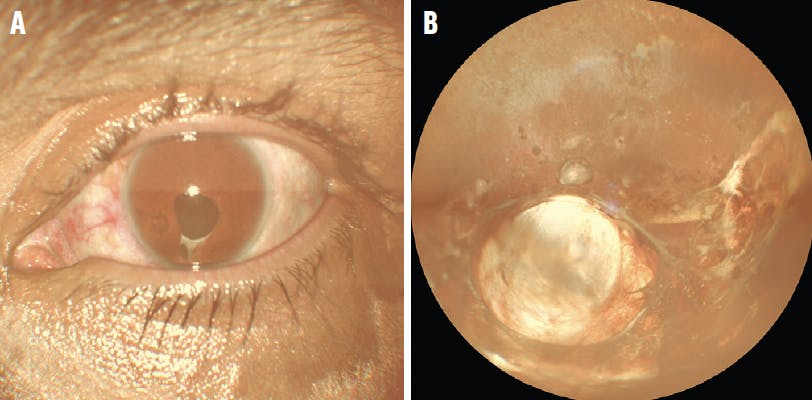
Figure 5. The pupil was non-dilating and maintained a keyhole shape (A). Widefield imaging showed an attached retina with a retinochoroidal coloboma (B).
CASE NO. 6
A 37-year-old woman presented with decreased vision in her right eye for 3 years and a VA of 6/60. The anterior segment examination showed posterior synechiae with a festooned pupil and complicated cataract (Figure 6A). The patient noted a history of recurrent attacks and had recently completed a course of oral steroids with immunosuppressants. On OCT, the foveal contour was altered with multiple cystoid spaces in the right eye (Figure 6B). The patient received a dexamethasone intravitreal implant (Ozurdex, Allergan/AbbVie) followed by cataract surgery with synechiolysis.
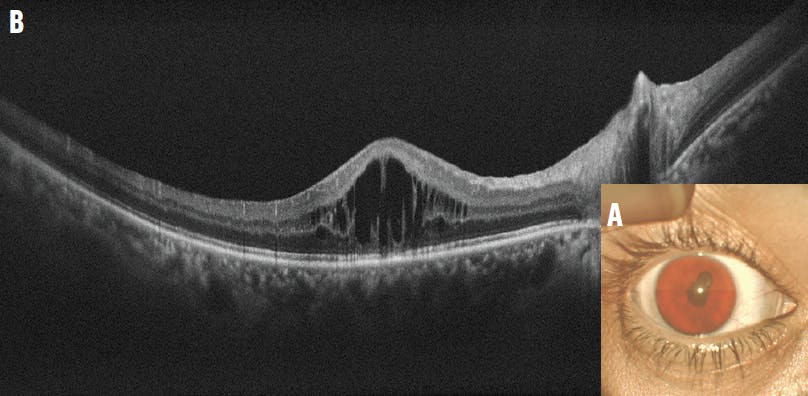
Figure 6. The anterior segment examination showed posterior synechiae with a festooned pupil and complicated cataract (A). OCT showed an altered foveal contour with cystoid spaces (B).
DISCUSSION
To ensure a 140° range of incident light, clinicians need a pupil diameter of at least 2 mm. Because the normal pupil’s diameter ranges from 2.5 mm to 4.0 mm, widefield imaging systems can achieve 200° retinal imaging with a non-mydriatic pupil.2
Without SLO-based multimodal imaging, fundus examination in non-dilating pupils is extremely difficult. Missing important findings can significantly—and negatively—affect the treatment and follow-up plans. Whether defining the extent of an RD, identifying subretinal bleeds that require anti-VEGF injections, or confirming a leak on FA and planning laser treatment, it’s possible with widefield multimodal imaging.
1. Nagpal M, Mohan G, Soni A et al. Widefield multimodal imaging: documenting the periphery is vital in many retinal pathologies. Retina Today. 2020;15(1):50-60.
2. Kato Y, Oguchi M, Tamaoki A, Yoshida N, Kaga T, Ichikawa K. Performance of fundus photography using the ultra-widefield scanning laser ophthalmoscope Optos 200TxTM. J Jap Ass Cert Orthoptist. 2012;41(0):207-212.


