


The management of combined tractional and rhegmatogenous retinal detachment (TRD/RRD) in the setting of diabetic retinopathy (DR) is particularly challenging, and visual outcomes are often poor.1
In eyes with longstanding RD, such as in the following case, features such as retinal stiffness and foreshortening, subretinal membranes, and extensive fibrous proliferation are often present; in these cases, retinectomy is often required to relieve traction and achieve retinal reattachment.2
CASE REPORT
A 54-year-old man with a 20-year history of poorly controlled type 2 diabetes and various systemic comorbidities—including hypertension, obesity, dyslipidemia, and a prior cerebrovascular accident—presented with several months of progressive vision loss in his left eye. His BCVA was 20/30 OD and hand motion OS. He had not previously received ophthalmic care.
Fundoscopic examination of his right eye revealed signs of proliferative DR, for which panretinal photocoagulation was promptly performed. His left eye exhibited dense vitreous hemorrhage and a cortical cataract that precluded adequate fundus visualization; B-scan ultrasonography was used to confirm a TRD/RRD.
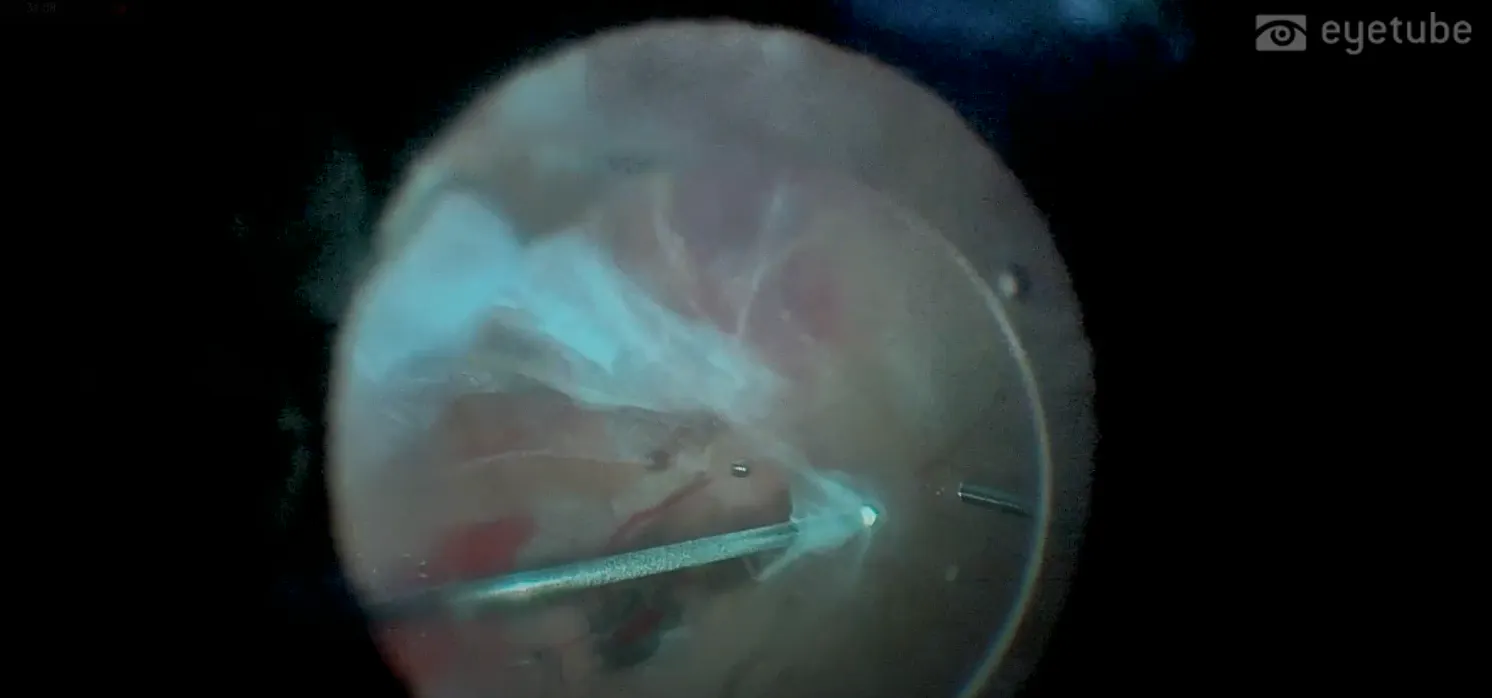
A combined surgical procedure was pursued, including phacoemulsification with IOL implantation and 27-gauge pars plana vitrectomy. Intraoperatively, extensive fibrovascular proliferation was noted, extending from the inferior optic nerve to the vitreous base (Figure 1).

Additional findings included subretinal membranes and a partially adherent posterior hyaloid, consistent with a combined TRD/RRD. Thus, membrane dissection and posterior hyaloid removal were performed, and the subretinal membranes were extracted through strategically placed retinotomies.
Despite these efforts, significant tenting of the inferior retina toward the dense peripheral fibrovascular tissue persisted, precluding reattachment and necessitating a retinectomy under air to relieve residual traction (Figure 2). This approach allowed real-time visualization of retinal flattening and minimized the extent of necessary retinal excision. Silicone oil was used as a long-term tamponade (Video).

Video. Surgical Management of Combined Tractional and Rhegmatogenous Retinal Detachment and Cataract
Postoperatively, the retina remained attached (Figures 3 and 4), and VA improved to counting fingers at 4 ft OS. The patient is scheduled for silicone oil removal.


BALANCING MULTIPLE SURGICAL GOALS
Retinectomy under air provided enhanced intraoperative visualization and control, particularly in the setting of complex combined TRD/RRD. By integrating cataract extraction and advanced vitreoretinal techniques in a single procedure, we were able to optimize both anatomic and functional outcomes in a highly challenging clinical scenario.
1. Storey PP, Ter-Zakarian A, Philander SA, et al. Visual and anatomical outcomes after diabetic traction and traction-rhegmatogenous retinal detachment repair. Retina. 2018;38(10):1913-1919.
2. Ramamurthy SR, Dave VP, Chou HD, et al. Retinotomies and retinectomies: A review of indications, techniques, results, and complications. Surv Ophthalmol. 2023;68(6):1038-1049.


