



KEY TAKEAWAYS
- The Orphan Drug Act and its subsequent amendments created an incentive structure that now defines rare disease drug development.
- FDA guidance now allows smaller clinical trials, often combining phase 1 and phase 2, with historical controls rather than placebo.
- Standard cost-effectiveness frameworks undervalue durable one-time interventions relative to chronically administered alternatives.
When the FDA approved voretigene neparvovec (Luxturna, Spark Therapeutics) for biallelic RPE65-associated inherited retinal disease (IRD) in 2017, the central question was whether such a therapy could be developed, approved, and reimbursed at all. Having contributed to voretigene neparvovec’s development at Spark Therapeutics, I have followed the answer to that question closely over the past 8 years. As additional retinal gene therapy programs have advanced, the FDA has finalized its gene therapy guidance framework, and the commercial and reimbursement trajectory of early-generation programs has clarified the real-world economics.
THE ORPHAN DRUG FRAMEWORK
A rare disease is defined as one affecting fewer than 200,000 persons in the United States or affecting more than 200,000 persons for which the cost of development is not expected to be recovered from US sales.1 When Congress passed the Orphan Drug Act in 1983, the biotechnology industry had produced relatively few therapies for rare conditions, as small patient populations offered limited prospect of commercial return. The Act and its subsequent amendments created the incentive structure that now defines rare disease drug development (Table).2
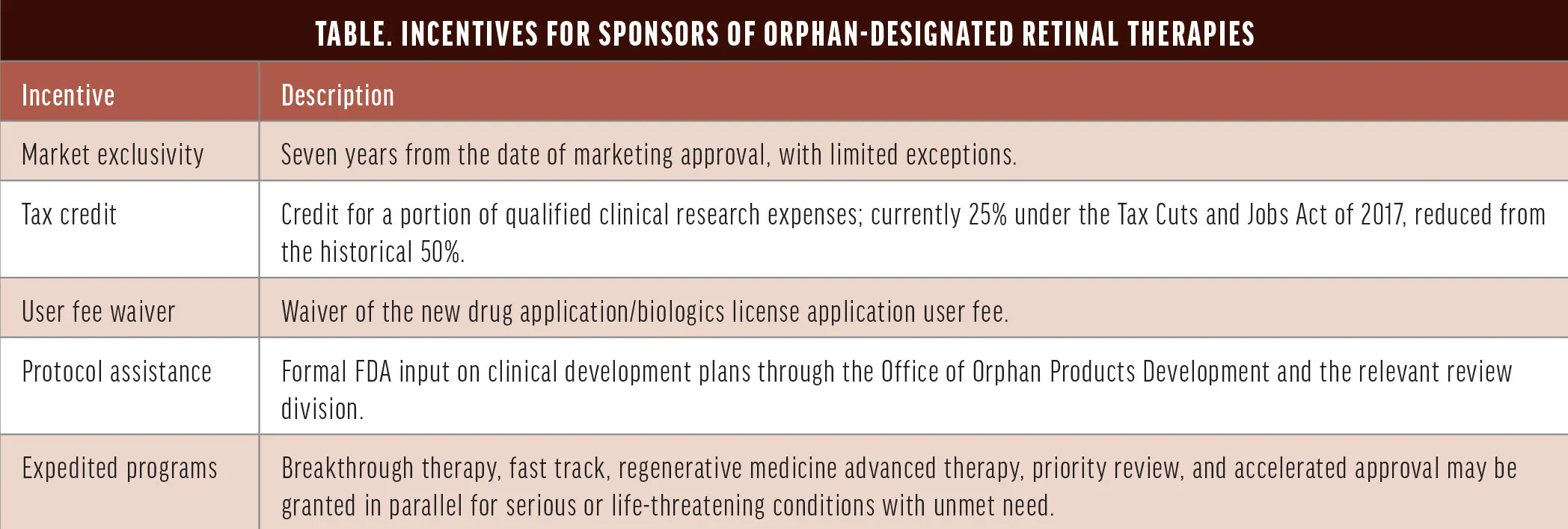
In 2024, therapies with orphan designation accounted for 52% of novel FDA drug approvals, continuing the broader trend toward orphan-focused development.3 The retina is a particularly attractive target for this category of development, given the large number of monogenic retinal disorders, the accessibility of target cells, the capacity for noninvasive monitoring, and the relative immune privilege of the eye.4
A DEVELOPMENT PATHWAY FOR GENE THERAPY
The FDA finalized its Human Gene Therapy for Rare Diseases guidance in January 2020, along with a companion Human Gene Therapy for Retinal Disorders guidance.5 Clinical trials are smaller, often combining phase 1 and phase 2 to assess safety and preliminary efficacy simultaneously, and can rely on historical controls rather than placebo. Natural history studies should begin early, often in parallel with preclinical development, to support these comparator structures.
Novel functional endpoints are often needed; for example, the voretigene neparvovec pivotal program used a multi-luminance mobility test as its primary endpoint rather than conventional visual acuity. Chemistry, manufacturing, and controls considerations must be established early because smaller populations mean fewer manufacturing lots for process parameters. Long-term follow-up is risk-based, generally up to 5 years for non-integrating adeno associated viral vector products and up to 15 years for integrating or potentially persistent genome-modifying platforms, depending on FDA risk assessment.5
Two operational realities warrant specific attention: 1) Part of the work of bringing an orphan retinal therapy to patients is building the genetic diagnostic pathway itself, and 2) The orphan disease development pathway typically produces a centralized treatment center model at commercialization. Rarity, technical complexity of administration, and the need for standardized outcome monitoring mandate a limited network of authorized sites rather than general availability.
For retina specialists outside a designated treatment center, the relevant activities become patient identification, genetic confirmation, referral, and post-treatment comanagement rather than primary administration.
REIMBURSEMENT: METHODOLOGY MATTERS
The unresolved challenge for one-time therapies relates to timing. The cost is incurred at a single point in time; the clinical benefit is distributed across years or decades. Standard cost-effectiveness frameworks, which discount future benefits against present costs, systematically undervalue durable one-time interventions relative to chronically administered alternatives. With cell and gene therapy products now priced more than $300,000 and approximately 40 approved products on the market, this misalignment has become the defining operational issue for the field.
For example, an assessment by the Institute for Clinical and Economic Review concluded that voretigene neparvovec was unlikely to reach traditional cost-effectiveness standards.6 However, after examining the underlying inputs, the company noted that the health utility values used had been drawn from a cohort of diabetic retinopathy patients whose average age was 62, with substantial comorbidity burden.7 The patients in the voretigene neparvovec pivotal trials averaged 15 years of age and were otherwise healthy. Because the reference population was already impaired on generic quality-of-life dimensions, the analysis failed to capture the utility decrement associated with progression to complete blindness in a pediatric IRD population.
In a revised cost-effectiveness analysis using RPE65-mediated IRD-specific utility values and including indirect costs such as educational attainment, productivity, caregiver burden, and government program use, voretigene neparvovec was dominant over standard care8,9; excluding indirect costs, the incremental cost fell well within traditional willingness-to-pay thresholds.
Beyond methodology, the reimbursement architecture itself has evolved. Outcomes-based contracting, in which reimbursement is linked to measured treatment response, has emerged as one application of pay-for-performance in gene therapy. The Centers for Medicare and Medicaid Services announced its Cell and Gene Therapy Access Model in 2024, with an initial focus on sickle cell disease; more than 30 states, the District of Columbia, and Puerto Rico have signed agreements, representing approximately 84% of Medicaid beneficiaries with sickle cell disease.10 The model centrally negotiates outcomes-based terms on behalf of state Medicaid programs. These mechanisms remain underdeveloped for retinal gene therapies, which are administered in the outpatient surgical setting rather than the inpatient context. Outpatient delivery will require continued evolution of billing pathways, ophthalmic-appropriate outcome metrics, and risk-sharing arrangements calibrated to intravitreal, subretinal, and suprachoroidal therapies.
THE BOTTOM LINE
The Orphan Drug Act paradigm has proven durable, and the regulatory pathway for gene therapy has matured with finalized FDA guidance. The commercial realities of ultra-rare monogenic indications, however, are more challenging than early enthusiasm suggested, and the field has adapted by pursuing larger rare populations and mutation-agnostic approaches. Reimbursement remains the rate-limiting step, and cost-effectiveness methodology deserves more scrutiny than it has traditionally received in our field. The coming years will likely bring additional approved gene therapies and continued refinement of the infrastructure that supports their delivery.
1. US Food and Drug Administration. Rare diseases: considerations for the development of drugs and biological products; guidance for industry. Accessed May 26, 2026. tinyurl.com/bdfs84ek
2. Commonwealth Fund. Revisiting the Orphan Drug Act. November 2025. Accessed May 26, 2026. tinyurl.com/42zc73be
3. US Food and Drug Administration, Center for Drug Evaluation and Research. Advancing health through innovation: new drug therapy approvals 2024. January 2025. Accessed May 26, 2026. tinyurl.com/ythjtx5c
4. Moore NA, Morral N, Ciulla TA, Bracha P. Gene therapy for inherited retinal and optic nerve degenerations. Expert Opin Biol Ther. 2018;18(1):37-49.
5. US Food and Drug Administration. Human gene therapy for rare diseases: guidance for industry. January 2020. Companion: Human gene therapy for retinal disorders: guidance for industry. January 2020. Accessed May 26, 2026. tinyurl.com/5a2tm4xr
6. Zimmermann M, Lubinga SJ, Banken R, et al. Cost utility of voretigene neparvovec for biallelic RPE65-mediated inherited retinal disease. Value Health. 2019;22(2):161-167.
7. Buessing M, O’Connell T, Johnson S, Pitluck S, Ciulla TA. Important considerations in modeling the cost-effectiveness for the first Food and Drug Administration–approved gene therapy and implications for future one-time therapies. Value Health. 2019;22(8):970-971.
8. Lloyd A, Piglowska N, Ciulla T, et al. Estimation of impact of RPE65-mediated inherited retinal disease on quality of life and the potential benefits of gene therapy. Br J Ophthalmol. 2019;103(11):1610-1614.
9. Johnson S, Buessing M, O’Connell T, Pitluck S, Ciulla TA. Cost-effectiveness of voretigene neparvovec-rzyl vs standard care for RPE65-mediated inherited retinal disease. JAMA Ophthalmol. 2019;137(10):1115-1123.
10. Centers for Medicare and Medicaid Services. CMS expands access to lifesaving gene therapies through innovative state agreements [press release]. July 15, 2025. Accessed May 26, 2026. tinyurl.com/5dtc2b5n


_1784132761.jpg?auto=compress,format&w=70)


