


KEY TAKEAWAYS
- Novel drug delivery approaches hold promise for extending treatment efficacy for patients with wet AMD, including gene therapy and tyrosine kinase inhibition.
- Extending treatment durability should also decrease visit burden for patients with wet AMD, maybe with the help of new imaging tools such as home OCT.
- Several hurdles remain, including the risk of inflammation, the potential for the denaturization and aggregation of macromolecules, and cost.
- Other novel approaches include tweaking the VEGF-A and angiopoietin-2 blockades, interleukin-6, WNT agonism, and direct Tie2 agonism.
The advent of anti-VEGF agents, coupled with OCT imaging, transformed the care of our patients with wet AMD. We now have amazingly effective therapies to preserve and even restore vision for these patients (Figure), with second-generation agents providing even more durability. Now, clinicians and researchers are working to extend efficacy to reduce treatment burden with novel sustained delivery platforms, gene therapies, and various mechanisms of action.
Here, experts discuss the many novel therapies with diverse mechanisms of action and delivery methods working their way through the pipeline that hold promise for extending treatment efficacy for patients with wet AMD.
LEJLA VAJZOVIC, MD, FASRS: HOW MIGHT NOVEL DELIVERY METHODS EXTEND DURABILITY OR REDUCE TREATMENT BURDEN FOR OUR PATIENTS WITH WET AMD?
Robert L. Avery, MD: First, we are already using higher molar doses of our first-generation anti-VEGF agents. For example, compared with the legacy ranibizumab 0.5 mg (Lucentis, Genentech/Roche) and aflibercept 2 mg (Eylea, Regeneron), we now have aflibercept 8 mg (Eylea HD, Regeneron) and faricimab 6 mg (Vabysmo, Genentech/Roche). The higher doses allow for longer durability.
There’s significant variability in the need for treatment among patients with wet AMD, and with OCT and these newer drugs, we can extend many patients out and treat them when needed.
Second, higher doses of other drugs and newer mechanisms of action are being developed. Ollin Therapeutics has a compound, OLN324, that is smaller than a full-length antibody, and significantly higher molar doses are being tested. In early trials, it seems to have a better drying effect than even some second-generation anti-VEGF agents.1
As for drug delivery, researchers have found ways to put these molecules into slow-release polymers. Small molecules such as tyrosine kinase inhibitors (TKIs) can go into hydrogels. I am excited to see the phase 3 results from several companies with TKIs coming out soon.
However, the macromolecules are harder to integrate into a polymer, as they are more likely to denature and aggregate. Still, Re-Vana has a photocrosslinked polymer that shows promise for enabling anti-VEGF agents to work even when embedded in a slow-release device.
There are also other ways of forming antibody biopolymer conjugates, which are covalent links of an antibody to a large polymer. Kodiak Sciences is working on tarcocimab and KSI-501, both antibody biopolymer conjugate drugs, with KSI-501 binding both VEGF and interleukin-6. By binding an antibody to a polymer with a huge molecular weight, you have longer retention in the vitreous and a longer half-life.
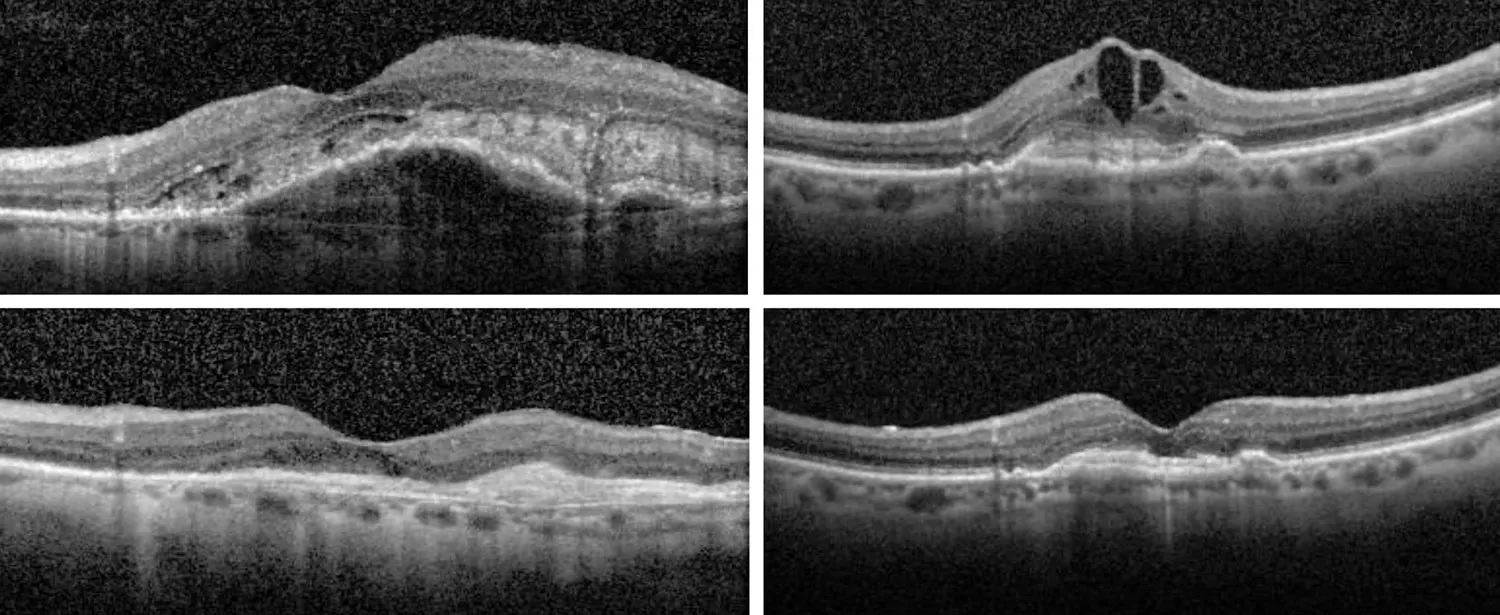
Figure. OCT images of two cases of wet AMD before (above) and after (below) three monthly injections of a first-generation anti-VEGF agent with excellent resolution of exudation. Images courtesy of Carl D. Regillo, MD, FASRS.
Finally, some companies such as Optigo are binding anti-VEGF agents covalently to a molecule that binds vitreous components, such as collagen or hyaluronic acid. These agents can linger in the vitreous, using the existing vitreous as their polymer, so to speak, and have great durability.
Multiple exciting options are on the horizon for us to deliver these drugs that have been so revolutionary in our treatment of retinal diseases, and all these different mechanisms have a lot of promise.
Carl D. Regillo, MD, FASRS: We have a sustained delivery platform that’s FDA approved and commercially available, the port delivery system (PDS) with ranibizumab (Susvimo, Genentech/Roche). It is well established that this sustained delivery approach provides effective therapeutic levels of ranibizumab for at least 6 months in most patients with wet AMD. We now have more than 7 years of follow-up showing outstanding visual outcomes with excellent maintenance of the vision gains that you get in the induction phase with anti-VEGF biologic injections that carry through for years to follow in the maintenance phase.
Not only is this sustained delivery available now, but the concept of sustained delivery bodes well for any slow release of an anti-VEGF agent in the pipeline, such as anti-VEGF biologic gene therapy or small molecules (eg, TKIs) incorporated into injectable sustained-release drug delivery polymer platforms.
Durga S. Borkar, MD, MMCi: The key will be how we integrate some of these new therapies into practice. We think a lot about extended durability and decreasing treatment burden, but we also need to decrease visit burden for our patients with some of these drugs. We will need to incorporate other technologies such as home OCT, if that becomes widely available, to decrease the amount of times our patients must come into the clinic.
NEW RETINA RADIO
Want to hear the conversation? Check out the accompanying New Retina Radio Podcast Extending Treatment Efficacy in Wet AMD.
DR. VAJZOVIC: WHAT DO CLINICIANS NEED TO KNOW ABOUT VARIOUS GENE THERAPIES UNDER INVESTIGATION?
Dr. Borkar: Our clinical trials show that anti-VEGF agents work well for most patients, but our real-world data suggest we’re likely undertreating many patients for a variety of reasons. Pharmacokinetic studies and anatomic outcomes in central subfield thickness show the seesaw pattern in routine care. This is where gene therapy comes into play.
Most investigational therapies in the wet AMD space are ocular biofactories, which use an adeno-associated viral (AAV) vector to continuously produce an anti-VEGF protein. ABBV-RGX-314 (sura-vec, Regenxbio/Abbvie) has promising results both for subretinal and suprachoroidal administration of an AAV8 vector encoding an anti-VEGF fab that’s similar to ranibizumab. The phase 3 subretinal trials, ATMOSPHERE and ASCENT, should have pivotal data later this year. The company also has a phase 2 suprachoroidal program, AAVIATE. The different modes of delivery are important when considering incorporating gene therapy into routine clinical care, where it might be most accessible to patients in the office, rather than taking them to the OR.
Additionally, there are two intravitreal gene therapies under investigation from Adverum (ixo-vec) and 4DMT (4D-150), both delivering an AAV vector encoding aflibercept. Both companies have shown promising results with initial concerns about inflammation with intravitreal administration. Finding the appropriate doses and initiating antiinflammatory treatment at the onset is important.
Lastly, and a little earlier in development, is NG101 (elisigen, formerly Neuracle Genetics), which is also an AAV8 vector that’s designed for a low-dose delivery of aflibercept.
One or more of these options may hopefully become available to soon to help us manage this chronic disease in a way that’s more sustainable for our patients.
FURTHER READING
Anti-VEGF and Beyond: Expanding Therapeutic Options for Wet AMD
By Matthew Elitt, MD, PhD; Pariyamon Thaprawat, BS; and Nita Valikodath, MD, MS
DR. VAJZOVIC: HOW DO YOU SEE TKIS FITTING INTO OUR LONG-TERM MANAGEMENT OF WET AMD?
Dr. Regillo: Most TKIs offer an intravitreally delivered sustained delivery platform. These are small molecules that must be packaged in such a way that there’s slow release or sustained delivery over at least several months. There are two candidates in phase 3 now: OTX-TKI (Ocular Therapeutix) and EYP-1901 (Eyepoint Pharmaceuticals). Both are intravitreal, but they differ in the type of TKI molecule and the associated bioerodible polymer. Based on early phase 1/2 data, they appear to be similar in terms of good wet AMD disease control for about 6 months or more in most patients along with having a good safety profile.
Sustained delivery approaches, in general, not only have the potential to decrease treatment burden, but they also hold the promise of better real-world vision outcomes because any sustained delivery method is going to be more forgiving to variable patient follow-up or missed appointments. If a patient skips a visit or two because of health issues, their vision likely won't be affected as much because there is still some degree of therapeutic effect in the eye to keep the disease in check. For patients who need anti-VEGF biologic injections on a frequent basis to control disease, it would be great if we could offer them something that’s much more durable in the maintenance phase of therapy. With TKIs, the preliminary data show that most patients can be extended to at least 6 months. Later this year and in early 2027, we’re going to see all the phase 3 study results for both these drug candidates. I call it the year of the TKIs.
DR. VAJZOVIC: WHAT ARE SOME OF THE CHALLENGES INVESTIGATORS FACE WITH THESE NEW THERAPIES POTENTIALLY COMING ON THE MARKET?
Dr. Avery: The first is inflammation. We have been spoiled with our early agents, which are shockingly benign without a lot of inflammation. As we evolved our therapies with second-generation agents and higher concentrations, we started to see more inflammation. We must weigh the benefits of treatment with the risk of inflammation that comes with many investigational therapies.
The intravitreal gene therapies come with more concern for inflammation compared with the surgical subretinal delivery approach, but the trade-off is going to the OR versus an in-office injection. In addition, companies are developing lower intravitreal doses to minimize the risk of inflammation.
The second concern with many of the extended-delivery platforms is denaturization and aggregation of the macromolecules. If the polymer is dissolvable, such as a hydrogel, patients may see floaters. It’s not a big problem, and it won’t stop the potential adoption of these therapies, but it’s something to take into account.
The third issue will be cost. The cost of the original anti-VEGF agents has dropped considerably over the years, and that will be a factor when new therapies hit the market. In addition, step therapy and other insurance coverage issues will come into play as well, limiting initial use of the new agents.
Dr. Regillo: As we get into an era of more choice with novel therapies, there will be potential trade-offs in terms of side effects. For example, with intravitreal gene therapy, patients will need to be monitored for intraocular inflammation and may need to use steroid drops to suppress inflammation for long periods of time. Other novel approaches that require a surgical procedure to administer—such as the PDS or subretinal gene therapy—may face surgical adverse events and related safety issues. As new options become available, the conversations with patients will become much more involved to discuss a broader array of treatment choices with very different risk-benefit profiles.
Dr. Borkar: When thinking about the risks and benefits with these potential new therapies, we will also have to decide what treatment is best for each patient because there are no head-to-head data. Most of the trial data compares with standard of care, and we don’t know how many of these treatments compare with each other and who responds better to one versus another. It’s going to be a challenge to generate that data outside of a trial setting to help us understand which patients would do well with each of these therapies.
Dr. Vajzovic: We will definitely need more personalized treatment strategies and imaging biomarkers to understand which drug might be the best fit for each patient with AMD.
DR. VAJZOVIC: WHAT OTHER NOVEL THERAPIES ARE UNDER INVESTIGATION IN THE WET AMD SPACE?
Dr. Regillo: We are continuing to tweak the VEGF-A blockade by making the molecules smaller for better penetration or greater molar concentration, increasing binding affinity, or increasing drug half-life through novel mechanisms such as binding to the native components of the vitreous gel including heparan or hyaluronic acid. There are also new or different mechanisms of action. We’re all familiar with faricimab, which is both a VEGF-A and angiopoietin-2 (Ang-2) blocker. Other companies are exploring enhanced Ang-2 blockades or direct Tie2 stimulation. Interleukin-6 is also being explored as a target for wet AMD, as is WNT agonism as a stand-alone or combination approach.
Dr. Avery: Direct Tie2 agonism, as opposed to Ang-2 blockade, is particularly interesting with MK-8748 (Tiespectus, Merck); so far, it’s showing a very nice effect in AMD, and it may be able to work in the relative absence of Ang-1. I’m also interested in the research on antifibrosis agents or agents that may be able to minimize the atrophy that is developing after the choroidal neovascular membrane is treated.
It seems that we’ve gone about as far as we can go with respect to visual improvement with anti-VEGF agents. There’s room for better durability, but to get better vision, it may take other mechanisms such as fibrosis and atrophy, which seem to cause a lot of the visual loss once we’ve stopped the leakage with anti-VEGF agents.
Dr. Vajzovic: It’s a very exciting time for those of us in retina. It’s important that we begin to think about how all these therapies coming to the market in the future can help us take care of our patients better.
Editor's note: This manuscript has been edited from the original transcript for clarity and space purposes.
1. Wykoff CC. Randomized phase 1b trial of OLN324 vs faricimab–first-time results of the JADE trial. Presented at Angiogenesis, Exudation, and Degeneration 2026; February 7, 2026. Virtual.