May/June Spotlight: CRVO, BRVO, and DME
In 2006, Michael S. Ip, MD, contributed an article on The Future of CRVO, BRVO, and DME Therapies (click here to read the original article). He noted that “not many existing treatments produce profound improvements in visual acuity,” and the only effective therapy for diabetic macular edema (DME) was laser photocoagulation.
Here, he reflects on the advances in our armamentarium for macular edema due to central retinal vein occlusion (CRVO), branch retinal vein occlusion (BRVO), and diabetic retinopathy over the last 20 years, and the innovations poised to change the treatment paradigm once again.
RETINA TODAY (RT): How were you treating RVOs and DME in 2006?
Dr. Ip: We were treating RVO and DME primarily with laser photocoagulation, or observation in the case of CRVO. Intravitreal corticosteroids were also an option, and level 1 evidence regarding their use came out following the release of the DRCR Retina Network’s Protocol B dataset and the original SCORE dataset.1,2
RT: How has the therapeutic landscape evolved over the last 2 decades?
Dr. Ip: The introduction of anti-VEGF therapy came with the release of the BRAVO, CRUISE, RIDE, and RISE data for ranibizumab (Lucentis, Genentech/Roche) for RVO and DME, as well as the release of DRCR Retina Network’s Protocol I.3-6 The Copernicus, Galileo, VIVID, and VISTA trials for 2 mg aflibercept (Eylea, Regeneron) soon followed.7-9
These trials established anti-VEGF therapy as a standard of care for RVO and DME, which provides excellent results with overall excellent safety (Figure). Since then, we have added 8 mg aflibercept (Eylea HD, Regeneron) and faricimab (Vabysmo, Genentech/Roche) for both indications. For DME, the port delivery system with ranibizumab (Susvimo, Genentech/Roche) offers an extended treatment effect.
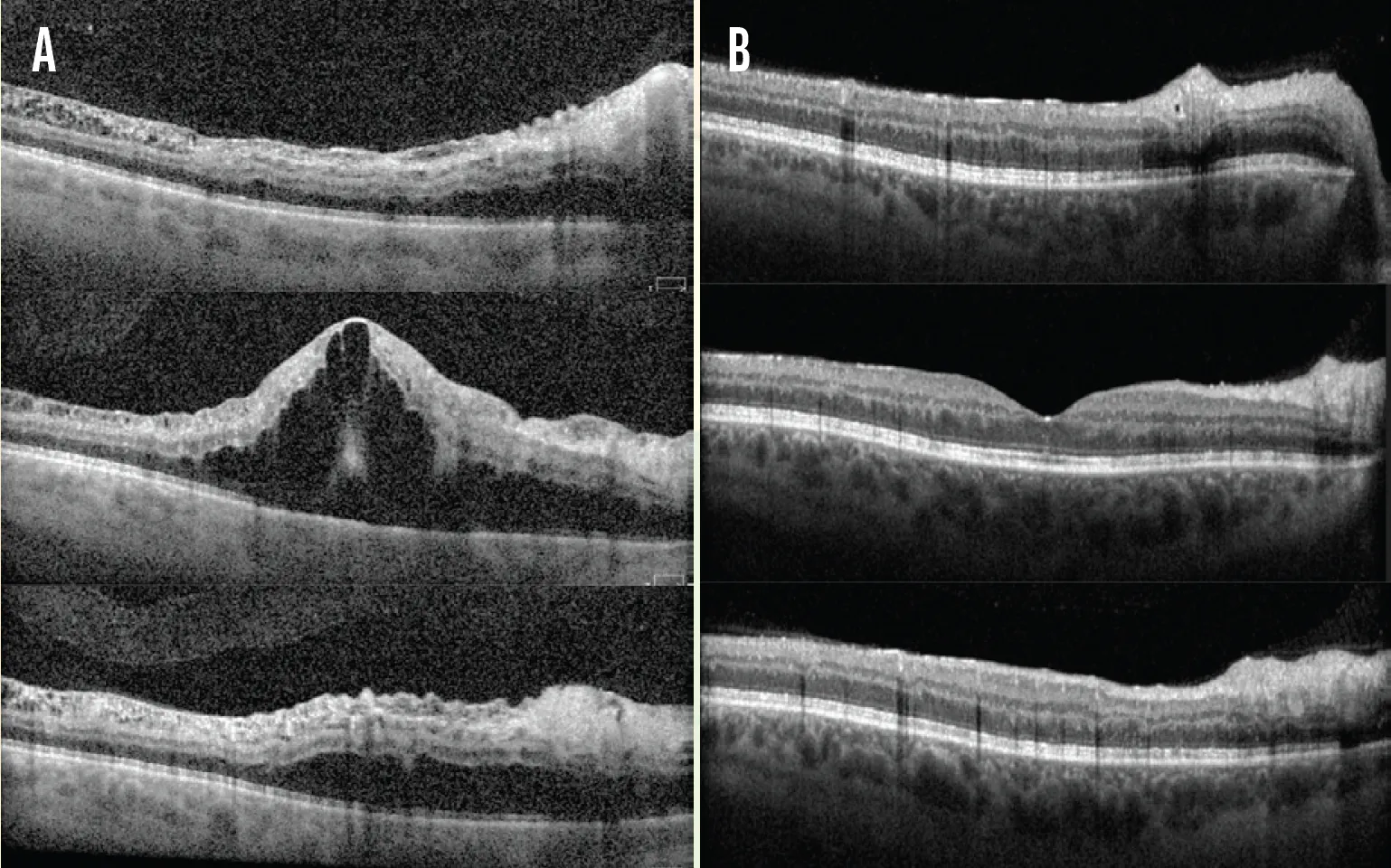
Figure. This patient presented with a CRVO in the right eye with a VA of 20/150 (A). In 2006, this patient would have been observed. In 2026, the patient was treated with a single intravitreal injection of faricimab, leading to a profound improvement in vision (VA of 20/30) at the 1-month follow-up (B).
RT: What new therapies are you hoping to see?
Dr. Ip: Although repeat injections are generally safe and highly effective, I hope to see more durable therapies to help reduce the treatment burden for patients with these chronic conditions. Novel intravitreal therapies are under development that may block different molecular pathways, leading to a more durable treatment effect. Gene therapies using a biofactory approach to release anti-VEGF also look promising. Some researchers are even evaluating very early RVO treatment with intravenous approaches to reduce erythrocyte aggregation to prevent progression to long-term complications.
Time will tell if these new approaches will join our list of options to treat macular edema from RVO and diabetic retinopathy.
1. Diabetic Retinopathy Clinical Research Network (DRCR.net); Beck RW, Edwards AR, Aiello LP, et al. Three-year follow-up of a randomized trial comparing focal/grid photocoagulation and intravitreal triamcinolone for diabetic macular edema. Arch Ophthalmol. 2009;127(3):245-251.
2. Scott IU, VanVeldhuisen PC, Oden NL, et al; SCORE Study Investigator Group. SCORE Study report 1: baseline associations between central retinal thickness and visual acuity in patients with retinal vein occlusion. Ophthalmology. 2009;116(3):504-512.
3. Campochiaro PA, Heier JS, Feiner L, et al; BRAVO Investigators. Ranibizumab for macular edema following branch retinal vein occlusion: six-month primary end point results of a phase III study. Ophthalmology. 2010;117(6):1102-1112.e1.
4. Brown DM, Campochiaro PA, Singh RP, et al; CRUISE Investigators. Ranibizumab for macular edema following central retinal vein occlusion: six-month primary end point results of a phase III study. Ophthalmology. 2010;117(6):1124-1133.e1.
5. Bressler SB, Odia I, Glassman AR, et al. Changes in diabetic retinopathy severity when treating diabetic macular edema with ranibizumab: DRCR.net Protocol I 5-year report. Retina. 2018;38(10):1896-1904.
6. Nguyen QD, Brown DM, Marcus DM, et al; RISE and RIDE Research Group. Ranibizumab for diabetic macular edema: results from 2 phase III randomized trials: RISE and RIDE. Ophthalmology. 2012;119(4):789-801.
7. Heier JS, Clark WL, Boyer DS, et al. Intravitreal aflibercept injection for macular edema due to central retinal vein occlusion: two-year results from the COPERNICUS study. Ophthalmology. 2014;121(7):1414-1420.
8. Ogura Y, Roider J, Korobelnik JF, et al. GALILEO Study Group Intravitreal aflibercept for macular edema secondary to central retinal vein occlusion: 18-month results of the phase 3 GALILEO study. Am J Ophthalmol. 2014;158(5):1032-1038.
9. Heier JS, Korobelnik JF, Brown DM, et al. Intravitreal aflibercept for diabetic macular edema: 148-week results from the VISTA and VIVID studies. Ophthalmology. 2016;123(11):2376-2385.