


KEY TAKEAWAYS
- Despite recent advances, diabetic retinopathy (DR) screening remains underused and highly variable worldwide, particularly in low- and middle-income countries.
- Experts from Brazil, Saudi Arabia, Sierra Leone, Singapore, United Kingdom, and the United States discuss their experiences with DR screening efforts in their region.
- Barriers to global screening efforts include limited access to specialized care, patient awareness, integration with larger health systems, proper treatment follow-through, and technology constraints.
Diabetic retinopathy (DR) remains a leading cause of vision loss among the working-age population worldwide. The numbers are overwhelming; approximately 103 million adults are affected globally, and the burden is projected to exceed 160 million by 2045.1,2
Luckily, DR screening programs have expanded substantially over the past 2 decades. Among the most established examples are the United Kingdom’s National Diabetic Eye Screening Program and Singapore’s Integrated Diabetic Retinopathy Program. Both demonstrate the feasibility of large-scale, systematic DR screening and serve as important models for implementation across diverse health care settings.3-5
Recent advances in autonomous AI systems have marked an important step forward in DR screening, expanding the potential for disease detection beyond traditional eye care settings. LumineticsCore (formerly IDx-DR, Digital Diagnostics) was the first autonomous systems introduced to detect more-than-mild DR (mtmDR) in adults with diabetes. Subsequent systems, including Eyenuk’s EyeArt platform, have expanded automated screening to detect both mtmDR and vision-threatening DR (vtDR). More recently, AEYE Health introduced autonomous mtmDR detection using a portable handheld device, enabling screening across a wider range of clinical and community-based settings. Since then, numerous studies have demonstrated that AI-powered DR screening can match human grading performance and may offer a scalable approach for global screening programs by allowing DR testing for patients in frontline settings where they already receive care (Figure).6-11
Despite these advances, DR screening remains underused and highly variable worldwide, particularly in low- and middle-income countries, where the diabetes burden continues to rise. Although successful programs have been implemented in individual countries and regions, few initiatives have established coordinated multi-national frameworks that can be widely adapted across diverse resource levels and patient populations. This raises an important question: If DR screening is feasible, effective, and capable of preventing blindness, why has broader global acceptance and implementation remained so difficult? Here, we explore the promise of global DR screening, and the hurdles we have yet to overcome.
THE UNMET NEED
Given the projected rise in DR, we should be concerned that we might be failing this patient population. Despite current and emerging treatments, DR remains a significant issue that affects individuals, families, health care systems, and governments. Evidence-based research links early identification and timely treatment to improved clinical outcomes, but there is still a disconnect with adoption.
Majda Hadziahmetovic, MD: In Saudi Arabia, what is the single biggest reason patients are still being missed?
Abdullah AlQahtani, MD, DES, DISSO, FEBO: Multiple health providers are involved in each patient’s care, and we do not have a unified data-sharing system. Without a national program, each service provider has their own costly and inefficient screening program; a lack of centralized data also means we do not have a clear understanding of the national size of the DR burden in our country.
Dr. Hadziahmetovic: What is the main barrier to proper DR screening in Brazil?
Jorge C. P. Rocha, MD, PhD: In Brazil, a country with substantial disparities in health care infrastructure across its regions, we continue to face significant barriers to ensuring that patients receive timely ophthalmic evaluation.
For example, limited access to ophthalmologists—particularly retina specialists—remains a major challenge. Within the public health care system in Brazil, long waiting lists for ophthalmic consultations often delay a patient's diagnosis and treatment.
In addition, patient awareness remains inadequate, and many individuals with diabetes are unaware that the disease can affect the eyes and lead to DR.
Expanding access to retinal examinations through the Brazilian public health care system is essential, particularly in underserved regions where ophthalmologists are scarce. At the same time, continuous efforts to educate patients with diabetes are crucial so that they understand the importance of regular screening, even in the absence of visual symptoms.
Dr. Hadziahmetovic: Where do you think screening fails most often?
Sobha Sivaprasad, MBBS, MS, DM, FRCS, FRCOphth: Ensuring treatment follow-through of referred positive cases is the biggest challenge. Over the last decade, we have made significant strides in retinal screening for patients with diabetes. However, most programs are run as independent services, and the link to a secondary care center that offers treatment is nonexistent. Secondary care is usually provided by another health care provider with different reimbursement systems.
This breakdown between the referral of screen-positive patients and treatment defeats the purpose of screening. The referral-to-treatment pathway should be planned and appropriately reimbursed before DR screening programs are established.
Lloyd C. M. Harrison-Williams, MBChB, MMed(Ophth), FCOphthECSA, FCPSSL: It is imperative that screening exercises are not done in isolation; they should be paired with a clear path to further care. First-line treatment should be available at the point of screening, if possible. However, when treatment isn’t possible at the screening location, counseling should be mandatory as a crucial first step to ensure patients understand the risk of vtDR, the next line of care, and the financial implications. National eye health programs should commit to implementing this basic tenet and keep a register of screened patients to follow up with their care.
In this way, all are empowered to ensure that screening exercises culminate in adequate action to reduce the complications of diabetic eye disease.
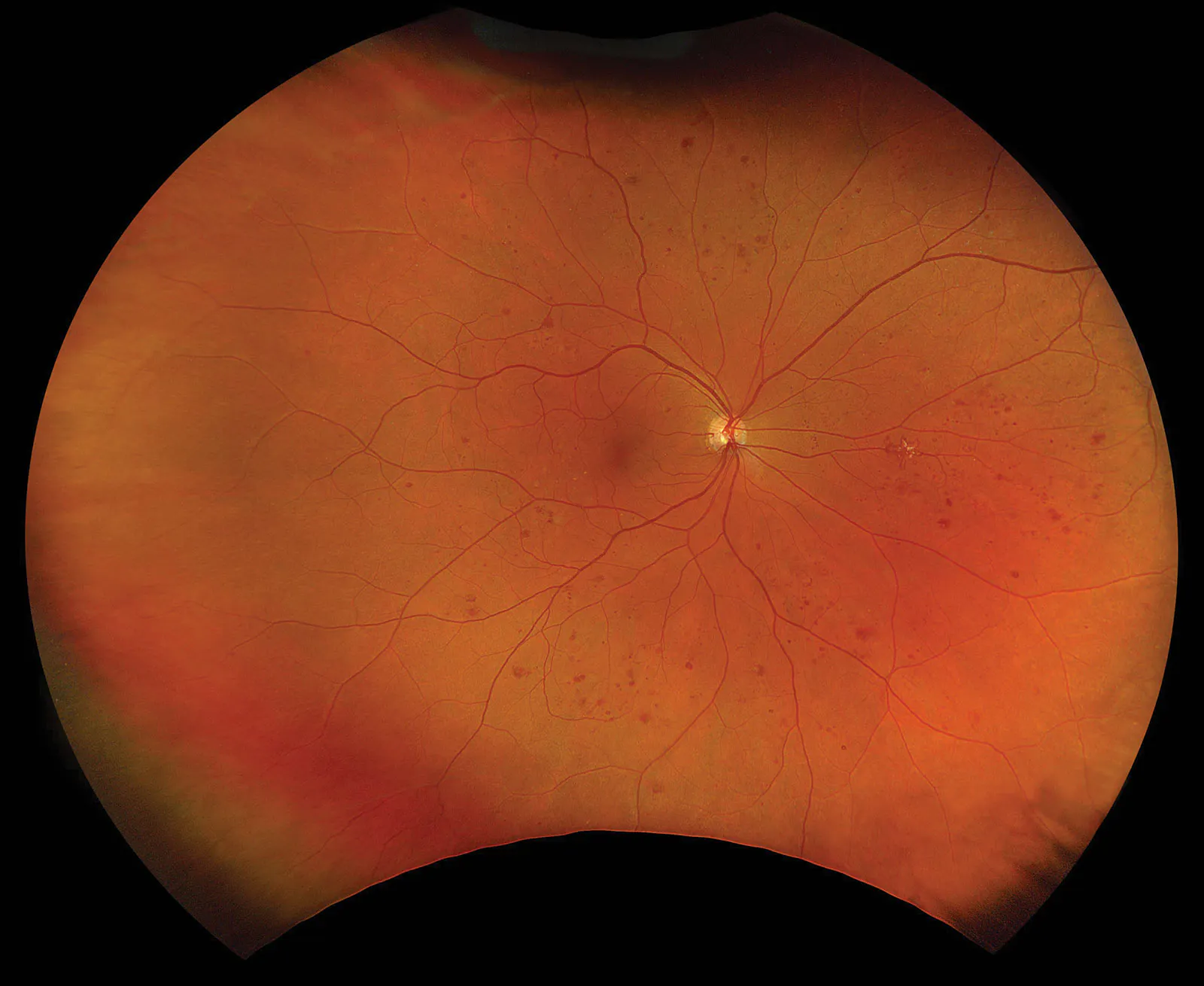
Figure. Patients, such as this one with moderate-to-severe nonproliferative DR, can benefit from organized retinal screening. Image courtesy of Retina Rocks (retinarocks.org, @retina.rocks).
IMPLEMENTATION BARRIERS
DR screening should not be reduced to identifying patients at risk; it should provide an end-to-end system, from image capture at the point of service to closing the loop on referrals and treatments. Successful implementation requires significant effort from the top (eg, stakeholders, IT teams, providers, clinic staff) without disrupting the workflow while ensuring sufficient capture.
Dr. Hadziahmetovic: What lessons have we learned from successful programs that may not translate easily to lower-resource settings?
Gavin Tan Siew Wei, MBBS, PhD: A successful DR screening program with the goal of reducing blindness and visual impairment must be part of an end-to-end effort to:
- provide comprehensive and regular eye screening (include retinal photography) to patients with diabetes coupled with DR education and awareness regarding the importance of screening and risk factor control (glycemic and other risk factors);
- create a sustainable referral pathway to secondary or tertiary care for those with referrable or worse DR with the provision of affordable treatment options; and
- implement a feedback system to the primary care physician to ensure glycemic control is titrated and optimized in accordance with the disease severity.
The challenges in a low-resource setting are multifactorial. Screening and education may be episodic, and a sustainable referral pathway may be lacking due to a dearth of accessible secondary or tertiary eye care. Patients may be unable to afford treatment, and there is often a lack of a coordinated primary care pathway for diabetes control with a consistent feedback mechanism.
Dr. Hadziahmetovic: How important is integration with other specialties such as primary care, endocrinology, nephrology, and diabetes clinics?
Michael D. Abramoff, MD, PhD: With DR, we know that early diagnosis and treatment is key, but we also know that it’s not happening. Most of these patients with diabetes are not reaching our offices. The only way to solve the problem is to be where the patient is, which is primary care, endocrinology, nephrology, diabetes clinics, and emergency departments—that’s where these screening programs must start.
However, other specialties don’t have the expertise to examine the retina, which is where AI comes in. We have accurate screening systems we can put into other specialty offices without needing the retina specialist to be there.
These programs help solve the problem of patients not having easy access to screening. The key is ensuring they work for primary care; they need to fit into the workflow and be financially beneficial, in addition to improving the patient/provider experience and patient outcome.
Dr. Hadziahmetovic: In your experience, what causes screening programs to fail after the initial pilot phase?
Dr. Sivaprasad: The initial pilot phase is usually funded by an academic grant or by the government. When the pilot phase is complete and an evidence-based, feasible system is developed, the most common cause of failure to pursue is the lack of funding. However, other reasons exist, such as competing health priorities, lack of initiative or lack of enthusiasm by busy staff to take on more assignments, the lack of trained staff, and the low prevalence of vtDR compared with the total number of patients screened—usually about six in 100 patients. In addition, patients who screen positive may not feel the need to travel to a secondary care office and incur out-of-pocket expenses for an asymptomatic eye condition, as there is a lack of public awareness of the potential for irreversible visual impairment due to diabetic retinal disease.
AI, IMAGING, AND TECHNOLOGY
Imaging and technology are major determinants of successful DR screening. Although advances in AI and automated image interpretation have the potential to transform this field, progress has been insufficient. We need to focus on rigorous validation and clear demonstration of improved clinical outcomes. Current efforts have proven feasibility, but sustainability and wider adoption remain questionable.
Dr. Hadziahmetovic: What is the primary barrier to the adoption of AI screening programs?
Dr. Tan: The main barrier is the need to implement a sustainable photography-based DR screening system. If there is no system to electronically capture retinal photographs on a regular basis, AI can help, but it only provides a small portion of the requirements. If there is a digital telemedicine-based screening program already in place, then the barriers to using AI are regulatory, physician acceptance, and cost.
Dr. Hadziahmetovic: What minimum standards should be required before AI-based DR screening is deployed on a large scale?
Dr. Abramoff: In the primary care clinic or other frontline offices, staff don’t have the time or expertise to properly examine the retina, so any automated system we implement must be simple to use. When we sought FDA clearance for LumineticsCore, we ensured the system can be operated by anyone with a high school diploma and minimum training.
In addition to technician training, the system must work in harsh conditions. Low-resource settings don’t have a nice dark room with an experienced photographer on hand. Nothing that’s designed to work in a traditional ophthalmology or retina lane works in the real-world setting. It all breaks. Whatever system you create must provide clear retina images without an ideal environment with an unskilled photographer.
EQUITY AND GLOBAL HEALTH
Diabetes and DR place a heavy burden on people in underdeveloped and developing areas. Unfortunately, patients most at risk of vision loss are often the least likely to receive timely eye care. Around the world, barriers such as limited access to care, cost, transportation, low health literacy, fragmented referral systems, and competing medical priorities prevent many patients with diabetes from completing recommended retinal screening. As a result, the disease often progresses and leads to irreversible vision loss.
Dr. Hadziahmetovic: Based on your experience, which model is most effective at reaching patients earlier, especially in underdeveloped and developing regions?
Dr. Harrison-Williams: As in all screening programs, there are broadly three models. In the fixed (clinic-based) model, patients travel to the eye facility to access screening.
With the outreach model, eye specialists travel with their equipment to conduct screening within the communities or institutions. This approach, while costly, is effective in optimizing patients access to screening. However, high patient volumes and reduced efficiency may deter some patients.
The mixed (hub-and-spoke) model leverages the advantages and efficiency of the clinic setting with the benefits of meeting patients in their communities; with this approach, a screening team is regularly stationed on specific, well-publicized days in the community.
An ideal model of screening in resource-challenged settings—such as ours in Sierra Leone—is one that uses free online software and common smartphones (if any additional hardware is necessary, it must be economical and readily available). AI-assisted DR screening software could be used by residents to detect early signs of vtDR and then recommend the location and times of nearby screening facilities (spoke-level).
The local screening facility can further assess for vtDR and, if possible, offer first-line treatment. Those with severe complications can be referred to the clinic (hub-level) for surgical intervention.
This model, when well-coordinated with collaboration between key stakeholders, can lead to increased screening at all levels, earlier access to treatment, and reduced prevalence of vtDR.
Dr. Hadziahmetovic: How should screening programs be adapted for low-resource regions?
Dr. Rocha: Brazil is an upper-middle-income country characterized by marked socioeconomic and regional disparities. Rural areas and small inland cities face significant limitations in health care infrastructure, particularly in eye care. Expanding access to ophthalmic services requires the development of a low-cost, sustainable infrastructure supported by government policies that enable patients to access screening services quickly and easily.
Ideally, every municipality should have a DR screening center where endocrinologists, primary care physicians, and comprehensive ophthalmologists can refer patients without unnecessary bureaucratic barriers. Following retinal imaging and AI-based screening, patients identified as having referable DR or requiring treatment should be automatically referred to a specialized retina center, where they can receive timely evaluation and treatment.
The success of this model depends on three essential pillars: (1) screening centers equipped with retina cameras integrated with AI-based diagnostic systems; (2) an automated and streamlined referral pathway; and (3) retina centers capable of providing prompt treatment.
Dr. Hadziahmetovic: Which is more important for global impact: building high-quality centralized reading centers, deploying AI-supported imaging, training local graders, or embedding screening into diabetes visits?
Dr. Sivaprasad: Deploying AI-supported retinal imaging in diabetes care visits will have a positive effect on patients. Most diabetes care clinics review patients for all complications of diabetes and have the capability to offer a more holistic approach, especially to identify screen-positive patients. Previously, diabetes care clinics found DR screening challenging due to the lack of specialist staff and the need for costly retina cameras. Now, with automated, AI-integrated, affordable screening, any technician or nurse can capture retinal images. An AI-graded clinical outcome is made instantly available to the patients. This pathway will also ensure personalized health education is provided to screen-positive patients to attend secondary care for treatment.
ECONOMICS AND SUSTAINABILITY
DR screening can prevent costly vision loss by identifying disease earlier, enabling timely treatment and better visual outcomes, but programs must be operationally and financially sustainable. Beyond being affordable and scalable, these efforts must be tailored to local realities that differ on many levels.
Dr. Hadziahmetovic: Which financial model is needed for a sustainable DR screening program?
Dr. Tan: The financing model depends on the reimbursement system, which varies between countries. Essentially, you need a payer willing to invest in screening based on the strong evidence-based recommendation that it is cost-effective, and it prevents future vision loss.
It’s less important if the payer is the government, insurer, non-governmental organization, or another industry partner; what matters is that the program is funded to achieve the complete cycle required to prevent vision loss. Depending on the patients to pay out-of-pocket is often difficult except in higher income countries with extremely good DR education programs. But health systems with good education and awareness programs usually rely on a government payer system in the first place.
Dr. Hadziahmetovic: How should we measure the value of screening?
Dr. AlQahtani: We measure the value by documenting earlier detection of disease and a drop in complicated cases, both of which lead to a lower cost of management. Programs can show their value by comparing the number of patients treated after screening with those seen in the clinic, care which is usually delayed because of the waiting list.
In addition, a well-run screening program can allow a more accurate evaluation of the disease burden. Some countries have a high prevalence of patients with diabetes, creating a significant financial burden; early detection and care will decrease that cost burden.
THE FUTURE
Despite tremendous advances in the diagnosis and treatment of DR, more than half of patients with diabetes do not adhere to recommended retinopathy screening, putting them at risk of vision loss.12 This holds true not only in underdeveloped and developing countries but also in the United States. We now have the opportunity to close this gap through organized, advanced technology-assisted, equitable screening programs.
Dr. Hadziahmetovic: What evidence do stakeholders still need before they invest more seriously in large-scale DR screening?
Dr. Abramoff: Currently, only approximately 2% of all people with diabetes in the United States are being diagnosed with diabetic eye disease using an AI system. Given the rising prevalence of DR, that number should be 80% or more. Luckily, we were able to establish reimbursement for AI screening. The reimbursement makes it work for clinics who adopt autonomous AI.
As part of our advocacy with the AAO, we have sought to help US Congress understand that the burden of care for diabetic eye disease is too high for retina specialists to handle alone. With the help of AI, we can take care of all patients who deserve eye examinations because screening positive gets them into our clinics, where we provide the care.
At the end of the day, we need buy-in from all stakeholders, including retina specialists and primary care providers. To get that buy-in, you must solve simple hurdles such as integrated workflow and equipment needs, site support, patient education, and improved outcomes. Research is accumulating, including randomized controlled trials that show the improved outcomes and efficiency and clinician job satisfaction benefits of AI screening for diabetic eye disease. However, population-level outcomes data are still needed to truly understand the lasting effect of AI screening.
1. Yau JW, Rogers SL, Kawasaki R, et al. Global prevalence and major risk factors of diabetic retinopathy. Diabetes Care. 2012;35(3):556-564. doi.org/10.2337/dc11-1909
2. Saeedi P, Petersohn I, Salpea P, et al. Global and regional diabetes prevalence estimates for 2019 and projections for 2030 and 2045: Results from the International Diabetes Federation Diabetes Atlas. Diabetes Res Clin Pract. 2019;157:107843. doi.org/10.1016/j.diabres.2019.107843
3. Scanlon PH. The English National Screening Programme for diabetic retinopathy 2003-2016. Acta Diabetol. 2017;54(6):515-525. doi.org/10.1007/s00592-017-0974-1
4. Nguyen HV, Tan GS, Tapp RJ, et al. Cost-effectiveness of a national telemedicine diabetic retinopathy screening program in Singapore. Ophthalmology. 2016;123(12):2571-2580. doi.org/10.1016/j.ophtha.2016.08.021
5. Sim DA, Mitry D, Alexander P, et al. The evolution of teleophthalmology programs in the United Kingdom: beyond diabetic retinopathy screening. J Diabetes Sci Technol. 2016;10(2):308-317. doi.org/10.1177/1932296816629983
6. Kuo D, Pajic M, Hadziahmetovic M. Ten years later: how is AI impacting retina care today?. Curr Opin Ophthalmol. 2025:10-97. doi.org/10.1097/ICU.0000000000001167
7. Abramoff MD, Lavin PT, Birch M, et al. Pivotal trial of an autonomous AI-based diagnostic system for detection of diabetic retinopathy in primary care offices. NPJ Digit Med. 2018;1:39. doi.org/10.1038/s41746-018-0040-6
8. US Food and Drug Administration. DEN180001: de novo classification summary for IDx-DR. 2018. Accessed August 16, 2026. www.accessdata.fda.gov/cdrh_docs/reviews/DEN180001.pdf
9. Ipp E, Liljenquist D, Bode B, et al. Pivotal evaluation of an artificial intelligence system for autonomous detection of referable and vision-threatening diabetic retinopathy. JAMA Netw Open. 2021;4(11):e2134254. doi.org/10.1001/jamanetworkopen.2021.34254
10. US Food and Drug Administration. K200667: 510(k) summary for EyeArt. 2020. Accessed August 16, 2026. www.accessdata.fda.gov/cdrh_docs/pdf20/K200667.pdf
11. US Food and Drug Administration. K240058: 510(k) summary for AEYE-DS. 2023. Accessed August 16, 2026. www.accessdata.fda.gov/cdrh_docs/pdf24/K240058.pdf
12. López MI, Díez A, Velilla S, Rueda A, Alvarez A, Pastor JC. Prevalence of diabetic retinopathy and eye care in a rural area of Spain. Ophthalmic Epidemiol. 2002;9:205-214. doi.org/10.1076/opep.9.3.205.1516


