




KEY TAKEAWAYS
- The 14th annual Vit-Buckle Society meeting included four medical retina debates on the peer review process, therapy for uveitis, the utility of photobiomodulation, and retinopathy of prematurity treatment options.
- Each topic exposed meaningful tensions between evidence, practicality, safety, and long-term outcomes.
- Save the date for the 15th annual Vit-Buckle Society Meeting, scheduled for April 1-3, 2027, in Miami.
The medical retina debates at the 14th annual Vit-Buckle Society (VBS) meeting, held April 9-11, 2026, in Las Vegas, provided some of the most spirited discussions of the meeting. Debaters dressed in their best Alice in Wonderland-themed costumes to deliver thought-provoking discussions on the peer review process and a range of hot-topic treatment approaches (Figure).
DEBATE 1: PEER REVIEW SHOULD BE…
The first debate tackled a long-standing academic grievance: Should peer review remain unpaid? Katherine E. Talcott, MD, from Cleveland Clinic, presented the argument that peer review is a highly skilled, unpaid labor that helps prop up massively profitable publishing companies, noting Elsevier’s reported $1.5 billion profit in 2024. She also pointed out the unspoken pressure of the current system, where many reviewers accept assignments out of a sense of obligation and lingering fear that declining an invitation may jeopardize a journal’s faith in their own future submissions.
Durga S. Borkar, MD, MMCi, from Duke University, presented the opposing view: that reviewing is an academic privilege. Introducing financial compensation could dangerously complicate the process and raise additional ethical dilemmas, she argued. She prosed several unanswered questions: Would reviewers prioritize journals that compensate more? Is one reviewer’s opinion worth more than another’s? Does the amount a journal pays determine the depth of the review you perform? Additionally, the sheer volume of global submissions makes paying every reviewer logistically impossible. Instead, she suggested publishers’ profits go toward subsidizing open-access initiatives.
The discussion highlighted a middle ground solution to incentivize reviewers through discounted journal fees rather than direct cash payments, which rewards the labor without compromising the ethics of the review process.
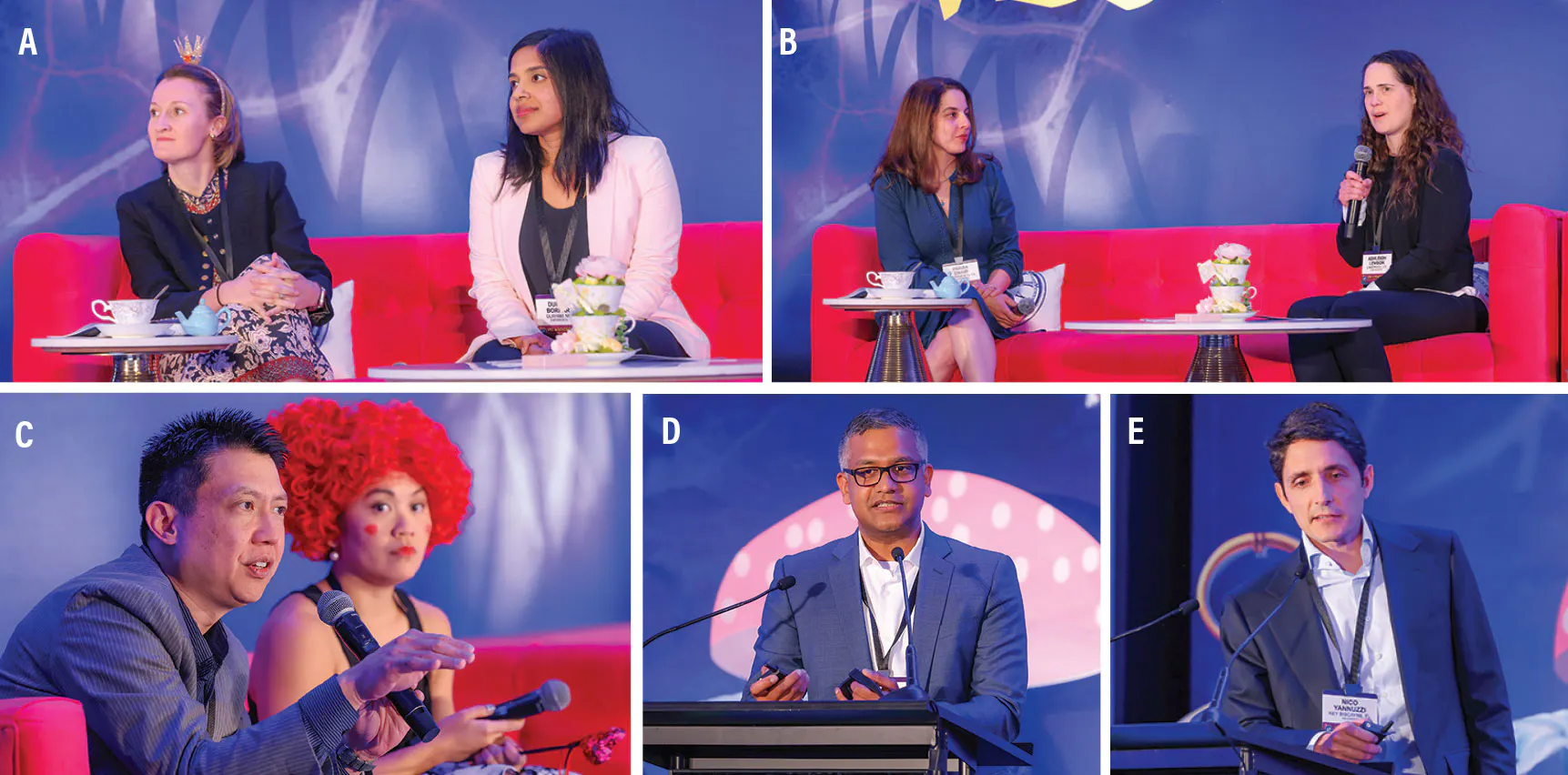
Figure. Lively debates between Drs. Talcott and Borkar (A), Emami and Levison (B), Chang and Hua (C), and Kuriyan (D) and Yannuzzi (E) showcased the complexity of medical retina care. Images courtesy of Kevin Caldwell Photography.
DEBATE 2: HOW TO MANAGE NONINFECTIOUS UVEITIS
The second debate focused on whether noninfectious uveitis should be managed with local corticosteroids or systemic immunomodulatory therapy (IMT). Parisa Emami, MD, from the University of California Davis, debated that while steroids are effective and act quickly, they have a host of ocular complications and don’t treat extraocular disease, which is often coexistent. Because conditions such as sarcoidosis often affect several systems, systemic IMT can treat both the underlying disease and control the bilateral ocular uveitis more effectively, she said.
Ashleigh L. Levison, MD, from Colorado Retina Associates, presented the case for local corticosteroids. Many uveitis patients have inflammation confined to the eye, making targeted therapy more practical and safer, she argued. In addition, steroids act rapidly, are familiar to ophthalmologists, and avoid the potentially severe systemic complications seen with IMT, which ophthalmologists may not be fully equipped to manage. Furthermore, she cited the Multicenter Uveitis Steroid Treatment Trial, which showed that steroid implants worked better at controlling inflammation at every time point up to 54 months compared with IMT.
The panel discussion suggested the answer is not black and white and that treatment is often tailored to disease type, systemic involvement, and patient preference.
DEBATE 3: MANAGING MID ZONE II ROP
The third debate addressed the optimal treatment for mid zone II retinopathy of prematurity (ROP). Emmanuel Y. Chang, MD, PhD, of Retina & Vitreous of Texas, presented the argument for laser photocoagulation for ROP, emphasizing long-term anatomic stability. He cited decades of follow-up data and high success rates supporting laser and noted that it offers a more definitive intervention, reducing clinic burden for patients and families. He argued that our focus should be on which treatment best preserves vision through adulthood and cautioned that peripheral avascular retina treated with anti-VEGF alone at infancy may thin out with ocular growth, predisposing these eyes to retinal tractional changes, tears, and detachments.
Hong-Uyen Hua, MD, of Bascom Palmer Eye Institute, discussed the advantages of anti-VEGF therapy, focusing on safety, accessibility, and structural preservation. She noted that laser treatment requires general anesthesia, which may not be suitable for smaller, sicker infants. She highlighted the increased incidence of myopia and strabismus due to laser-related changes. She also stressed the practicality of anti-VEGF therapy as an accessible and safe procedure that can be more reliably employed by pediatric ophthalmologists who may have less experience using lasers. Lastly, she emphasized that first-line anti-VEGF therapy allows for continued retinal vascularization. That said, Dr. Hua acknowledged limitations in the evidence supporting anti-VEGF therapy, noting that many studies have been retrospective and do not control for gestational age or birth weight.
The audience agreed with the practicality of anti-VEGF therapy, leveling the playing field by allowing more ophthalmologists to treat eyes with ROP.
DEBATE 4: PHOTOBIOMODULATION FOR DRY AMD
The session closed with a lively debate between Ajay Kuriyan, MD, of Mid Atlantic Retina and Wills Eye Hospital, and Nicolas A. Yannuzzi, MD, of Bascom Palmer Eye Institute, regarding the use of photobiomodulation.
Dr. Kuriyan summarized the evidence in favor of photobiomodulation, citing its plausible mechanism of action targeting mitochondria, which are known to be largely involved in AMD pathogenesis. He presented small sham-controlled studies showing visual improvement with treatment across all time points and noted an independent reading center study demonstrating less external limiting membrane and ellipsoid zone loss compared with sham.
Dr. Yannuzzi presented the opposing perspective that photobiomodulation has not yet been adequately validated. He underscored that current data supporting photobiomodulation consist of small trials with high attrition rates and imbalanced baseline features that favored the photobiomodulation group. Additionally, he emphasized weak anatomic data lacking baseline incidence rates and functional outcomes likely driven by regression to the mean effect. Finally, Dr. Yannuzzi noted the lack of benefit in other key functional endpoints, such as color and contrast sensitivity, and no visual or anatomic benefits shown in meta-analyses.
The discussion showed overwhelming consensus that larger, better-designed studies with stronger baseline characterization and longer follow-up are still needed to determine the efficacy of photobiomodulation for dry AMD.
THE ART OF FRIENDLY DEBATE
Across all four debates, the clearest takeaways were not necessarily a matter of reaching consensus, but of recognizing the complexity of these highly relevant issues in the field. Each topic exposed meaningful tensions between evidence, practicality, safety, and long-term outcomes.
SAVE THE DATE:
15th Annual Vit-Buckle Society Meeting
April 1-3, 2027, Miami


