


KEY TAKEAWAYS
- While AI tools offer meaningful efficiency gains, retina coding remains complex and dependent on precise clinical interpretation, payer policy, and documentation standards; thus, it is crucial to verify first, then trust.
- The quality of AI output depends on the quality of input. Vague or incomplete billing and coding questions often produce incomplete or even misleading answers.
- The author describes a practical four-step framework that can help ensure accurate and compliant coding decisions using AI.
AI use is rapidly becoming common in retina practices, including to support documentation, coding, and claim review. While AI tools can offer meaningful efficiency gains, retina coding remains complex and dependent on precise clinical interpretation, payer policy, and documentation standards. When AI-generated output is used without verification, it can lead to inaccurate coding decisions. Thus, the safest approach is simple: Verify first, then trust.
Retina procedures are complex, frequently bundled, and closely scrutinized by payers. Errors in Current Procedural Terminology (CPT) selection, modifier use, or diagnosis linkage can trigger denials, repayment, or audit exposure.
In this article, I outline a framework for using AI in retina billing and coding that aims to mitigate errors, while still enjoying efficiency gains.
AI IN RETINA CODING: USEFUL, BUT IMPERFECT
AI tools can quickly generate coding suggestions, summarize documentation, and propose CPT and International Classification of Diseases, Tenth Revision (ICD-10) codes. However, these outputs may be incomplete, outdated, or incorrect, as retina procedures often involve multiple surgical steps, global period considerations, and diagnosis-specific coverage rules—details AI may miss.
Accurate retina coding requires a structured process: Review the documentation, confirm CPT descriptors, check National Correct Coding Initiative (NCCI) edits, apply modifiers, and validate diagnosis linkage. AI can support this workflow, but it cannot replace it.
The quality of AI output depends on the quality of input. In coding and billing, vague or incomplete questions often produce incomplete or even misleading answers. This is especially important in retina, where coding decisions depend on payer rules, diagnosis specificity, and clinical context.
When more specific questions are posed to AI tools, such as ChatGPT (Open AI), Copilot (Microsoft), or Google’s AI overview, they produce more useful answers. Consider the following versions of asking a question about billing for OCT imaging:
Basic question (limited value): How often can you bill for OCT imaging?
- Lacks test specificity, diagnosis, and payer context.
- May produce generic or outdated guidance.
Better question (more useful): How often can you bill for retina OCT for AMD?
- Adds subspecialty and diagnosis.
- Narrows the scope but still lacks payer specificity.
Best question (actionable): How often can you bill for retina OCT (CPT 92134) for a patient with Medicare Part B insurance with exudative AMD with choroidal neovascularization to monitor active intravitreal injection treatments under a specific Medicare Administrative Contractor (eg, Novitas) policy?
- Includes CPT code, diagnosis specificity, staging, treatment, payer, and jurisdiction.
- Produces an answer that can be verified against policy.
THE ABCS OF AI IN RETINA CODING
A structured approach is needed to evaluate whether an AI output can be trusted. The ABCs—accuracy, bias, and context—explain why AI output must be verified.
Accuracy: AI may generate outdated or incorrect guidance, as coding rules and payer policies change frequently. Confirm AI-generated information using current, trusted resources.
Bias: AI models are trained on broad datasets and may not reflect retina-specific nuances. This can lead to incorrect assumptions about procedure combinations or modifier use.
Context: AI lacks full context. Retina coding depends on encounter-specific details, including prior procedures and documentation. Thus, AI may produce technically correct, but clinically and surgically irrelevant, answers.
FOUR-STEP FRAMEWORK TO VERIFY AI OUTPUT
A dedicated framework can provide a practical method to apply these principles and ensure accurate, compliant coding.
The process begins with reviewing the documentation itself. Accurate coding depends on what is documented in the medical record, and each step of the framework builds upon confirming that the coding reflects the services performed.
Here are the four steps to the framework:
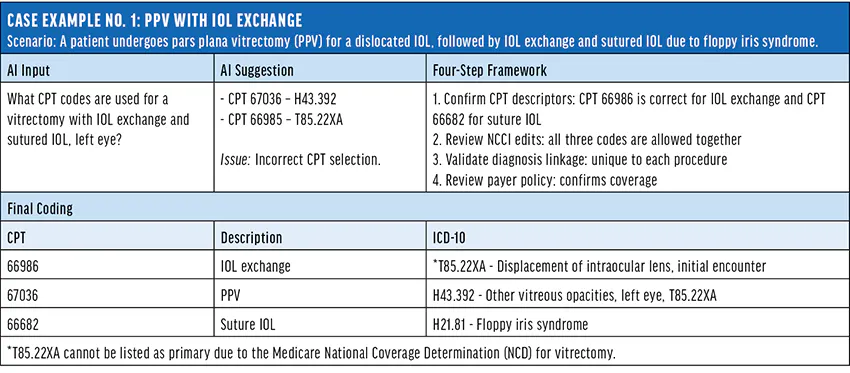
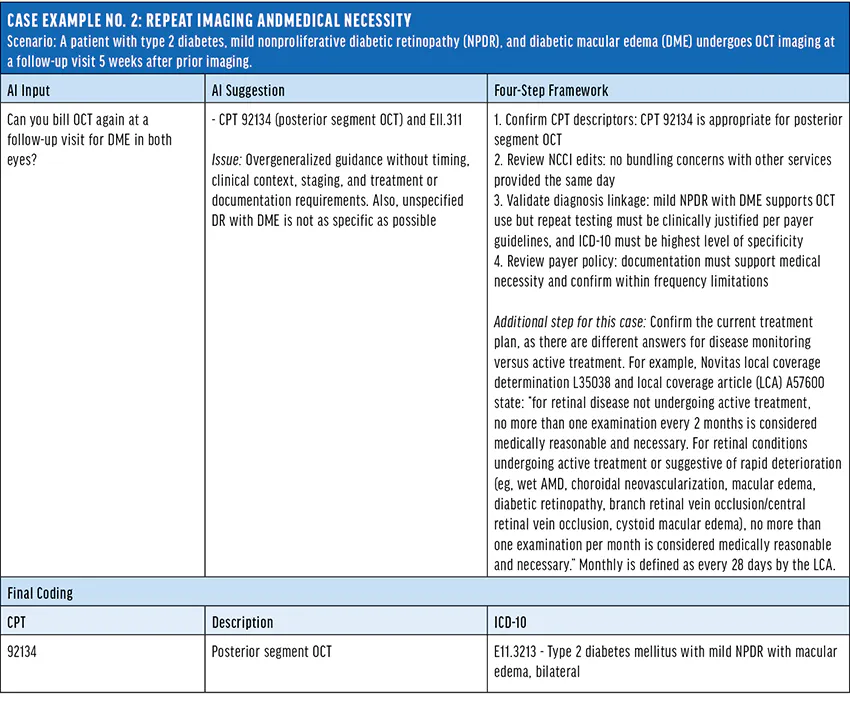
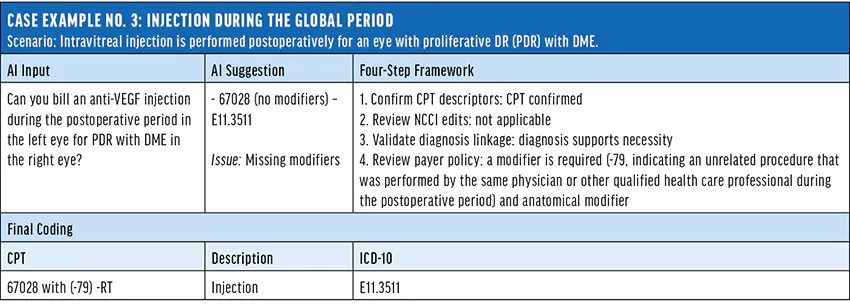
- Review the full CPT descriptor to ensure the code accurately reflects the procedure performed.
- Determine whether codes can be billed together and identify bundling restrictions.
- Ensure each CPT code is linked to the most appropriate ICD-10 diagnosis.
- Review payer policies and confirm guidance using current, trusted sources. Confirm coding aligns with payer-specific rules, including coverage and documentation requirements.
The three examples shared throughout this article demonstrate how this process can be used in common retina scenarios to identify and correct AI-driven coding errors.
FURTHER READING
10 Essential Steps for Accurate Retina Surgery Coding
By Joy Woodke, COE, OCS, OCSR, and Matthew Baugh, MHA, COT, OCS, OCS
AVOID COMMON AI PITFALLS
AI-generated coding suggestions can introduce errors that affect both reimbursement and compliance. The common pitfalls highlighted in this article demonsrate the importance of verifying all AI-generated coding before claim submission.
1. Baugh M. Verify then trust: the key to using AI safely in ophthalmic coding. EyeNet. American Academy of Ophthalmology. 2024. Accessed April 23, 2026. www.aao.org/eyenet/article/verify-then-trust-ai-ophthalmic-coding
2. American Academy of Ophthalmology. Coding resources. AAO Practice Management. Accessed April 23, 2026. www.aao.org/practice-management/coding
3. Centers for Medicare & Medicaid Services. National Correct Coding Initiative (NCCI) edits. CMS.gov. Accessed April 23, 2026. www.cms.gov/medicare/coding-billing/national-correct-coding-initiative-ncci-edits


_1784132761.jpg?auto=compress,format&w=70)


